Give your Twitter post a clear next step
Twitter call-to-action examples that give readers a useful next step
A post can earn likes while the action you wanted never happens. Make the request fit what you shared, then check the result that matters for that post.
On this page
The post got attention. What did you want the reader to do?
You wrote something useful, added a link, and ended with "Thoughts?" The replies might be interesting, but they won't tell you whether anyone opened the resource you wanted to share.
A Twitter call to action is a request for a next step: read an example, answer a specific question, try a task, or follow a continuing topic. Choose the action from the purpose of the post. Tell readers what they will get from doing it, and leave out the request when the post already feels complete.
This guide covers organic X/Twitter posts. The examples are writing options to adapt to your actual work, not formulas that guarantee reach or conversions.
Choose the action before writing the last sentence
Finish this sentence privately: "After reading this, the person who needs it should be able to ___." An article preview might lead to the full explanation. A genuine question might help you understand how people handle a task. Those posts need different endings.
Asking someone to like, reply, repost, follow, and open a link gives them several unrelated jobs. Pick the request that advances the point you just made. This is an editorial recommendation, not a claim that X applies a particular penalty to multiple requests.
X's advertising creative guidance recommends a clear CTA and one exit point. That advice concerns ads. For organic posts, use it as a writing idea to evaluate, not evidence of a ranking advantage.
| Purpose of the post | A useful request | What to review |
|---|---|---|
| Help someone use a resource | Name the resource and what opens at the link | Available URL clicks, then relevant website activity |
| Understand a specific problem | Ask a question the reader can answer from experience | The substance of replies as well as their count |
| Introduce a continuing topic | Explain what future posts will cover before inviting a follow | Profile clicks and account follower change, without attributing every follow to one post |
| Share a complete explanation | Often no request is needed | Whether the explanation served its intended purpose; saves or replies may offer clues |
The last row matters. Adding "Agree?" to every explanation can turn a finished thought into a question you don't actually want answered.
Three Twitter CTA examples with context
These examples describe a fictional freelance design resource. They are not customer posts or evidence of results. Replace every capability, destination, and future commitment with something true about your work.
Invite someone to inspect a resource
Client feedback gets messy when each email refers to a different design version. This review checklist shows what to include before you send a file. Open the filled-in example to see how the checklist works: [link]
"Check it out" would leave the destination unclear. "Open the filled-in example" says what the reader will see and why it relates to the problem. The linked page must actually contain that example, not a signup gate you forgot to mention.
If visiting the page is the purpose, make the link easy to find. You don't need to hide every URL in a reply. The Twitter link-placement guide covers the old link-penalty advice and X's statement that it no longer applies.
Ask a question you can use
I'm revising a client handoff checklist. Which detail do clients most often ask you to resend after you deliver a design file? I'd like to cover the missing context in the next version.
The question names a situation and explains what the answer will change. Someone can respond from experience without writing an essay about their entire workflow.
Use this ending only if you genuinely want the answers and will read them. A pile of one-word replies is not automatically more useful than a few detailed accounts of the problem. For a post where choosing between options is the real task, the Twitter polls guide offers another format.
Give people a reason to follow
I'll use the next few posts to walk through a client handoff: the file, the review notes, and the final approval. Follow if you want to see the checklist applied to a complete example.
This tells a potential follower what to expect. It also creates a commitment: publish that walkthrough. Don't promise a daily series, a result, or access to a resource merely because the sentence sounds persuasive.
Your profile should support the same promise. A useful follow invitation followed by an unrelated bio and pinned post creates confusion. Review the Twitter bio guide if visitors can't tell what they'll get from your account.
Keep the request honest
Don't invent scarcity or a deadline to make an ending feel urgent. "Try the example" is enough if the example helps. If the resource is paid or requires signup, say so when leaving it out would change the reader's decision.
Avoid engagement exchanges such as promising a follow in return for a like. X's authenticity policy prohibits coordinated engagement exchanges and artificial metric inflation, including compensated activity. It also prohibits irrelevant promotional replies. A CTA doesn't make an unrelated pitch relevant to somebody else's conversation.
These rules don't establish that every genuine question is forbidden or that a specific closing phrase will suppress reach. Keep policy claims separate from your own preference for useful, natural writing.
Monetization programs can have stricter conditions. X's Original Content Rewards requirements prohibit repeatedly instructing users to like, reply, bookmark, follow, or repost. If you participate, review those conditions before turning any engagement request into a recurring format. A writing example is not an exemption from program rules.
An agent can suggest more specific wording. It cannot supply a missing customer result, product capability, or personal experience on your behalf. Give it the facts before asking it to make the post more persuasive.
Judge the action you asked for
For a resource post, inspect available URL clicks beside impressions. For a conversation, read the responses. A high engagement total can include actions that had little to do with your request.
X's metrics documentation distinguishes replies, URL clicks and profile clicks. Impressions count appearances, not unique people. A clicks-per-impression rate therefore isn't the percentage of readers who clicked, and a click isn't a signup or sale.
For a fictional comparison, suppose one resource post records 30 URL clicks from 2,400 impressions. That's 1.25 clicks per 100 impressions. Another records 18 clicks from 900 impressions, or 2 per 100. The first delivered more clicks; the second had the higher rate. Neither result alone proves which CTA caused more interest.
Different topics, audiences, links, and post ages can explain part of that difference. Compare similar purposes at a review point you can apply consistently. Keep missing metrics separate from zero, and use website traffic tracking to investigate what happened after the click.
In PilotMyX, read the actual posts alongside their recorded results. The Data search can help you find posts mentioning a destination or topic; it doesn't automatically label which CTA they used. Decide which examples belong together by reading them.
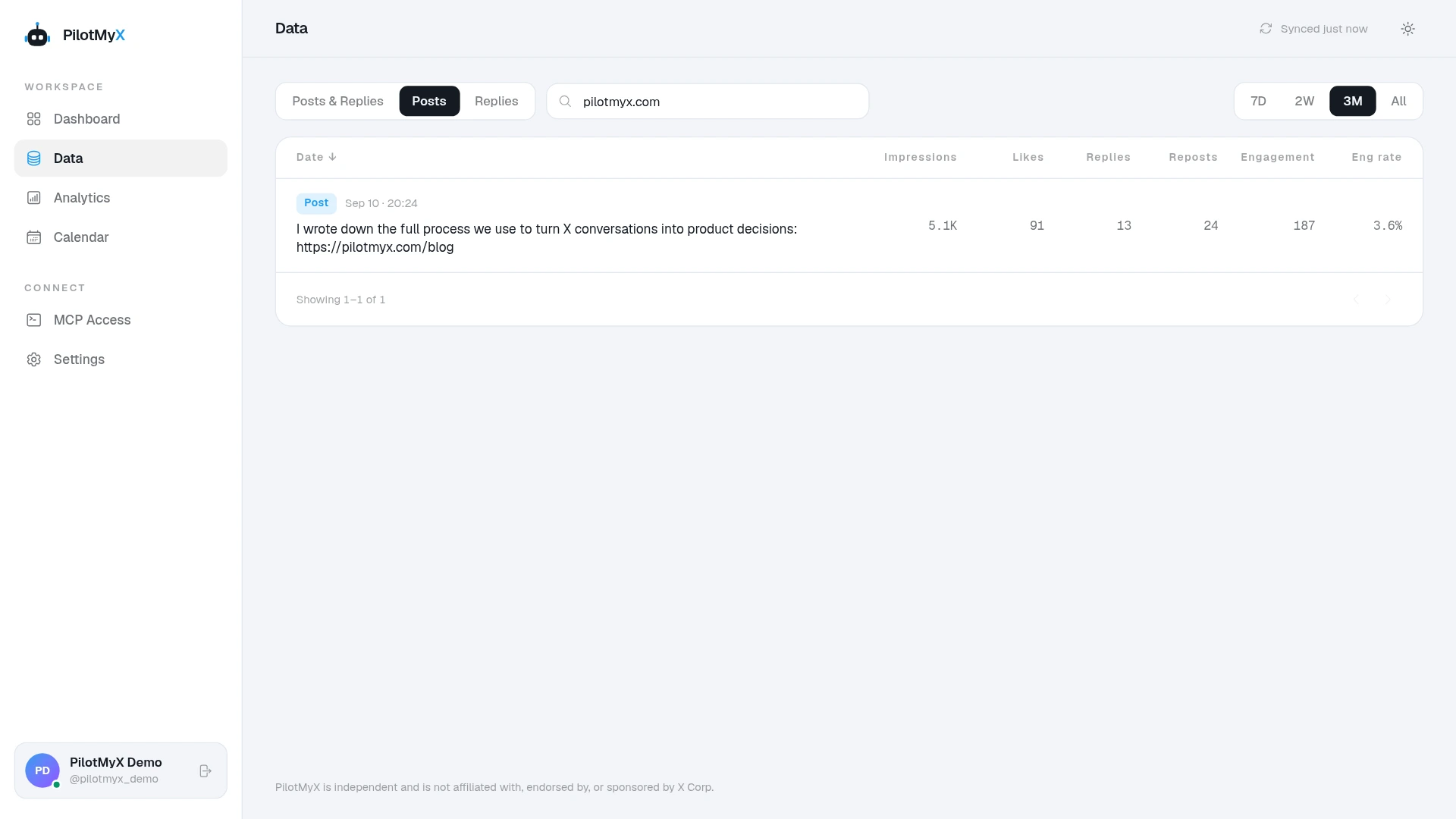
Start with the last 14 complete days in your account timezone if that gives you enough relevant examples. Keep original posts separate from replies. Review a few with stronger and weaker results, note their intended action, and choose one change to test in your next original post. If the period has too few comparable posts, say that rather than manufacturing a pattern.
Ask your agent to review the ending
After connecting an agent to PilotMyX, use this prompt to get suggestions without changing your drafts or calendar:
Help me improve the call to action in an original Twitter post.

Draft: [exact text]
Intended reader: [audience and problem]
Desired action: [one action, or none]
Destination and access conditions: [what opens, signup/payment, or none]
Facts and commitments I can support: [verified details]

Use PilotMyX read-only. Inspect relevant original posts from the
last 14 complete days in my account timezone. State the dates,
sample size and freshness. Read the text, not just the rankings.
Keep replies separate and missing metrics distinct from zero.

Match the review to the goal: available URL clicks and impressions
for resource posts, actual responses for questions, profile clicks
as a clue for introductions. Don't infer sales or per-post follows.

Suggest two alternative endings, including no CTA if that fits.
Keep the claim and destination unchanged. Ask for missing facts;
don't invent urgency, results, access conditions or future promises.
Explain one hypothesis worth testing, not a guaranteed improvement.

Don't refresh, create or update drafts, schedule, or publish.
Wait for my approval before any change in PilotMyX.
If you approve a version, open its destination and confirm that it delivers what the post promised before using the scheduling workflow.
Use your own account