Make the first line worth reading
How to write Twitter hooks that give people a reason to read
You know why your idea matters. A reader scrolling past doesn't. Start with the problem, decision, or useful detail instead of making them wait for it.
On this page
Your useful point is hiding behind the introduction
You have something worth saying, but your Twitter post starts with "Some thoughts on onboarding." A reader has to keep reading just to find out whether those thoughts solve a problem they have.
A Twitter hook is the opening that gives someone a reason to read the post. Name a recognizable problem, put a useful detail up front, or describe a decision with a real consequence. Then deliver what that opening promises. You don't need to imply that you've discovered a secret or invented a growth formula.
This is a writing method, not a documented ranking rule. A clearer first line can make the point easier to understand; it doesn't guarantee impressions. If the idea itself is still vague, use your account data to choose a subject before polishing the opening.
Find the sentence you would tell someone in person
Write the point before trying to make it catchy. "I moved the Save button because two testers couldn't find it" gives you something to work with. "Five lessons that changed everything" hides the subject and promises more than you may have.
Ask what a reader needs to recognize immediately. A designer might care about a confusing screen. A freelancer might care about an invoice that still hasn't been paid. A creator might recognize the pressure to post every day. Use those nouns rather than "this," "success," or "the game."
Sometimes the strongest opening already gives the answer: "Before sending another invoice reminder, check that the customer can pay on a phone." The rest of the post can explain how to check. You don't have to withhold useful information to create curiosity.
An unresolved decision can work too, when it's yours to make. "I'm removing a feature that customers asked for" needs an explanation. If nobody asked for the feature, that line needs a rewrite, however good it sounds.
Twitter hook examples with the facts held fixed
These are fictional writing exercises, not published posts or customer results. Each row assumes the stated situation is true. Use the same level of detail with your own facts, rather than borrowing the story.
| Situation | Vague opening | More useful opening | What the rest must deliver |
|---|---|---|---|
| A mobile invoice page has no working payment button | A lesson about getting paid faster. | Your invoice reminder won't help if the customer can't pay on a phone. | The mobile problem and how to check it, without blaming every late payment on the page. |
| Two testers missed the Save button | I learned a lot from user testing. | Two testers couldn't find Save. I moved the button before adding another feature. | What confused them and what changed, without claiming the redesign improved conversion. |
| Daily posting has become a source of filler | Consistency is important, but so is quality. | I'm cutting my posting schedule because I keep writing posts I wouldn't read. | The actual trade-off and the pace being tested, not advice that everyone should post less. |
| An onboarding question collects information nobody uses | Here are my tips for better onboarding. | Before you shorten an onboarding form, remove the question you never use. | An example of an unused answer and any reason the question still needs to stay. |
These openings give a reader something specific to care about without a revenue number or an algorithm claim.
For the Save button example, a complete draft could be:
Two testers couldn't find Save. I moved the button before adding another feature. The screen made sense to me because I knew where to look. In the next test, I'm checking whether someone can finish without me pointing at the button.
The draft names an observation and a next check. It doesn't pretend the check has already succeeded. That's also what keeps it from sounding like a generic lesson an AI could attach to any product.
Cut the setup without making the claim bigger
Delete phrases such as "I've been thinking about" when the thought that follows can stand alone. Keep them when the uncertainty is genuinely the point. A post about a decision you haven't made can sound uncertain without being weak.
Check the scope of every strong sentence. "This button confused two testers" is different from "Your onboarding is killing your sales." The second claim needs evidence about sales, not just a usability observation.
X describes 280 characters as the usual post limit and supports longer posts. That isn't evidence for an ideal hook length. Read the draft on a phone and make sure the opening identifies the subject without relying on a particular line break or feed truncation. A rule like "exactly seven words" can force you to remove the detail that made the idea useful.
If the first line promises a checklist, provide the checklist. If it introduces a mistake, explain what happened. Don't spend the rest of the post asking for follows before you've answered the opening.
Use your account history to choose a test
In PilotMyX, read the wording beside the results. Select Posts for original-post comparisons, then look at several posts about similar subjects. A reply can suggest a useful phrase, but its surrounding conversation gives it context an original post won't have.
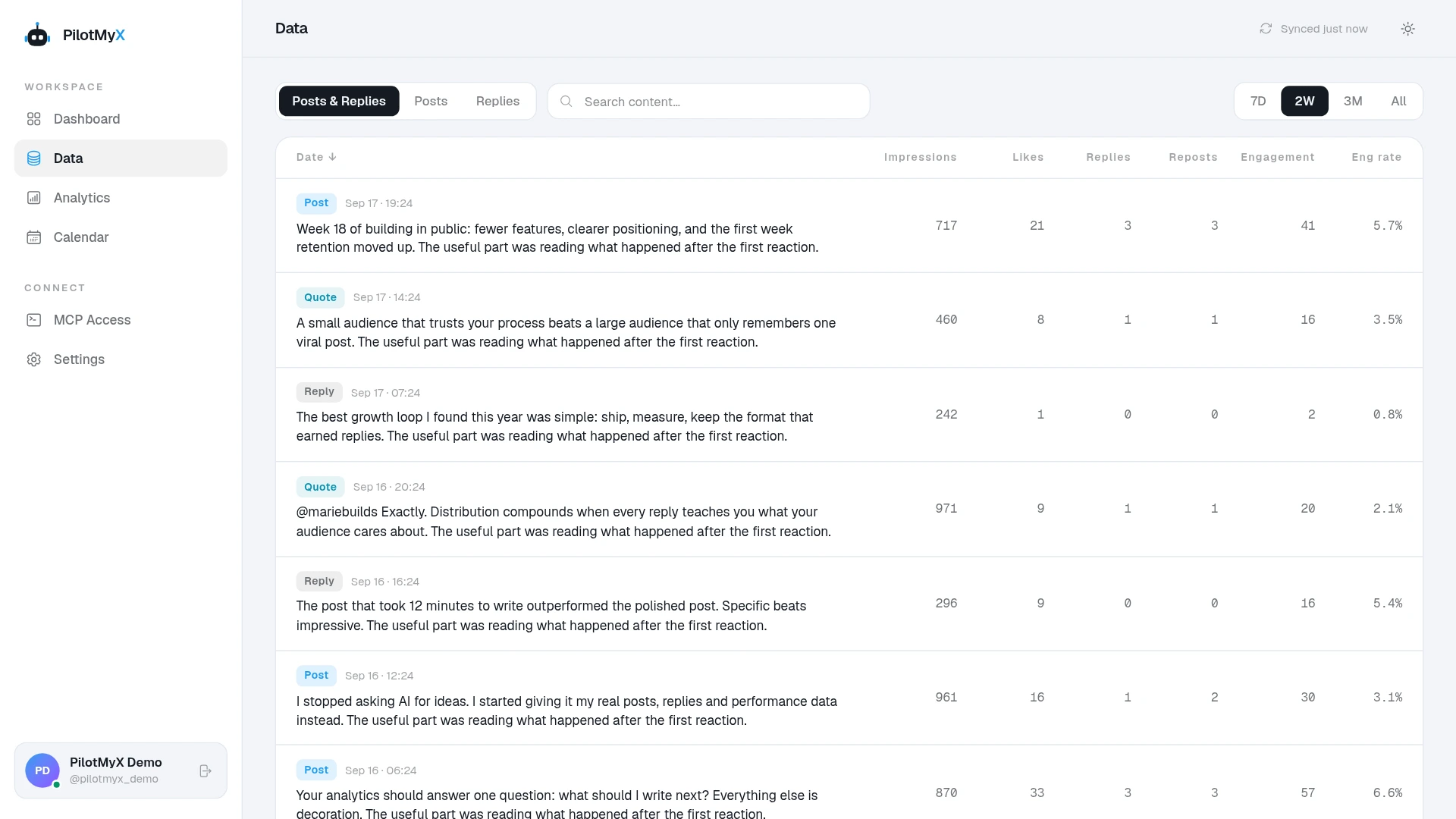
Suppose several original posts about onboarding make people curious enough to open your profile. Read both the stronger and quieter examples. Did they name a specific screen problem? Did one benefit from a screenshot, a repost, or a timely discussion? Write down an opening worth trying again, along with those other explanations.
Choose a metric that matches the post's purpose. For an introduction to your work, available profile clicks may be useful. For a resource meant to send someone to your site, review available URL clicks. Read replies when you wanted a conversation, rather than treating their count as proof that it was a useful one.
X's metrics documentation defines impressions as appearances on a screen, including repeat views. It distinguishes them from clicks and other interactions. None of those counts tells you whether someone read the first sentence or the whole text. X also limits access to non-public click metrics to posts created within the last 30 days; a missing value shouldn't become zero in your comparison.
Give the posts a comparable amount of time before reviewing them. The guide to when to judge a Twitter post covers that comparison. Two organic posts aren't a randomized A/B test: subject, timing, media, and audience can change with the opening.
Ask an agent for alternatives that preserve the point
A request for "ten viral hooks" invites dramatic claims that weren't in your draft. Give the agent the facts first. An agent connected to PilotMyX can read your past posts and propose wording that fits the way you explain things. PilotMyX supplies the account data through MCP; the agent does the writing.
Help me improve the opening of this original X/Twitter post.

Draft: [full draft]
Verified facts: [facts I can support]
Intended reader: [audience]
Purpose: [what I want the reader to understand or do]

Read the last 28 complete days available in PilotMyX. State the
range, freshness, and sample size. Compare original posts with
original posts; keep replies and quote posts separate.
Read relevant examples with stronger and quieter results, not
only the most-liked post. Label missing metrics rather than
treating them as zero.

Show two alternative openings that keep the same facts and
purpose. Include the full post under each so I can check that
the body delivers the promise. Keep my voice; do not add revenue,
customers, results, controversy, or an opinion I haven't supplied.

Flag any claim that needs my confirmation. Explain which wording
you changed and suggest one comparable test, including the metric
and review point. Do not claim the opening caused past results.
Keep this in the conversation: do not save, schedule, publish,
or refresh anything.
If the drafts sound unlike you, bring the agent back to real examples of your writing. Once you approve the complete post, you can prepare and schedule it in PilotMyX. Record the opening you chose and when you'll review its results.
Questions about Twitter hooks
How long should a Twitter hook be?
Long enough to make the subject and reason to read clear. Cut the introduction before cutting the useful detail. There is no length in this guide that promises better reach; check how the complete post reads on a phone.
Do all posts need a curiosity gap?
No. An opening can deliver a useful instruction immediately and use the rest of the post to explain it. Make a reader curious when the explanation genuinely matters, rather than hiding a simple answer.
Can I tell which opening performed better from impressions?
You can compare the results of posts with different openings. Impressions alone don't measure reading, and the comparison doesn't isolate the opening from the topic, media, timing, or people who saw the post. Treat a promising pattern as a reason for another test.
Can AI write the hook without changing my story?
It can propose alternatives if you supply the facts and review the full draft. Reject any version that adds an achievement, stronger opinion, or outcome you haven't confirmed. A more exciting sentence isn't useful if it misrepresents what happened.
Use your own account