Posts vs replies on X/Twitter
Posts vs Replies on X: What Should You Focus On?
When you have few followers, replies help people discover your account. Your original posts give profile visitors a reason to follow. Build both parts before judging the results.
On this page
The short answer
With few followers, you can write a useful post and still reach almost nobody. For a small X/Twitter account, use replies to get discovered in relevant conversations and original posts to give profile visitors a reason to follow.
That means spending more of your early effort on useful replies while keeping good posts on your own profile. Reply impressions help people notice you. Your posts show them what they would get by following. Choosing only one format leaves part of that path unfinished.
When you have few followers, use replies for discovery
The people you want to reach may already be reading another account's posts, even if they've never heard of you. A reply lets you join that conversation without waiting for them to find your profile first. Answer a question, add an example from your work, or explain something the discussion missed.
Choose conversations about the subjects you want to be known for. A popular debate unrelated to your work might bring impressions, but it gives those readers little reason to care about your account. A useful reply in a smaller, relevant discussion can be a better introduction.
X's reply guide explains that replies join conversations and are ranked for relevance rather than always shown chronologically. This supports using replies to take part where people are already reading; it does not establish a guaranteed reach boost or a daily reply quota.
Your posts give those visitors a reason to follow
Getting a reply seen is only the first part. Someone who taps your name needs to understand what following you will add to their feed. Your bio and pinned post introduce the account. Your recent original posts show whether you deliver on that introduction.
If you reply about building a product, keep posts on your profile that show what you're building, decisions you've made, or useful explanations from that work. A visitor who liked your answer should find more of the same perspective, with enough context to read it independently.
Before increasing your reply activity, make sure you have posts worth finding. Then keep publishing while you join conversations. Otherwise, you can generate reply impressions and profile visits without giving those visitors much reason to follow.
Replies can also earn follows directly, and original posts can reach people who don't follow you. The distinction is where to focus when you're starting: replies help with discovery; your posts and profile help turn that interest into a decision to follow. The guide to growing on Twitter from zero covers the bio, photo, banner, and pinned post in more detail.
Why the totals can send you in the wrong direction
Suppose you write five original posts and fifty replies in a month. Replies may produce more total impressions simply because they had ten times as many chances to be seen.
One unusually large conversation can distort the comparison too. If most reply impressions came from a single debate, the total describes that event more than it describes your usual reply performance.
Before choosing a winner, compare:
- how many posts and replies you wrote;
- the median result for each format;
- the share of results produced by the top item;
- the topics and audiences behind the strongest results;
- the actions people took after seeing the content.
This will not produce a universal answer. It will produce an answer that belongs to your account.
What original posts are good at
An original post lives on your profile without depending on someone else's conversation for context. It gives a new visitor a sample of what following you will be like. That makes it useful when you want to:
- explain an idea in your own words;
- show new profile visitors what you work on;
- announce a product, article, or update;
- build a recognizable body of opinions and examples;
- schedule important ideas instead of waiting for the right conversation.
Posts also give you more control over the opening, structure, media, link, and publishing time. That control matters when the content needs to qualify an audience or lead toward a specific next step.
The trade-off is distribution. A post starts with the attention your account can attract. A strong idea can still travel, but publishing it does not guarantee that the right people will see it.
What replies are good at
A reply enters a conversation where people are already reading. When your own audience is small, that makes it a practical way to introduce your work and point of view to people who would not have found your original posts.
Replies are useful for:
- joining discussions that overlap with your expertise;
- testing whether an idea creates a response;
- meeting people in the audience you want to reach;
- finding natural phrases and explanations that sound like you;
- discovering questions worth answering in a future post.
The trade-off is control. The original post sets the context and attracts the audience. A reply can generate plenty of exposure while bringing little interest in what you actually build or publish.
That is why the biggest reply is not always the most useful one. A smaller conversation with the right people may lead to better profile visits, follows, product clicks, or future discussions.
Compare the job, not only the format
Use the same evaluation window for posts and replies, but judge them against the role you expected them to play.
| Goal | What to inspect in original posts | What to inspect in replies |
|---|---|---|
| Discovery | Impressions and non-follower reach when available | Impressions across relevant conversations |
| Profile interest | Profile visits and follows after publishing | Profile visits from conversations that fit your audience |
| Engagement | Response per post, topic, and opening | Response per reply, topic, and account involved |
| Product interest | Relevant link clicks and resulting visits | Whether conversation-driven profile visits continue to the product |
| Idea development | Posts that earn repeated interest | Replies that contain an idea worth expanding |
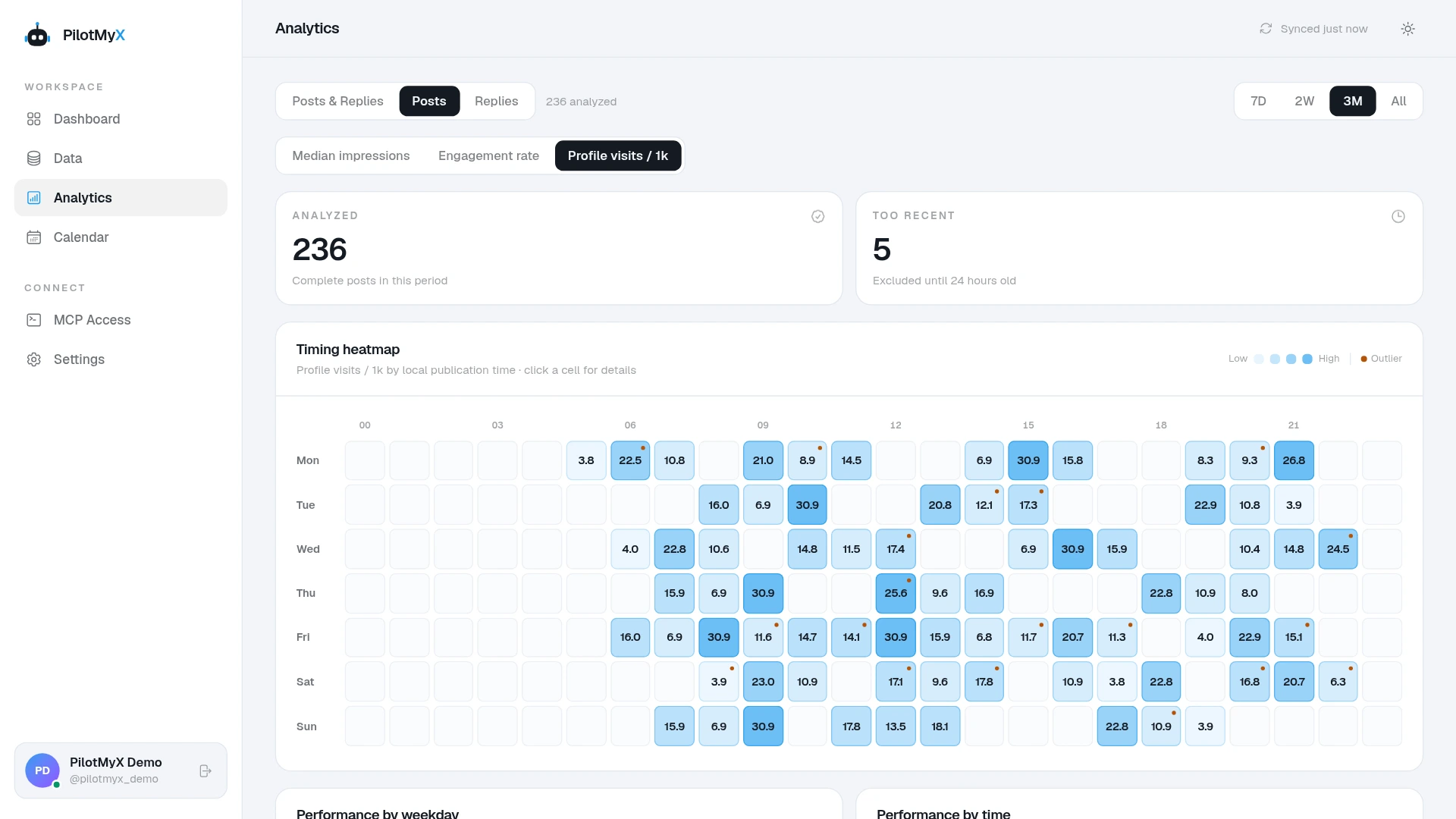
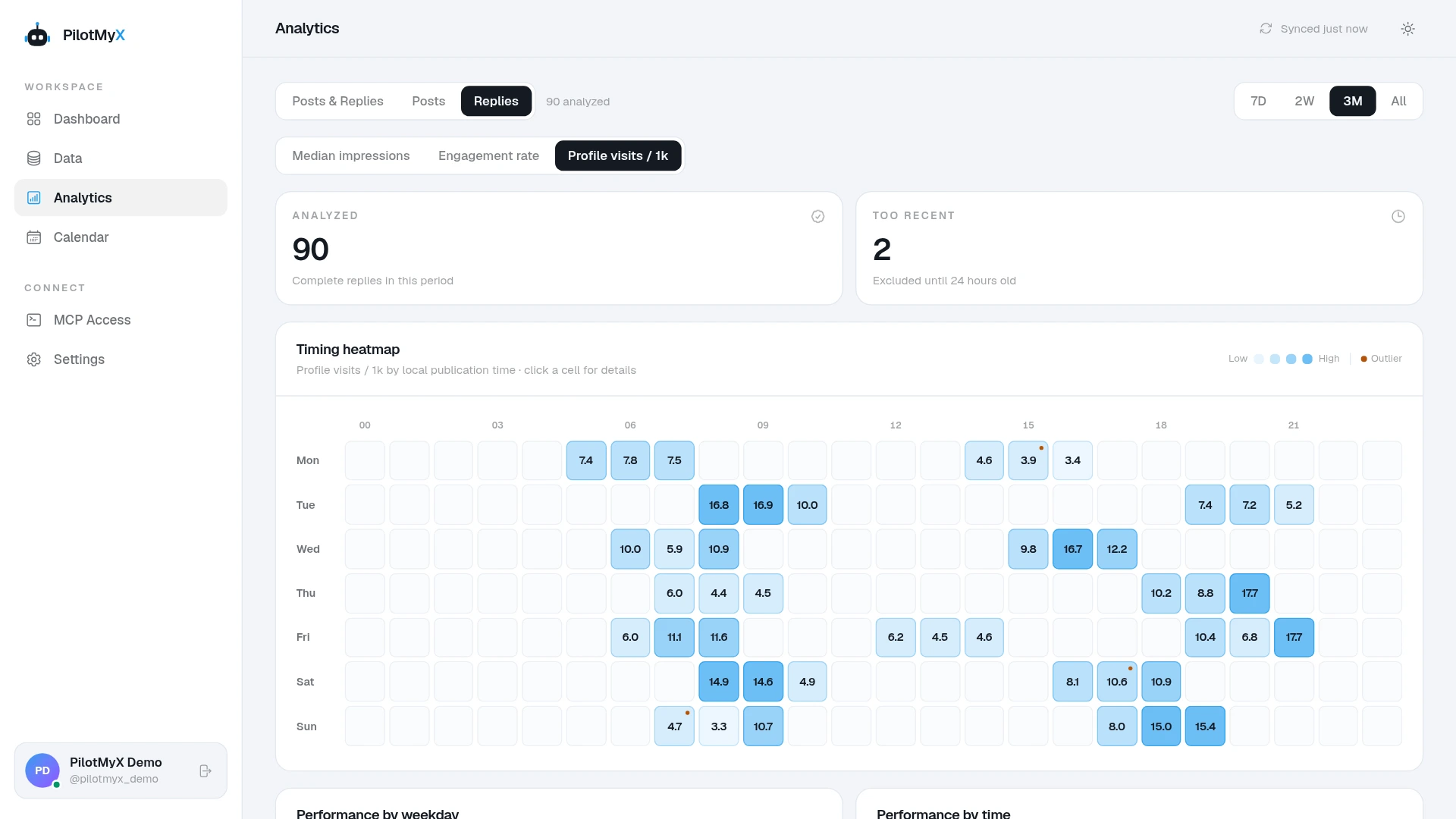
X defines impressions as the number of times a post appears on a screen, not the number of unique people who saw it. Treat impressions as exposure rather than audience size. Its metrics documentation also lists profile clicks separately.
In PilotMyX, compare your Posts and Replies over the same period to see which content gets viewed and which leads people to open your profile. Record follower growth over that period too, but don't assign every new follow to a single reply or post. Someone may discover you in a reply and decide to follow only after reading your profile and recent posts.
Run an outlier check before changing your strategy
Look at the strongest item in each group. Then compare the results again without it.
If the conclusion changes completely, you do not have a stable format winner. You have an outlier worth understanding.
Read the item in context:
- What topic was being discussed?
- Which audience was already present?
- Did the content attract relevant profile visits or only exposure?
- Can you repeat the underlying idea without recreating the same event?
Keep the lesson if it fits the account you want to build. Do not turn the result into a baseline until it repeats.
A practical weekly review
You can compare posts and replies without building a complicated report.
- Choose one consistent period.
- Separate original posts from replies you wrote.
- Record publishing volume and the metrics tied to your current goal.
- Compare medians instead of relying only on totals and averages.
- Check how much the top item contributed.
- Label the topic and likely audience behind each strong result.
- Pick one action for the next period.
That action might be scheduling another original post on a topic that brought qualified profile visits. It might be spending more time in conversations with a specific group. It might also be turning a strong reply into a standalone post that makes sense without the original discussion.
Change one part of the plan at a time. If you change topic, frequency, timing, and format together, the next report will give you another pile of numbers without a clear lesson.
The decision should stay specific to your account
There is no reliable rule that says every creator should post more or reply more. Account size, audience, topic mix, activity level, and goals all change the result.
If you're starting with few followers and visibility is the problem, spend more time contributing useful replies to relevant conversations. Keep publishing original posts that make following you worthwhile. Once people are visiting your profile, review what they find there before deciding that you simply need more reply impressions.
Use your own account