Bring your X history in
Connect your account through X. PilotMyX imports the posts and replies included in your plan and refreshes recent data daily.
Muse Code + PilotMyX
Connect Meta's Muse Code terminal agent to your X/Twitter analytics with PilotMyX. This guide covers Muse Code, not the consumer Muse app. Connect over MCP and ask questions grounded in the posts and replies you actually published.
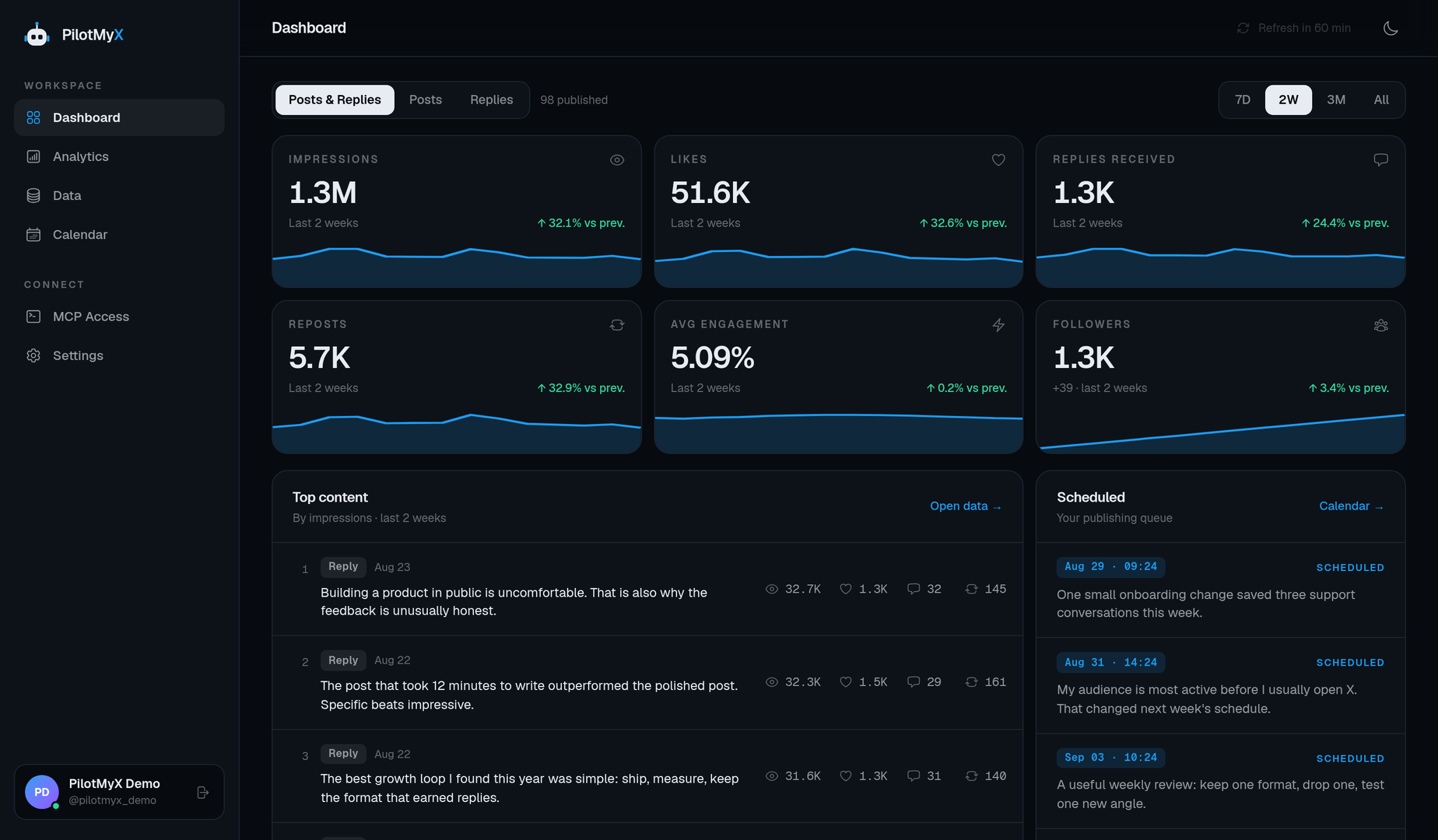
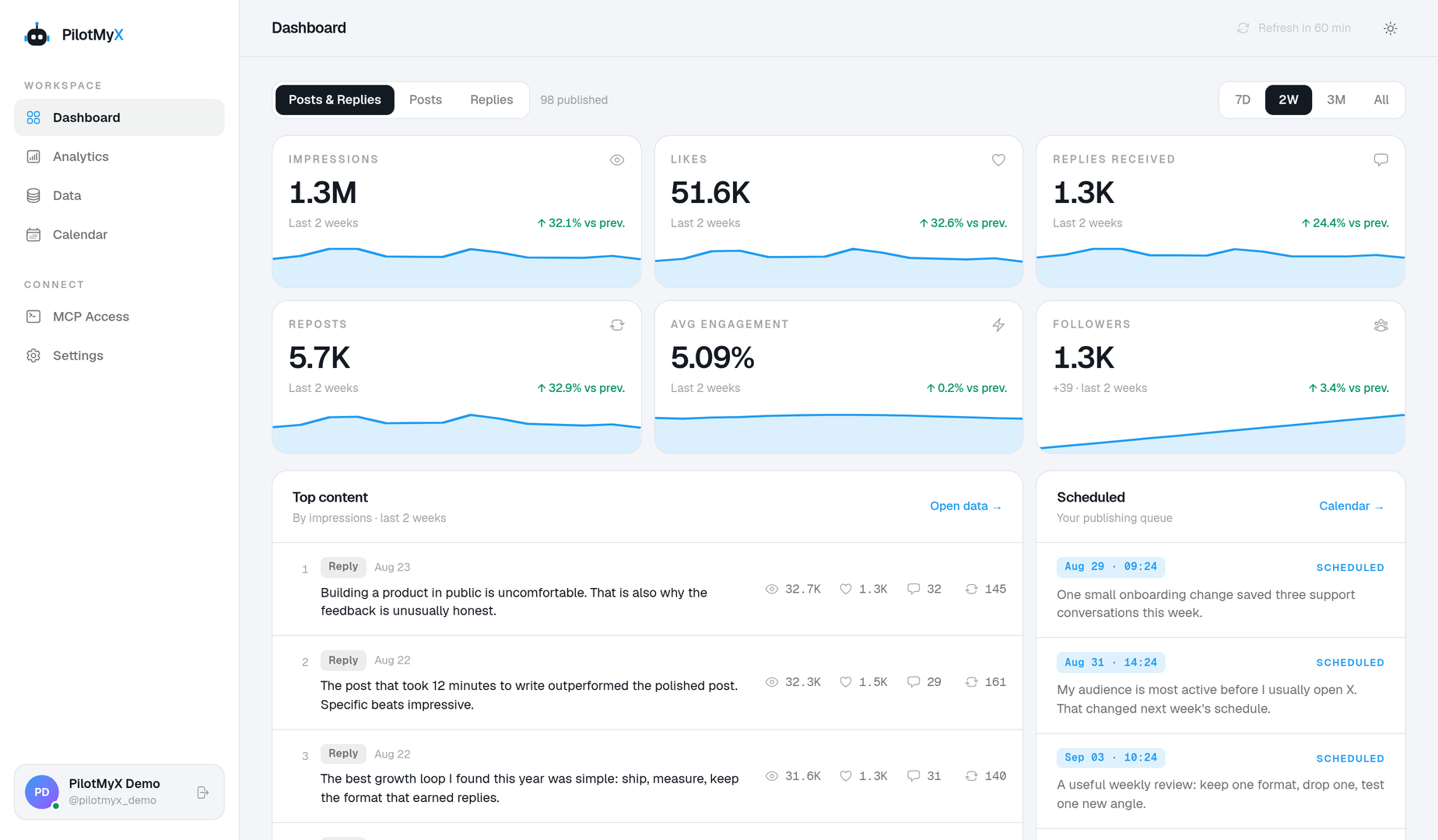
Which posts earned the most attention last month, and what should I test next?
From account to action
Connect once, give Muse Code a read-only view of your results, and use the evidence to decide what to try next.
Connect your account through X. PilotMyX imports the posts and replies included in your plan and refreshes recent data daily.
Approve read-only access on the PilotMyX sign-in screen. Ask what performed, over which period, and which real posts support the answer.
Use those findings to draft a new angle. Saving or scheduling through PilotMyX needs a separate, explicitly approved write permission.
What Muse Code can do with PilotMyX
PilotMyX supplies the facts. Muse Code helps you interpret them and plan the next test. It does not need publishing access to analyze your account.
Inspect reach and engagement for individual posts, with the content behind each result.
See whether original posts or replies are doing the work, using a shared time window.
Compare periods and account trends before deciding whether an idea is worth repeating.
Ask for a new angle based on examples from your own account, not generic posting advice.
Ask for a draft in your conversation. Saving or scheduling it through PilotMyX requires a separate write permission.
Review the requested permissions at sign-in and revoke the connection from PilotMyX when you need to.
The connection
It is the bridge between Muse Code and your connected X account. Your agent requests cached posts, replies and analytics from PilotMyX, then works with that evidence in your conversation.
PilotMyX does not generate your strategy on the server. Your agent does the reasoning; you decide whether a draft gets published.
Explore the MCP toolsRead-only by default · Publishing requires a separate scope
Try asking Muse Code
“Compare my original posts and replies from the last 30 days. Which had more reach? Show the sample size and three real examples.”
“Find the posts that beat my usual engagement. What do they have in common? Suggest one angle to test next, but don’t publish it.”
Setup guide
Follow these steps for Muse Code. The PilotMyX consent screen starts with read-only access; no token needs to be pasted into Muse Code.
This guide connects Muse Code, Meta's terminal agent. It does not describe a native connector in the consumer Muse app.
You need Muse Code installed and signed in, plus an active PilotMyX plan or trial with an imported X/Twitter account. The MCP connection gives Muse Code access to PMX's data; it does not give it your X credentials.
Merge the following server into ~/.config/muse/settings.json. If you use a custom XDG configuration directory, edit its Muse settings file instead.
{
  "mcp_servers": {
    "pilotmyx": {
      "transport": "streamable_http",
      "url": "https://pilotmyx.com/mcp",
      "enabled": true,
      "mode": "required"
    }
  }
}
Keep existing settings and other servers. required means an unavailable server stops the run instead of continuing without your account data.
Complete browser authorization with:
muse mcp login pilotmyx
On the PMX screen, check the X handle and select read-only access before choosing Allow connection. Leave dynamic client registration enabled in Muse Code; PilotMyX supports it.
Open an interactive Muse Code session and run /mcp. Confirm that pilotmyx is connected and its tools are listed.
Ask:
Use PilotMyX to check my account and data freshness. Compare posts and replies from the last 30 days. Which recurring topics earned profile visits? Show the examples and keep this read-only.
Check the account, timestamps and samples behind the answer. A plausible content plan without PMX tool calls does not verify the connection.
Install the PMX analysis skill using Copy prompt in MCP Access. Muse Code supports user skills under ~/.agents/skills; the installation prompt provides the current PMX bundle and workflow.
Read-only access lets Muse Code analyze results and write proposed text in the conversation. PMX draft, schedule and publish actions require their own permissions.
If a session reports 401, run muse mcp login pilotmyx and complete consent again. If the server fails at startup, check the URL and JSON settings rather than changing required to hide the error.
Use muse mcp logout pilotmyx to remove the local sign-in, and revoke its credential in MCP Access to end server-side access.
Client settings change. Check the platform's current requirements before connecting.
Read the platform documentation ↗FAQ
No. The default connection is read-only. Publishing needs a separate permission grant; the setup below does not request one.
No. PilotMyX provides the account data and publishing tools. Muse Code does the writing and analysis in your own agent session.
Ask the agent to check the last synchronization time before analyzing a period. PilotMyX refreshes subscribed accounts daily; the MCP skill explains how to check freshness and request a refresh when needed.
Connect your X account, then give Muse Code the real results behind your ideas.