Bring your X history in
Connect your account through X. PilotMyX imports the posts and replies included in your plan and refreshes recent data daily.
Kimi K3 + PilotMyX
Use Kimi Code's MCP client to analyze your X/Twitter posts and replies with the Kimi model available on your account. Connect over MCP and ask questions grounded in the posts and replies you actually published.
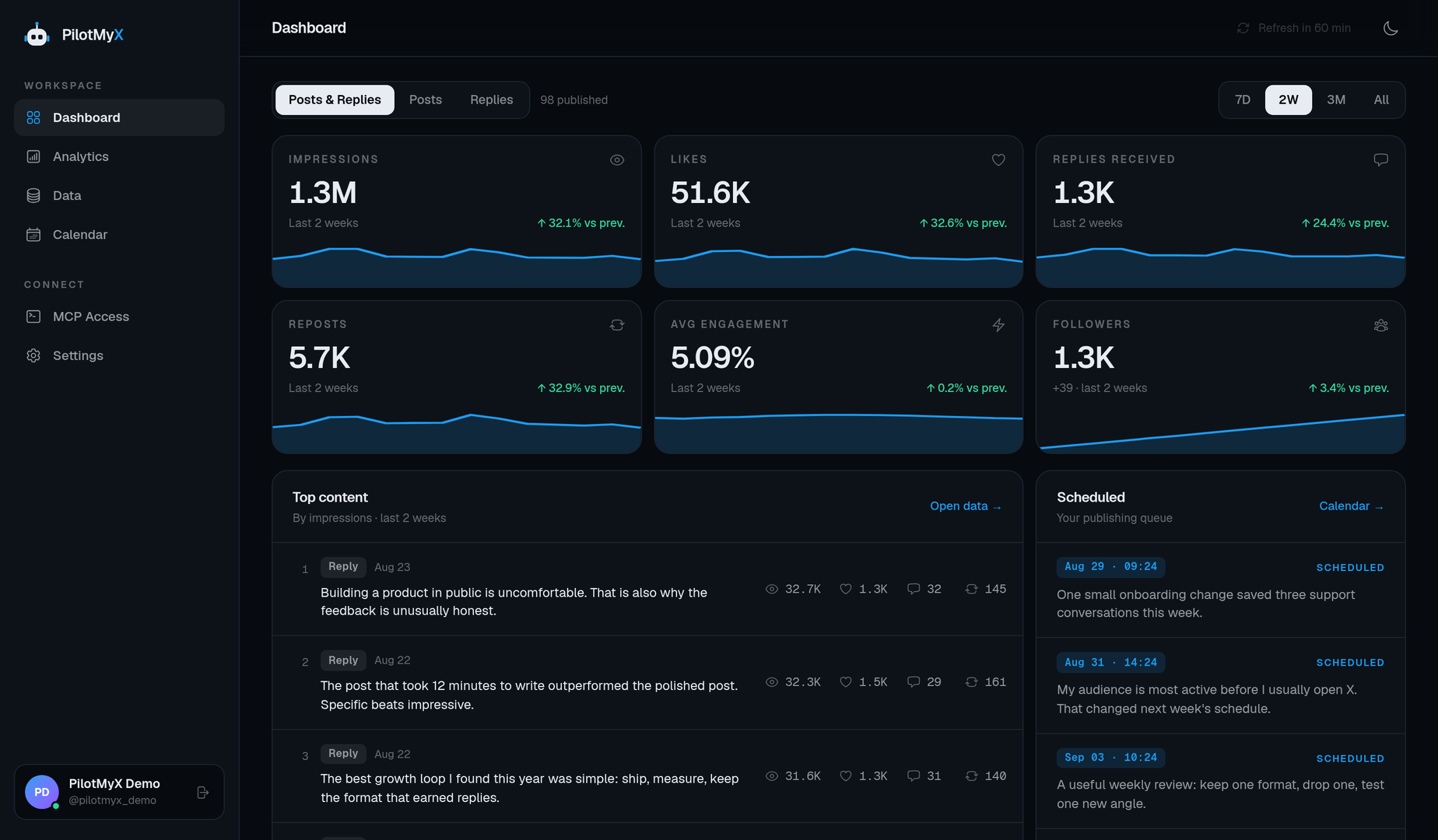
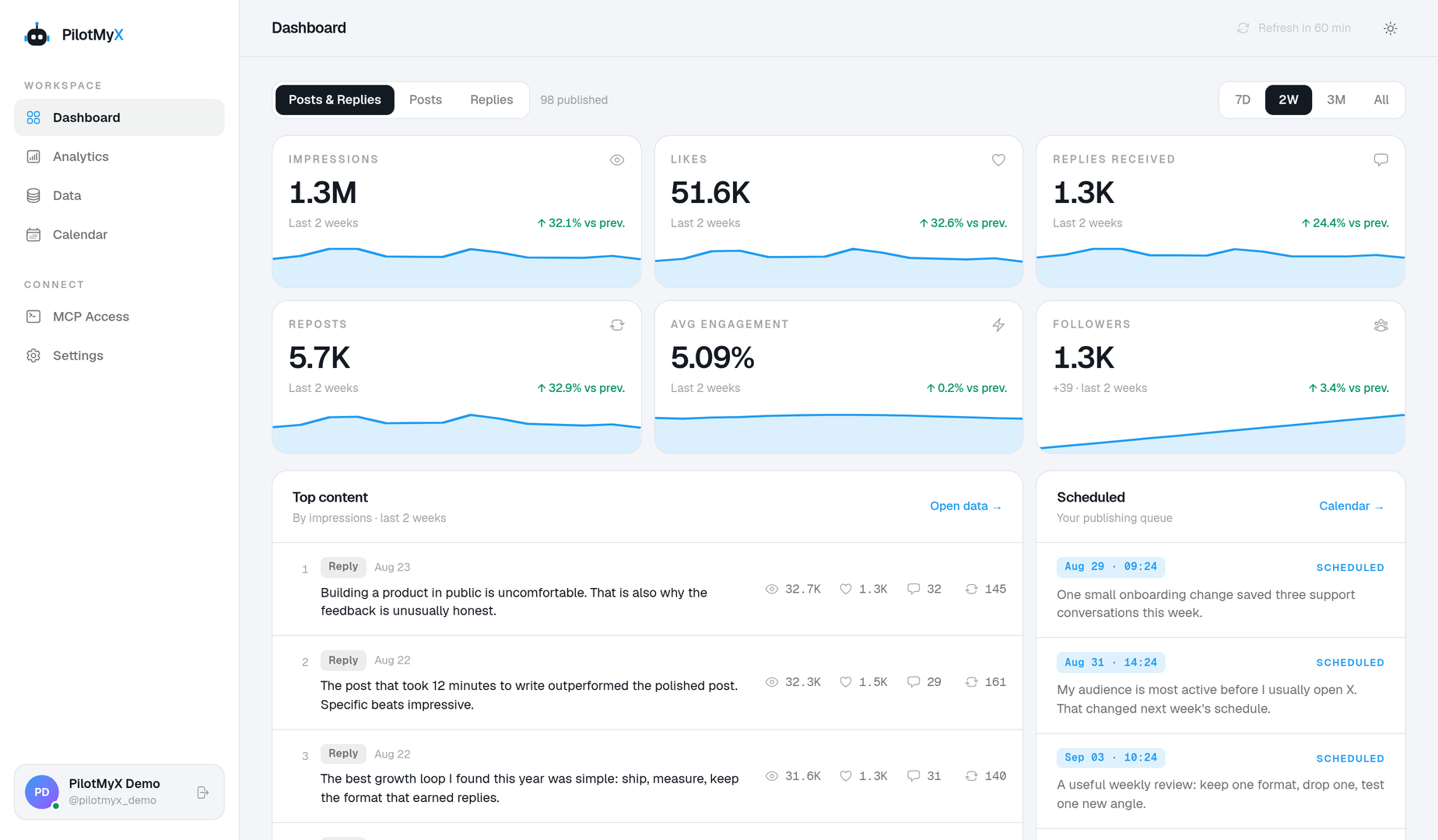
Which posts earned the most attention last month, and what should I test next?
From account to action
Connect once, give Kimi K3 a read-only view of your results, and use the evidence to decide what to try next.
Connect your account through X. PilotMyX imports the posts and replies included in your plan and refreshes recent data daily.
Create a scoped MCP token and install the PilotMyX skill. Ask what performed, over which period, and which real posts support the answer.
Use those findings to draft a new angle. Add separate write permissions only if you want the agent to save or schedule it.
What Kimi K3 can do with PilotMyX
PilotMyX supplies the facts. Kimi K3 helps you interpret them and plan the next test. It does not need publishing access to analyze your account.
Inspect reach and engagement for individual posts, with the content behind each result.
See whether original posts or replies are doing the work, using a shared time window.
Compare periods and account trends before deciding whether an idea is worth repeating.
Ask for a new angle based on examples from your own account, not generic posting advice.
Grant separate write scopes when you want the agent to prepare or schedule an approved post.
Start read-only, scope each token, and revoke access from PilotMyX when you need to.
The connection
It is the bridge between Kimi K3 and your connected X account. Your agent requests cached posts, replies and analytics from PilotMyX, then works with that evidence in your conversation.
PilotMyX does not generate your strategy on the server. Your agent does the reasoning; you decide whether a draft gets published.
Explore the MCP toolsRead-only by default · Publishing requires a separate scope
Try asking Kimi K3
“Compare my original posts and replies from the last 30 days. Which had more reach? Show the sample size and three real examples.”
“Find the posts that beat my usual engagement. What do they have in common? Suggest one angle to test next, but don’t publish it.”
Setup guide
Follow these steps for Kimi K3. Start with a read-only token; add publishing permissions only when you need them.
This guide uses Kimi Code CLI as the MCP client. Kimi K3 is a model choice, not an MCP configuration screen. Select the model available on your Kimi account; this setup does not unlock a model your plan does not include.
You need Kimi Code installed and signed in, and a PilotMyX plan or trial with imported X/Twitter posts and replies.
Create a token in MCP Access with account:read and data:read. Store it as PILOTMYX_MCP_TOKEN in Kimi Code's private process environment.
Do not put the value in a chat message, a shared repository, or a command saved to history.
Merge this entry into your user-level ~/.kimi-code/mcp.json:
{
  "mcpServers": {
    "pilotmyx": {
      "url": "https://pilotmyx.com/mcp",
      "bearerTokenEnvVar": "PILOTMYX_MCP_TOKEN",
      "enabled": true
    }
  }
}
If you configured KIMI_CODE_HOME, use its mcp.json instead. A project-level .kimi-code/mcp.json with the same server name overrides the user-level entry.
Kimi Code treats a URL entry as HTTP unless another transport is specified. Use this remote setup, not a local stdio command or a legacy SSE transport.
Start a new Kimi Code session after editing the file. Run /mcp to inspect connection status; /mcp-config manages server settings.
Install the PMX analysis skill with Copy prompt from MCP Access, then ask:
Check my PilotMyX account and freshness. Compare the last 30 days of posts with replies. Which repeated topics brought profile visits? Show the posts behind the conclusion. Keep this read-only.
Verify actual PMX calls, the account identity, and the date range before using the answer as a content plan.
Keep approval for unfamiliar actions. A client-level allow rule is not a replacement for PMX's scoped token.
If the server is missing from an existing session, start a new one. If authentication fails, check the environment variable in the Kimi process and whether the token is active. If a tool cannot write, read-only access is working as designed.
Draft in the conversation before granting draft or scheduling scopes. Revoke the token in MCP Access when you stop using the connection.
Client settings change. Check the platform's current requirements before connecting.
Read the platform documentation ↗FAQ
No. Start with a read-only token to analyze posts and replies. Drafting, scheduling and publishing require separate write scopes that you choose in MCP Access.
No. PilotMyX provides the account data and publishing tools. Kimi K3 does the writing and analysis in your own agent session.
Ask the agent to check the last synchronization time before analyzing a period. PilotMyX refreshes subscribed accounts daily; the MCP skill explains how to check freshness and request a refresh when needed.
Connect your X account, then give Kimi K3 the real results behind your ideas.