Data-led content planning
What Should I Post on Twitter? Start With Your Own Data
The internet can give you endless post ideas. It cannot tell you which one fits your audience, your voice, and the account you are building. Your own history is a better place to start.
On this page
Start with a decision, not a list of prompts
If you ask the internet what to post on Twitter, you will get familiar answers: share a lesson, ask a question, tell a story, post a hot take.
Those are containers. They do not tell you which lesson your audience wants, which question you can answer well, or which story brings the right people to your profile.
Your account already contains better clues. The job is to find a pattern worth testing without turning one viral post into a personality.
Build three short lists
Review a useful period, such as the last 60 or 90 days, and create three lists.
If two promising subjects leave you unsure what to explain next, ask a concrete question your readers can answer. The Twitter polls guide shows how to write useful options and turn the result into a follow-up, without mistaking votes for demand.
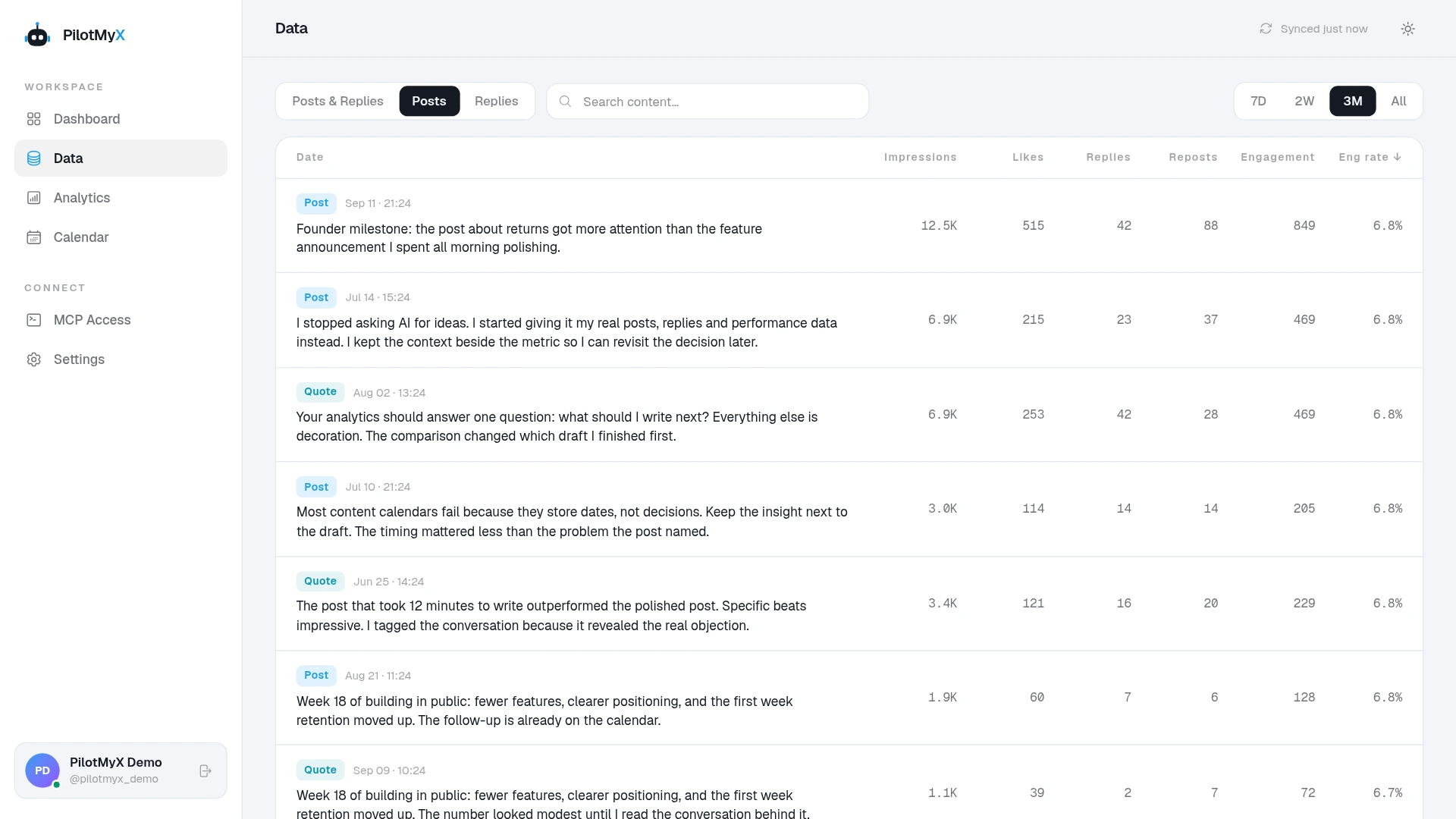
Topics that earned qualified attention
Find topics that produced profile visits, follows, link clicks, bookmarks, or relevant conversations more than once. A modest result that repeats can be more useful than a giant result from the wrong audience.
Openings that made the idea easy to enter
Look at the first line of comparable posts. Note whether the stronger examples began with a concrete problem, a result, an opinion, or a question. Describe the pattern instead of saving a swipe file of exact sentences.
Once you have the idea, use the Twitter hook guide to make its opening specific without changing the facts. A promising topic still needs a first line that tells a reader why to keep reading.
Replies that sounded unmistakably like you
Find explanations, disagreements, or jokes that felt natural and still attracted the audience you want. A strong reply can reveal a post idea and a voice pattern at the same time.
Remove the outliers before choosing
Now run the same review without the top one or two results.
If a topic disappears, it may have been an event rather than a repeatable pillar. If it still produces solid results across several posts or replies, it deserves more confidence.
This simple check protects you from spending the next month imitating a debate, mention, or lucky amplification you cannot reproduce.
Turn a pattern into a testable post
Suppose posts about shipping mistakes repeatedly bring profile visits, and your clearest replies use a direct “I tried this, it failed, here is what changed” structure.
Do not ask an AI for ten generic founder posts. Build one test:
- topic: a recent shipping mistake;
- tension: the reasonable choice that caused the problem;
- evidence: the specific cost or delay;
- payoff: the rule you now use;
- success signal: profile visits and relevant replies, not impressions alone.
That brief is specific enough to draft and clear enough to evaluate after publication.
Once the idea is clear, decide whether the reader needs to see it. The guide to Twitter images vs text helps you choose a useful screenshot or keep the post in words before spending time on a graphic.
Use four jobs to balance the calendar
Every post does not need the same job. A simple week can include:
- Discovery: an idea that enters a conversation your audience already cares about.
- Proof: a result, mistake, screenshot, or process that shows you did the work.
- Position: a clear view that helps people understand how you think.
- Conversion: a product or offer tied to a problem you just demonstrated.
This prevents a calendar full of product announcements or a feed full of broad opinions with no path to your work.
Decide what not to post
Data is as useful for subtraction as it is for ideas.
Stop or reduce a category when it repeatedly attracts the wrong audience, takes too long to produce, or creates reach without any sign of relevant curiosity. Keep room for personality, but do not confuse every large number with progress toward the account’s goal.
Also remove ideas that only make sense because an AI generated a clever sentence. If you cannot explain why the post belongs on your account, it does not deserve a calendar slot.
The same test applies to tags. If you're adding them only in the hope of extra reach, the guide to hashtags on Twitter helps you decide whether one actually belongs in the post.
Let an agent help without outsourcing the strategy
An AI agent can search more examples, compare periods, and turn a brief into several drafts. It should show the evidence behind the direction before it writes.
Ask for:
- the repeated pattern;
- two supporting examples and one counterexample;
- the audience the idea is meant to attract;
- a draft in your observed voice;
- one metric to review after publication.
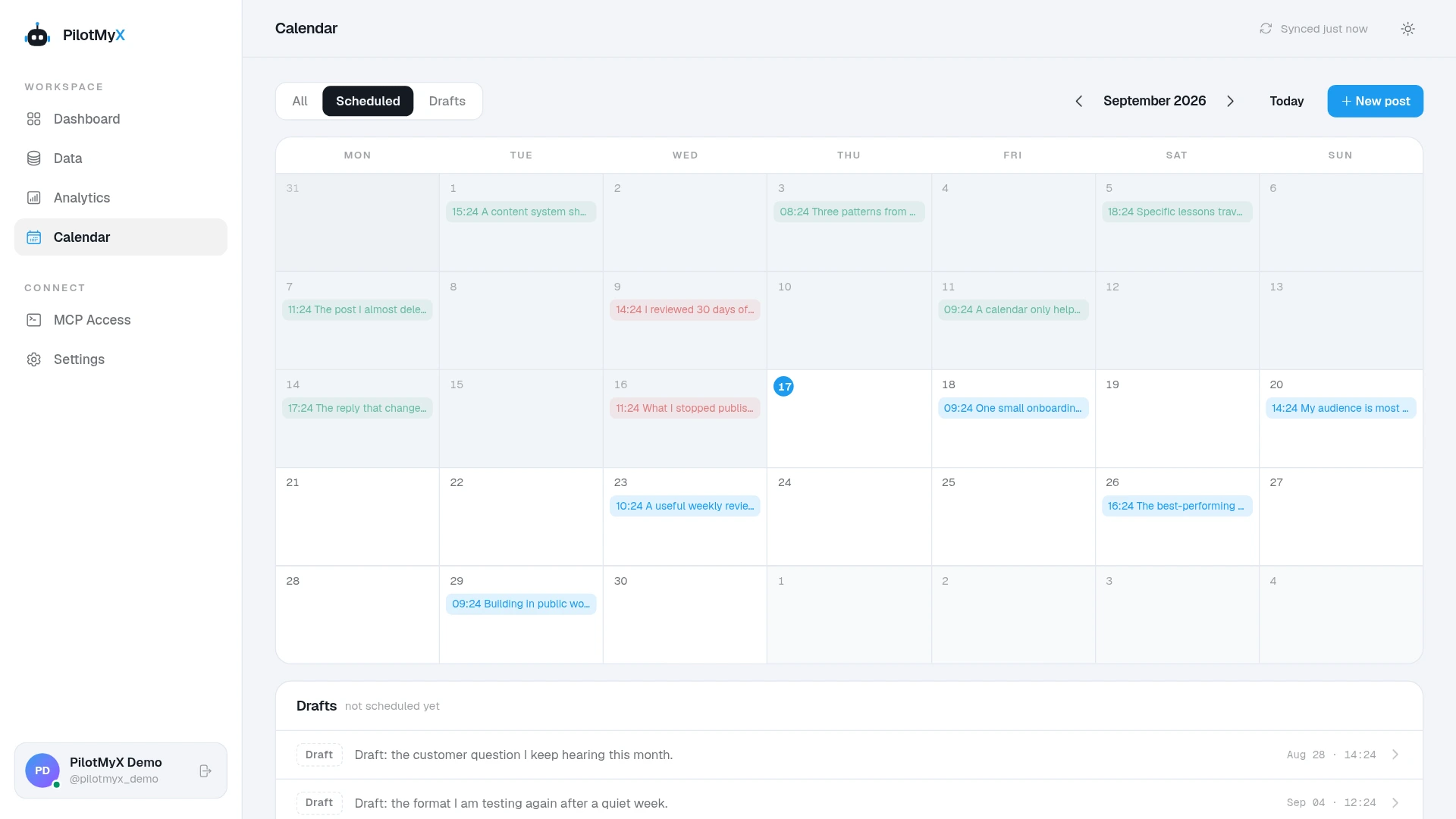
With PilotMyX MCP access, the agent can work from the authorized account data and then place the post you approve on the calendar. Without that context, give it the brief yourself and keep the same standard.
A weekly 30-minute routine
If the review leaves you short of ideas, try revisiting a useful older post. Add a verified example or a different application instead of filling the calendar with copies.
- Review the last seven days and a longer baseline.
- Name one result worth repeating and one result to ignore.
- Pick two topics with repeated qualified attention.
- Pull one voice pattern from your replies.
- Draft three posts with different jobs.
- Place them on the calendar with room between similar ideas.
- Write down what each post is testing.
Next week, review the tests rather than starting from zero. That is how an account becomes a learning system instead of an endless request for new prompts.
Use your own account