Make more of your X/Twitter ideas
How to reuse your best Twitter posts without repeating yourself
Your next useful post may start with an idea you've already explained. Find the original, decide what still holds up, and give readers a reason to read the new version.
On this page
You don't have to start every post from an empty draft
You're looking at tomorrow's calendar and can't think of anything worth publishing. Meanwhile, an older post contains a useful explanation you haven't touched since the day you wrote it.
To repurpose Twitter posts, recover the idea, check that it is still accurate, and choose what the next version adds. You might answer an objection, demonstrate a step, or explain what changed. If the original already says everything you need to say, a native Repost may be more honest than dressing the same text up as a new insight.
The aim is to spend less time hunting for ideas while keeping each new post useful. A successful old post is a candidate to investigate, not a promise that the next version will perform the same way.
Choose between a Repost, a Quote, and a new original
X's guide to Reposts and Quotes confirms that you can share your own older posts through either feature. A Quote references the original while letting you add context.
| Your situation | Option to consider | What the reader gets |
|---|---|---|
| The original is accurate and relevant again; you have nothing to add | Native Repost on X | The existing post, with its original context |
| A new event or correction makes the old post worth discussing | Quote with a useful explanation | The original beside what changed |
| You can explain a different application, step, or objection | New original post | A self-contained answer that adds something |
None of these choices guarantees extra reach. Decide based on what someone needs to understand now, rather than assuming that a change of format will revive an old result.
If you're trying to recover the original first, use the old-tweet search guide. If the starting material is an answer in a conversation, the reply-to-post guide explains how to restore the missing context.
Find an idea worth revisiting, not just your biggest number
Start with a period you actually have in your account history. Thirty days is a workable review window if those posts are available; it is not a rule about how often to repeat an idea.
In PilotMyX, open Data, select Posts, and inspect the text beside its results. Search for a topic you still want to discuss, then review several relevant posts. Use impressions if you're investigating visibility, replies received if you're investigating discussion, or profile visits when that metric is available and fits your goal.
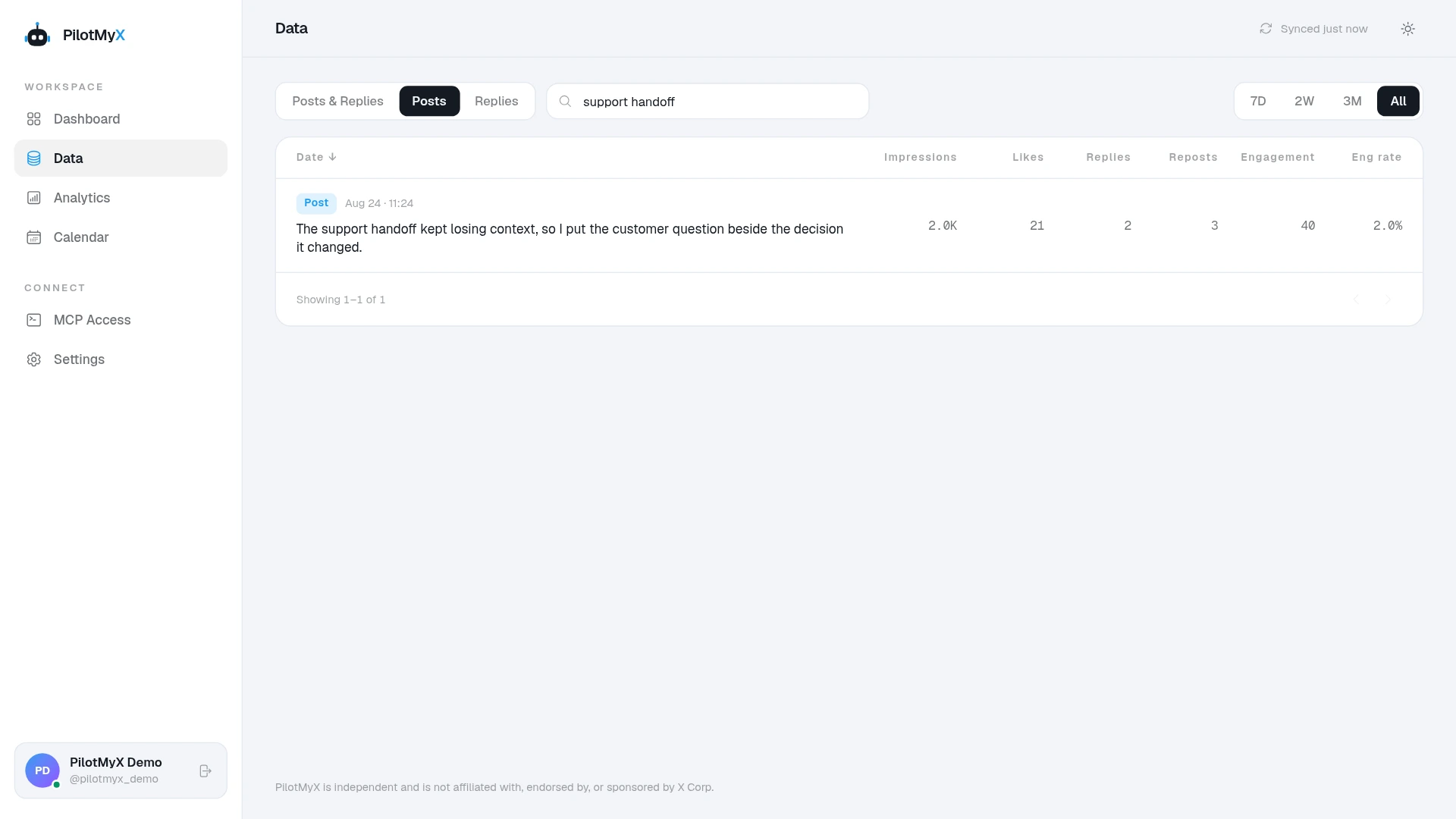
Read the post before turning its metric into a recommendation. An announcement can earn attention because it was news that day. A practical explanation may remain useful months later. A controversial remark may attract replies you don't want to repeat.
Compare similar posts and account for their age. An older post has had more time to accumulate impressions than one published this morning, and its stored metrics may have been captured at a different point in its life. The guide to judging a post's performance covers that distinction.
Look beyond one standout. If several posts address the same problem and readers ask useful follow-up questions, you have more material to examine. That is evidence of a conversation you can develop, not proof that the topic causes growth.
Add a reason to read the new version
Here is a fictional writing example, not a customer result. The older post says:
Support handoffs kept losing context, so I put the customer's question beside the decision it changed.
Changing "context" to "information" doesn't add much. A new version could instead describe the handoff someone can use:
Before handing off a support request, leave the next person the customer's question, what you've already checked, and the decision still needed. A ticket history doesn't always make those things easy to find.
That version gives the reader an action. Another angle could explain the limitation:
A support handoff can include every message and still leave the next person guessing. Put the unresolved question near the top, then link the history that explains it.
These drafts serve different purposes: one gives a handoff structure, the other explains why a complete history can still be hard to use. They are alternatives to choose between, not instructions to publish both back to back.
For your own post, write down exactly what changed. A verified example, a narrower audience, an actual follow-up question, or a step you previously left out can justify a new version. If you cannot name the addition, keep looking rather than forcing a rewrite.
Check old numbers, dates, screenshots, links, and product claims. Keep a historical figure clearly tied to its original period; don't describe last month's count as today's. Don't turn an untested suggestion into a story about something you tried.
Review repetition before adding anything to your calendar
X's authenticity policy prohibits repeatedly posting identical or nearly identical posts in a duplicative manner, as well as repeatedly posting and deleting the same content. Swapping words is not a reliable way to make a repeated post useful or compliant.
This is not a claim that revisiting a subject is forbidden. Check the whole publishing pattern and what the new post contributes. There is no policy-backed waiting period or percentage of changed words in the cited rule that makes duplication automatically acceptable.
Read the new draft beside the original and your recent posts. Name what someone who read the original would learn from this one. Then check whether queued posts already make that point, or whether the context that made the first post relevant has disappeared.
When you have an approved original, PilotMyX can help you put it on the calendar. Review the existing queue first so a new angle doesn't land beside a nearly identical draft. Keep native Reposts as a separate action on X; PilotMyX does not collect those actions as published content.
Ask your agent to propose a useful follow-up
An agent connected to PilotMyX can read your stored posts and help develop a new draft. It needs the original wording and your current facts, not just a ranking of impressions. The analysis and writing happen in your agent; PilotMyX supplies the account data.
After connecting your agent, try:
Help me find an older original Twitter post worth developing into a new post.
Use PilotMyX in read-only mode; do not refresh, create drafts, publish, or schedule.

Review original posts from the last 30 days that are available in my history.
State the dates, timezone, sample size, metric freshness, and any missing data.
Ask which outcome I want if it isn't already clear. Use the relevant available
metrics to shortlist five posts, but read their actual text and consider their age.
Don't treat one unusually large result as proof of a repeatable pattern.

Check my recent posts, drafts, and scheduled items for overlap.
For each candidate, show the original ID or URL, what is still useful,
and what a genuinely different follow-up could add. Ask me for any current fact,
experience, or example needed. Don't invent one or recycle outdated numbers.

Recommend one idea and propose a self-contained draft in my voice using only
verified information. Explain what it adds compared with the original.
Leave publication and scheduling for a separate approval.
If your history doesn't cover that range, the agent should work with the available sample and say so. If it needs a new example, answer that question before accepting the draft.
Once the text is ready, use the AI scheduling guide to review the exact post and timing before anything is scheduled. You can follow the same editorial process directly in the app without an agent.
FAQ
Can I repost my own old tweets?
Yes. X allows native Reposts and Quotes of your own older posts. Check whether the information still holds up and whether a new comment would help readers understand why you are sharing it again.
How long should I wait before reusing an idea?
There isn't a universal interval supported by the sources above. Revisit an idea when you have something useful to add or the original becomes relevant again. Review recent posts and your queue rather than treating a fixed delay as permission to repeat copies.
Will rewriting a successful tweet give me the same reach?
You can't assume that. The audience, context, timing, and age of the measured posts differ. Use the old result to choose a test, then evaluate the new post on its own terms.
Can PilotMyX write the new post for me?
Your connected agent can use PilotMyX data to propose a draft in your voice. PilotMyX does not generate the text itself. You can also inspect older posts directly in the app and prepare the new original there.
Use your own account