Make your best answers easier to find
How to turn a useful Twitter reply into a post
You gave an answer worth keeping. To make it useful on your own profile, put the question back into the post and check every claim before scheduling it.
On this page
You answered the question. Now the answer is buried.
You spend time writing a useful reply to someone's Twitter post. A week later, you answer nearly the same question again. Your own profile still has no post that explains the idea to a stranger.
Start with the question the reply answered. Keep the part you can stand behind, then write a new post with enough context to work on its own. Review its result alongside other original posts; the reply's earlier reach does not carry over.
Why a reply needs rewriting
X defines a reply as a response to another person's post. A reply can begin with "Exactly," name an account, or skip the problem because the original post already explained it. Move that text to a new post and a reader may have no idea what you mean.
An original post needs its own entry point. The first line should identify the problem or make a specific claim. The rest should give the reader a reason to believe it and something useful to do next. You are carrying over the idea, not the conversation's missing context.
Sometimes the other person's post is the point. If you are responding to their observation or correcting a particular claim, a quote post may be more honest than an independent explanation. X describes quote posts as posts that attach another person's post with your comment. Don't present someone else's discovery as your own.
Find an answer that deserves its own post
Open Data in PilotMyX, select Replies, and look at a recent period of replies you wrote. Search for a question you have answered more than once or an explanation you would still give today. Read the actual text. A high impression count is a reason to inspect a reply, not a reason to republish its words.
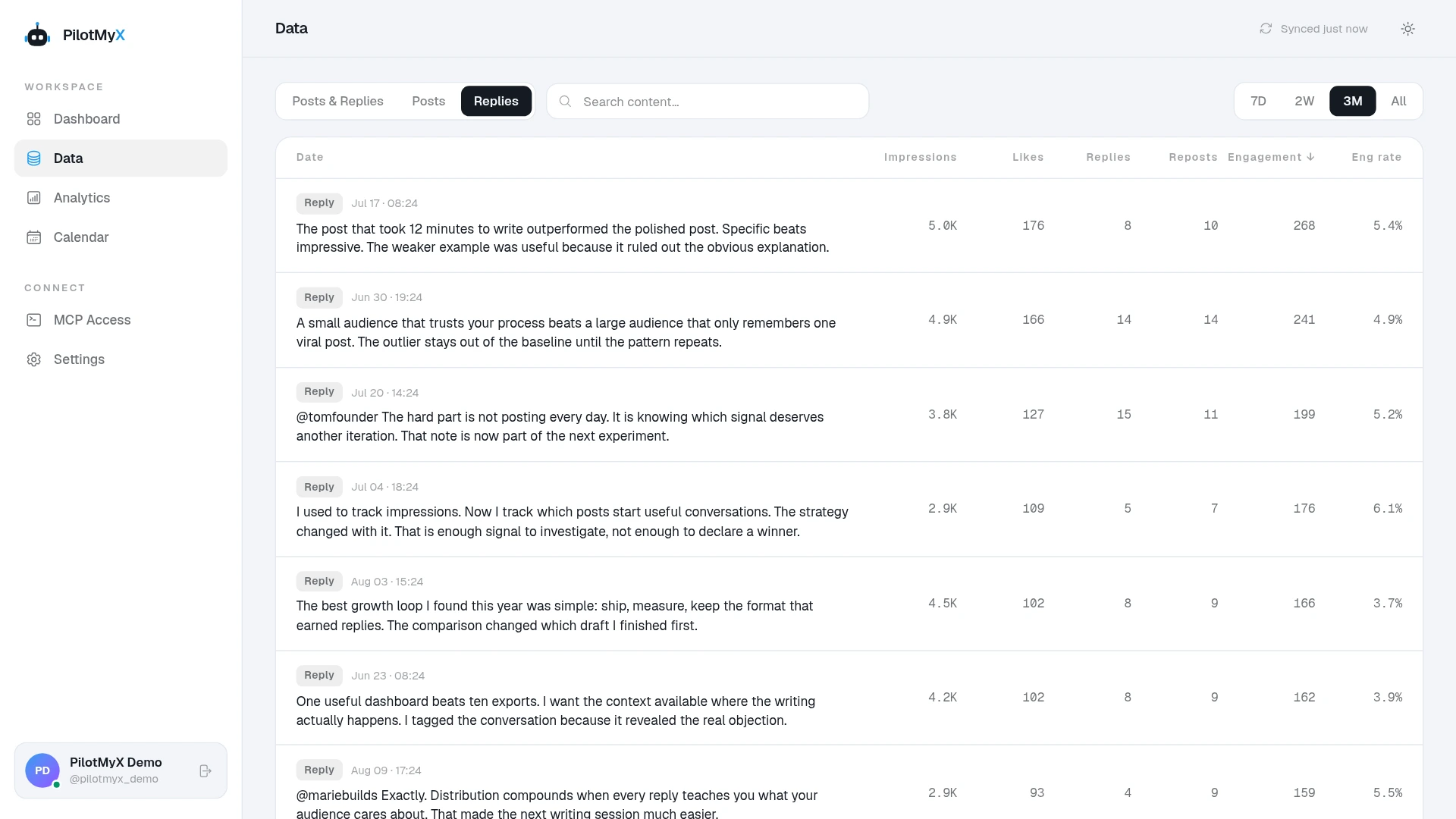
For a short list, ask:
- Does the reply contain a point you understand well enough to explain again?
- Can you recover the original question or the situation that prompted it?
- Is the subject relevant to the people you want following your account?
- Would a new reader benefit from a fuller explanation, rather than the same sentence twice?
Keep one ordinary reply in the mix. The most viewed answer may owe much of its reach to the original author's audience or the timing of the conversation. A less visible answer to a recurring question can still be the better post idea. PilotMyX shows the replies you authored and their available metrics; it does not reconstruct every surrounding conversation for you. Open the original post or use your own notes before drafting.
If you need a way to find better questions in the first place, use the conversation-finding guide. This step begins after you have already joined one.
Keep the question, then change the opening
Write down the reader's problem in one sentence. Next, write the answer you gave, the fact or experience behind it, and what a stranger would need to know. If you cannot verify a detail from the original conversation, leave it out or ask the person involved. A public reply is not permission to publish someone's private business numbers or support issue in a new post.
Here is a fictional example. Someone asks why clients open an invoice but do not pay. You reply:
Before sending more reminders, check whether the payment link works on a phone and whether the due date is clear. A stronger reminder will not fix a broken payment step.
Copied word for word, that answer starts halfway through the problem. A standalone version could be:
Clients opening invoices but not paying? Before sending another reminder, open the invoice on a phone. Can you find the due date and complete the payment? If either step fails, fix that first. Then review the reminder.
The revised post tells a new reader what is happening and what to check. It does not claim that this change increased payments, or that every late invoice has the same cause. The example is a writing exercise, not a customer result.
Some answers belong in their original conversation. The person's circumstances may be too unusual to generalize, or your short reply may already say all you know. Save your calendar for ideas you can explain accurately beyond that exchange.
Review the new post before scheduling it
Read the draft without looking at the original question. If the first sentence is vague, restore the problem. If the post uses "they," "that," or "this" without an obvious reference, name the thing. Remove borrowed claims and account handles that a new reader does not need.
Check your recent posts before adding the draft to your calendar. Have you already published almost the same explanation? X's authenticity policy prohibits repeatedly posting identical or nearly identical content in a duplicative manner. The point of this exercise is a new, self-contained explanation, not a queue of copied replies.
When you approve the text and time, save it as an original post in PilotMyX and put it on the calendar. The earlier reply remains part of your account history. You write the new post; PilotMyX does not convert the reply automatically.
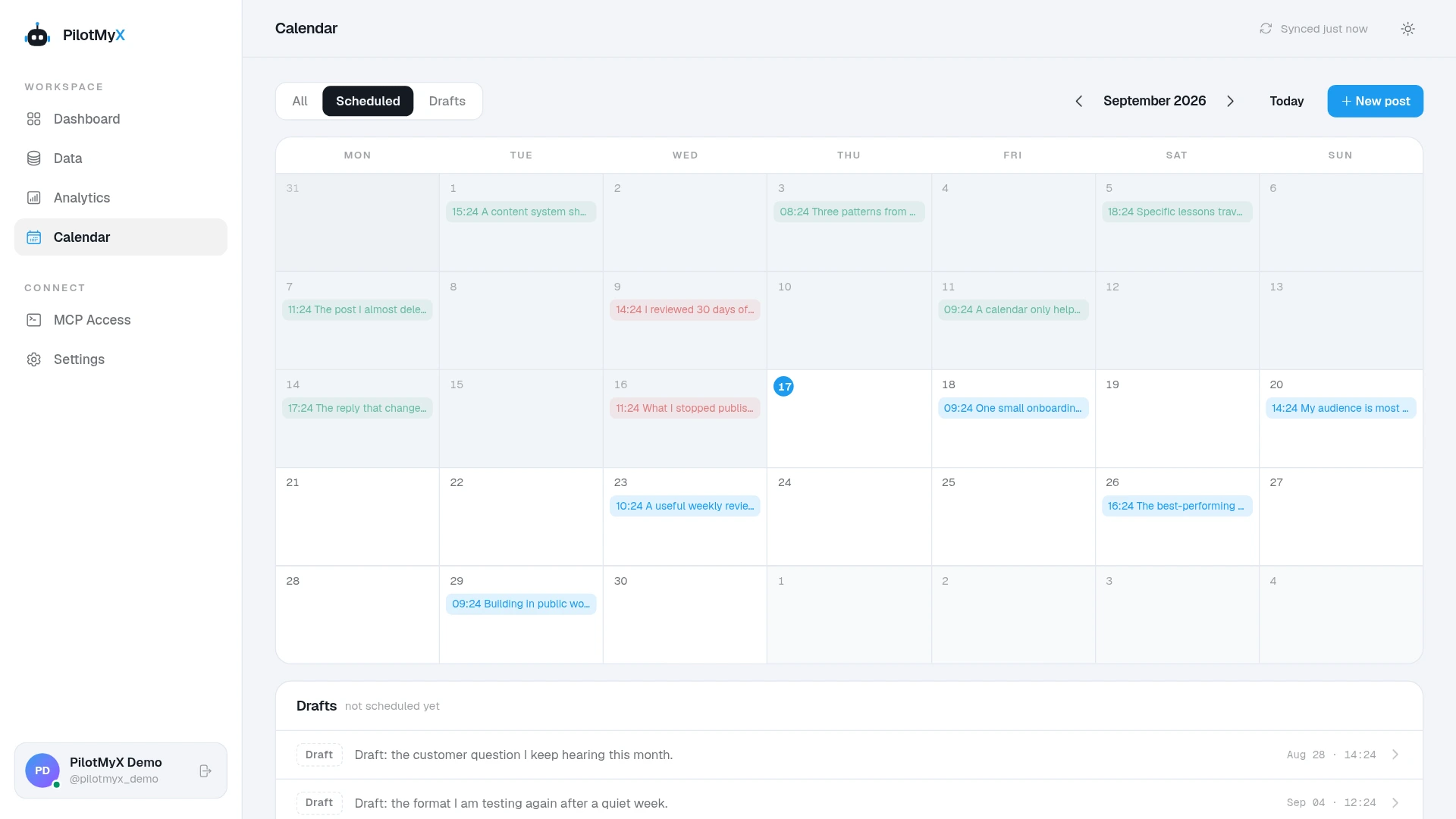
The AI-assisted scheduling guide covers the final draft and approval checks. A posting time can make the work easier to manage, but it cannot make a thin idea worth reading.
Judge the result as a new post
After publication, compare the post with other original posts that had a similar purpose. If you wanted the right people to notice your work, read the responses and available profile clicks alongside impressions. If the goal was to send readers to a guide, check the available URL clicks and what happened on your site. X's metrics documentation distinguishes those actions and defines impressions as appearances, not unique people.
Keep the original reply and the new post in separate groups. The reply reached readers inside another conversation; the post had to introduce its own context. Different results do not prove that one format is universally better, or that rewriting caused a change. The posts-versus-replies guide explains how to compare their different jobs without ranking the two formats by total views alone.
If the post starts useful conversations, note which question readers ask next. That may be the next idea worth explaining. If it does not, read it beside other posts before changing the whole plan. One attempt is a test, not a content strategy.
A prompt for a careful first draft
An agent connected to PilotMyX can shortlist replies from your cached account data and draft a post in your voice. Give it the audience and original conversation yourself when that context is missing. This prompt stops before any write or publication:
I want to turn one answer I wrote on X/Twitter into an original post.
My intended audience is [specific audience]. The subject is [topic].

Use my cached PilotMyX data from the last 28 complete days.
Do not refresh it. List up to three replies I authored about this subject,
with their text, post IDs, dates, available metrics, and data freshness.
Do not choose by impressions alone. Keep replies separate from posts.

For each candidate, explain what question it appears to answer and
what context you cannot verify from my account data. Ask me for the
original post or my notes rather than inventing the conversation.

Once I provide that context, draft one standalone original post.
Preserve my verified point, remove private details and unsupported
results, and show what you changed from the reply. Give me the draft
to review. Do not save, schedule, or publish anything yet.
Before scheduling, let someone read the draft without showing them the original reply. If they cannot tell what question you are answering, restore the missing context.
Use your own account