Make the destination easy to find
Should your Twitter link go in the post or the first reply?
A post can collect impressions while the page you wanted people to visit stays quiet. Decide whether the link is the next action or an optional resource, then review the whole route to your site.
On this page
More views won't help if readers cannot find the link
You put the link in your first reply because you don't want to hurt reach. Now readers have to open the conversation before they can reach your page. That extra step needs a reason, especially when visiting the page is the point of the post.
X says it no longer penalizes posts simply for containing links. You don't need to hide a URL in a reply to avoid the old penalty. Put a Twitter link in the main post when visiting the page is the action you want someone to take. A first reply can still suit an optional source or extra detail when the main post already delivers its value.
This guide covers organic X/Twitter posts. If you already know where the link belongs and need to label traffic in your reports, use the website traffic tracking guide.
X says it no longer penalizes link posts
The link-in-reply habit did not come from nowhere. On November 24, 2024, Paul Graham complained about the deprioritization of tweets containing links. Elon Musk advised him to describe the destination in the main post and put the link in a reply.
On July 29, 2026, Graham asked whether X no longer penalized tweets with links. Musk replied: "We haven’t for over a year." According to his statement, X had already stopped applying that penalty more than a year earlier. He did not give an exact date for the change.
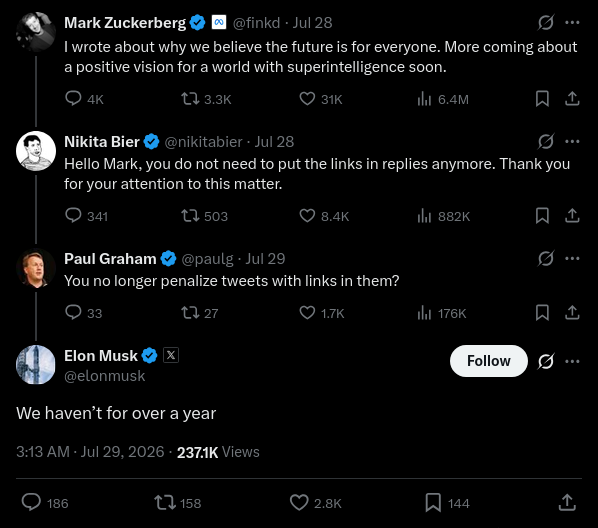
Read Elon Musk's original reply on X.
That makes the old blanket advice to move every link into the first reply outdated. Put the URL where readers can use it. Musk's statement does not promise identical reach for posts with and without links, but the old link penalty is no longer a reason to hide your destination.
Choose the placement from the job of the post
A person scrolling past your post has the words in front of them. When you put the destination there, they can open it directly. When you put it in a reply, they may need to open the conversation and find that reply first. Think about whether that extra step helps the post or just hides the action.
| What the reader came for | Sensible starting placement | What to check |
|---|---|---|
| Register for a workshop, try a tool, or read a specific guide | Link in the main post | The promise matches the destination and the next action is clear |
| Understand a lesson that fits inside the post | Optional supporting link in your reply | The post makes sense without opening the resource |
| Inspect a source behind a claim | Source beside the claim, or clearly identified in a reply | Readers can find and check the evidence |
| Discuss an observation with you | Keep the observation complete; add a link only if it helps | The URL does not replace the point you wanted to discuss |
This is a starting rule for writing, not an algorithm rule. If the entire message is "I launched a tool, link below," the reply holds almost everything the reader needs. Write what the tool helps them do and make the action easy to find.
X's guide to posting a link describes adding a URL directly to a post. Its reply documentation explains that replies belong to conversations and may be ordered differently from their publication order. Being the first reply you wrote is not a guarantee that every reader will see it first.
Separate a placement choice from a claim about reach
Once the old penalty is out of the decision, ask what each placement actually helps readers do. More impressions on the original post are not enough if the link-bearing reply goes unseen.
An announcement with a URL and a personal observation without one are different pieces of writing. If the observation gets more impressions, that comparison cannot isolate the effect of the link. The subject, opening, media, audience, timing, and any outside mention may also differ. Even comparable posts published at different times are not a randomized experiment.
X says shared links pass through its t.co service, including when you use another shortener, and you cannot opt out. That explains how the URL is handled; it is not evidence of a reach penalty.
You can still try both placements on your account. Treat the results as evidence for your next decision, with the limits of that evidence attached. Choose the next post from what readers did rather than turning one successful example into a platform law.
Give people a reason to open the page
Placement cannot carry an invitation that says almost nothing. "New article is live" asks a stranger to leave X before explaining what they will get.
Here are two fictional writing examples for the same guide:
Weak invitation:
New article is live. Link in the replies.

Clearer invitation:
Your signup form can record a button click even when account
creation fails. This guide shows how to check the completed signup
event before you judge a campaign: [guide link]
The second version names the problem and the work the page helps with. It makes no promise of a conversion uplift. Use that structure only if the destination actually teaches the check.
For a post that gives the full lesson on X, the supporting reply might say:
The source for the event definition is here: [source link].
The part to check is whether your event records successful account
creation or only the tap on the signup button.
A useful reply explains why the resource belongs there. "Link below" alone leaves the reader to guess. Before publishing, open the destination on your phone and check that the page delivers what the copy promised.
Review the original post and the link-bearing reply separately
In PilotMyX, open Data, choose a period within your available history, and search for the destination domain. Start with Posts for links in original posts. Then inspect Replies for links you placed in your own conversations. Keep a record of the original post URL and its matching reply so you can review the pair together; a domain search alone does not establish that relationship.
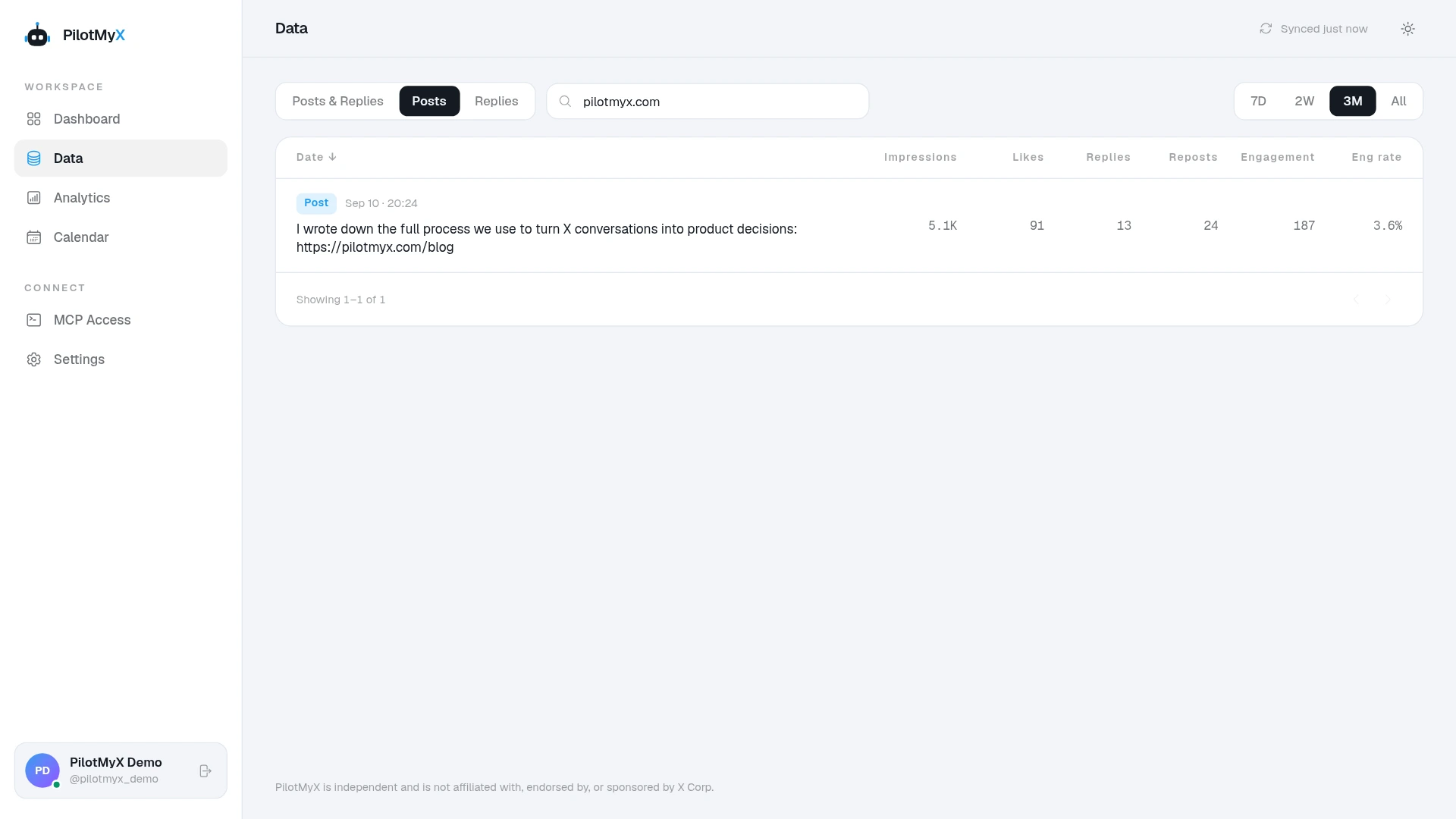
Read the exact text and the available post metrics. X's metrics reference distinguishes impressions from URL clicks and profile clicks. Private click metrics require access to your own content and are available through the API for posts created within the last 30 days. A value that was not available is not a measured zero.
If the URL lives in a reply, the original post's impressions are not impressions of that reply. Keep both items visible in your notes. Use website analytics for recorded visits and completed actions, since PilotMyX's X metrics do not tell you what someone did on your site.
For a practical review, record the placement, original post, link-bearing item, publication date, available URL clicks, and the website outcome you wanted. Give the two placements different tracking labels using the UTM setup guide. Compare similar goals and sufficiently mature posts; the post-age guide explains why a new post and an older one need different treatment.
Count the outcome that made you share the link
Suppose the goal is completed registrations for one workshop. These numbers are a fictional example, not PilotMyX results:
| Observed result | Link in main post | Link in own reply |
|---|---|---|
| Original post impressions | 1,200 | 3,100 |
| Recorded website visits from the tagged link | 28 | 19 |
| Completed registrations attributed to that visit group | 6 | 4 |
The reply placement has more original-post impressions. The main-post placement has more recorded registrations in this example. If registrations are the goal, choosing from impressions alone would favor the wrong result.
The table still cannot prove that placement caused the difference. It omits the reply's own exposure, and the posts may differ in other ways. Website attribution also has limits. Use the comparison to identify a candidate to try again, then read the posts and the destination before changing your routine.
Ask your agent for a placement recommendation
An agent connected to PilotMyX can inspect the relevant posts and replies. Give it the website results separately if those matter to the decision.
I want [audience] to visit [destination] and complete [action].
Help me choose whether the link belongs in my original Twitter
post or a supporting reply.

Use PilotMyX to review [date range] within my available history.
Find my posts and replies containing [domain]. State sample sizes,
publication dates, data freshness, and missing metrics. Where the
data supports it, pair each link-bearing reply with my original
post. Flag pairs you cannot verify.

Read the copy. Compare posts with similar purposes and note
differences in subject, opening, media, age, and timing.
Keep original-post impressions separate from reply impressions.

Website visits and completed actions, if available: [my report].
If that report is absent, do not invent visits or conversions.

Recommend a placement for this specific destination and explain
what the reader must do to reach it. Suggest one original-post
draft using only facts I have supplied. Do not claim a placement
caused reach, create a draft, schedule, or publish anything yet.
After reviewing the recommendation, approve the original post's words, destination, and timing. The AI scheduling guide covers that step. If the post asks someone to visit a page, read it once as a stranger: they should know why to go and where to click.
Use your own account