Start posting on X/Twitter
First tweet ideas: what to post when your account is empty
An empty account can make a small post feel like a big announcement. Pick one thing you can explain honestly, then give a future reader something worth reading.
On this page
Start with something a stranger can use
You've set up the account, opened the composer, and deleted the same introduction several times. Saying hello feels too small. Explaining your entire career feels like too much.
A useful first tweet can share one observation, show a piece of work, or ask a question you genuinely need answered. Add enough context for someone who has never heard of you. You can introduce yourself in that post, but give the reader a subject beyond the fact that you've joined Twitter.
For example, a designer can explain one choice in a menu layout. Someone learning photography can show what they're practicing. Neither needs an audience milestone or a success story to begin.
This is writing advice, not a special format that X promises to distribute. The aim is to publish something you can stand behind and build on.
Pick an idea from facts you already have
Before drafting, write down who you want to reach and one detail you can discuss publicly. That detail might be a decision you made, something you noticed while learning, or a question from your work.
Use the starting point that matches what you actually have:
| What you can truthfully share | A first-post angle |
|---|---|
| A choice you made in a piece of work | Explain the choice and show the relevant detail |
| A skill you're currently practicing | Describe the exercise and what you'll look for |
| A problem you're investigating | State the problem and the next thing you'll check |
| A question you need help deciding | Give the constraint and ask a specific question |
| A service or resource you can already provide | Explain who it's for and what it includes |
If you have no public result yet, write about the question or the work in progress. Don't turn a plan into a completed experiment. A first post doesn't need a claim such as "I've helped hundreds of people" to be interesting.
Five first tweet examples to adapt
These examples are fictional illustrations, not posts from real customers or claims about the founder. Each fits within a standard 280-character text post. Replace the situation with your own facts rather than copying a made-up experience.
1. Explain one choice in your work
I design menus for small cafés. In this breakfast layout, I put the price beside the dish instead of in a separate column. Here's the section I'm working on. I want ordering to take less scanning.
Use this when you have work you can show and permission to share it. Attach the actual layout if the image helps the explanation. The post names the work and the decision; it doesn't claim the change increased sales.
If your screenshot includes a client's name, private information, or unfinished work they haven't approved for publication, choose another example. Our Twitter image guide explains when an image adds useful evidence.
2. Start a learning record with a real exercise
I'm learning product photography with a desk lamp and a white card. This week I'm practicing the same mug from three angles so I can compare the shadows. I'll share the shots and what I change.
You don't need to present yourself as an expert. Name the exercise and the constraints that make it yours. Keep the promise small enough to follow through on; there's no need to announce daily lessons if you can't maintain that pace.
3. Describe a problem you're investigating
I'm building a booking form for a local repair shop. The awkward part is asking for a device model when the customer doesn't know it. I'm testing a photo-upload option next; I don't have results yet.
The interesting detail is the uncertainty, not a fabricated outcome. If you've only sketched the idea, say that instead of calling it a test. A later post can show what you tried and what you observed.
4. Ask a question with enough context to answer
I teach evening watercolor classes for adults. I'm planning a two-hour session for people who've never painted. Would you start with color mixing or one small finished painting, and why?
This gives relevant readers a decision to help with. "What should I post?" makes them do the work of defining your account. A focused question is useful only if you really want the answers; you don't need to end every post with one.
5. Introduce an offer by explaining its scope
I edit audio for independent podcasts. A basic cleanup includes background-noise reduction, volume balancing, and removing long pauses. I'll use this account to show short before-and-after examples with permission.
A business account can say what it sells. Be clear about the audience and the work instead of announcing that something "revolutionary" has arrived. Only promise examples you can share, and don't imply that a service already has customers when it doesn't.
Give the draft a quick check, then publish
Read the post without your bio beside it. Can a stranger tell what you're talking about? Replace a vague phrase such as "my journey" with the actual subject. Our Twitter hooks guide can help if the first line delays that context.
Check every factual claim, image, and link. Cut details the reader doesn't need yet. You can write a plain introduction if that's what you want; adding a concrete subject usually gives you more to discuss afterward.
To publish directly on X, open the composer, write the message, add any relevant media, and select Post. X's posting instructions describe the standard 280-character post and the supported media. A short text post is enough for these examples.
Your profile should make the same subject recognizable. X lets you edit your bio and pin a post that visitors see first on the profile; see its profile customization guide. You can change the pin later. Don't make choosing a permanent introduction a condition for publishing anything.
Use an agent to shape your facts, not invent a history
An empty account has no publishing history to analyze. Give the agent your context instead of asking it to infer your voice, audience, or past results from data that doesn't exist.
Help me write my first original X/Twitter post.
The people I want to reach: [specific audience].
What I can discuss publicly: [a real observation, piece of work, question, or offer].
Details I can verify: [facts and constraints].
What I haven't done or measured yet: [unknowns].
How I naturally explain this: [a few sentences in my own words].

Ask for any missing fact before drafting. Suggest two different angles and explain who each would help. Use only the facts I supplied. Don't invent customers, results, personal experiences, or an account history.

Write each draft within 280 characters. Show the exact text and any proposed image or link separately. Don't create drafts in PilotMyX, schedule, refresh data, or publish anything yet. Wait for my approval.
If you're using PilotMyX, you can save the approved text as a draft and decide separately whether to publish now or schedule it. The connected agent handles writing; PilotMyX keeps drafts and publication states.
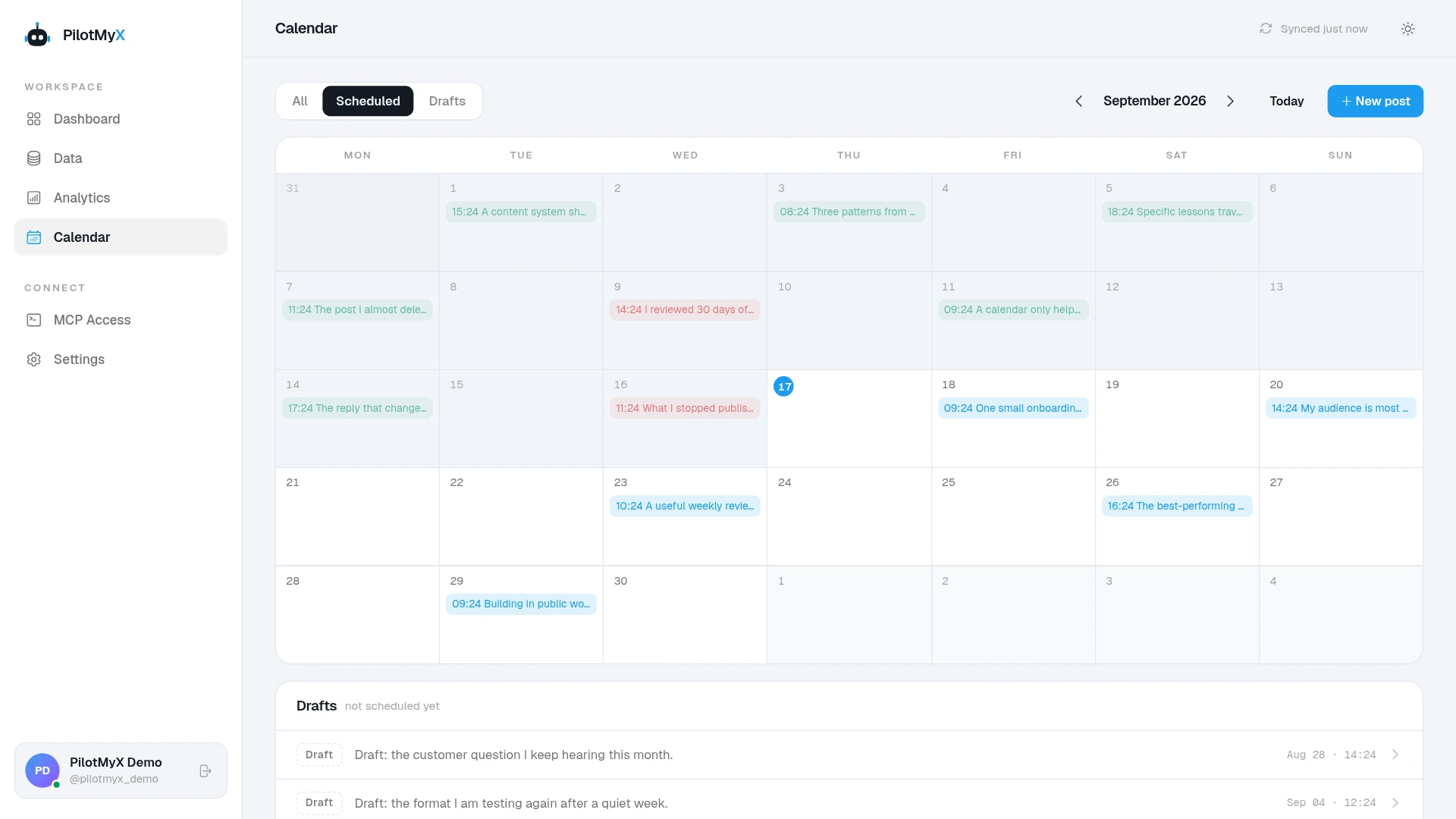
A saved draft isn't proof that a post went live. Check the publication's final status after sending it. For the approval and timing workflow, use the guide to scheduling Twitter posts with AI.
Have a second idea ready without turning day one into a campaign
Choose a follow-up that continues the same subject: the layout detail you couldn't fit, the photo you practiced, or the answer to your original question. You don't need to fill a month of slots before the first post is useful.
With few followers, relevant replies can help people encounter your perspective in conversations they already read. Your own posts then give a profile visitor something to explore. That is a practical distinction, not a guarantee of impressions or follows. The guide to growing from zero covers that broader routine.
Avoid pasting the introduction into unrelated replies or repeatedly deleting and reposting it to seek attention. X's authenticity policy prohibits disruptive content spam, including repetitive copies and bulk unsolicited replies.
If the first post gets little response, one observation isn't enough to judge your topic. Continue with something real you can share, take part in relevant conversations, and review the actual responses as you collect them.
Use your own account