Stop generating ads you cannot learn from
How to write Twitter ads with AI that sound like you
Twenty polished variations are useless when each one changes the promise, proof, and call to action. Start with one approved brief, then make every alternative answer one question.
Twenty AI-generated ads can leave you with nothing to learn
Ask an AI agent for twenty Twitter ads and it will probably oblige. The problem starts when every option changes the opening, promise, proof, and call to action at once. Even if one ad does better, you will not know which decision mattered.
To write Twitter ads with AI, begin with one approved customer problem, one supportable promise, and one destination. Write a control that makes those choices clear. Then create one or two alternatives where each changes a single creative decision. The agent speeds up the work; the brief keeps it honest and the comparison gives you something useful to learn.
This guide covers the copy and creative-testing workflow. The separate X Ads with AI guide covers campaign setup, permissions, reporting, and budget controls.
Start with the frustration, not the product vocabulary
An ad has to make sense to someone who did not attend your product meeting. Describe the moment your customer wants to escape before naming the feature you built.
Use a short brief with fields you can check:
| Decision | What to write down | What to leave out |
|---|---|---|
| Reader | The person facing the problem now | A broad audience such as “business owners” |
| Problem | The task, delay, or uncertainty they recognize | Internal feature names |
| Promise | The specific improvement your offer can support | A result you have not measured |
| Proof | A product fact, demonstration, or verified customer fact | Invented praise, urgency, or statistics |
| Destination | The page or profile that continues the same promise | A generic homepage with no next step |
| Desired action | The one action you want after the impression | Several competing calls to action |
| Test question | The creative decision you want to compare | “Which ad is best?” |
Imagine, as a fictional example, software that helps independent shops handle returns. The customer problem is not “fragmented reverse-logistics infrastructure.” It is opening three tabs and a spreadsheet to answer one shopper. The second version gives the writer a scene people can recognize.
Before drafting, list claims the agent must not add. If nobody has measured hours saved, the ad cannot promise that the product “saves hours every week.” A more polished sentence is still wrong when its evidence is missing.
Use your own writing as a constraint
Voice matters because an ad that sounds detached from the rest of your account creates a jarring handoff. It does not mean copying an old post or forcing a catchphrase into every variation.
Select a small set of representative posts and replies you would still stand behind. Include ordinary posts, not only the biggest results. Ask the agent to identify decisions it can point to in the examples: how you describe a problem, how much context you give, which words you avoid, and whether you end with a direct action.
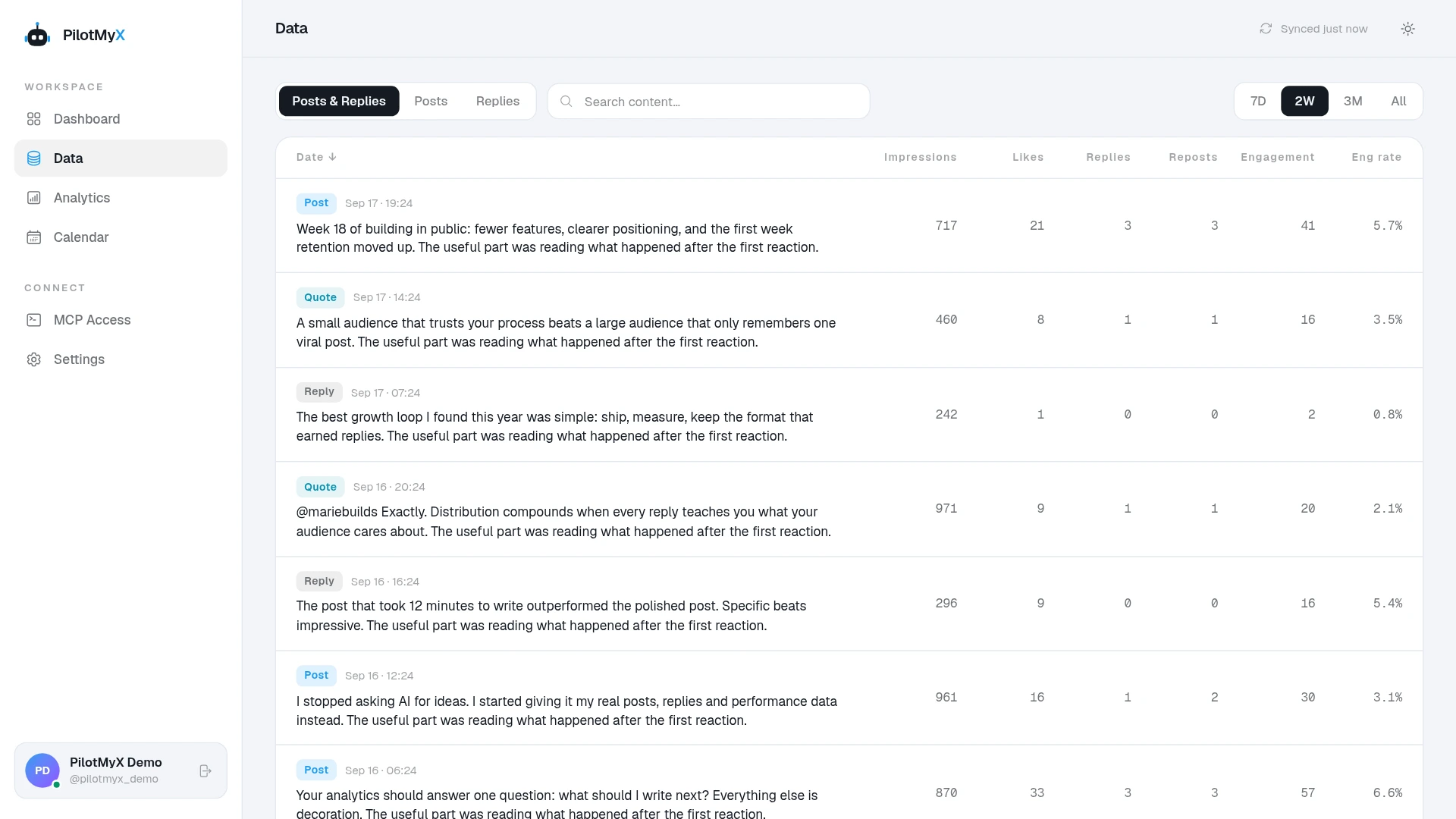
PilotMyX lets a connected agent read your published posts and your replies alongside their available account data. Your replies can be useful voice evidence because they show how you explain a problem in conversation. They are not ads to schedule, and engagement on an example does not prove its wording will work in paid distribution.
If you need to build the voice note first, use the guide to writing Twitter posts with AI in your voice. For this workflow, the note is an input to the ad brief. It is not the test variable.
Write the control before the alternatives
The control is the clearest version of your current idea. It is not a guaranteed winner or the ad you expect the platform to favor. Its job is to give every alternative a stable point of comparison.
For the fictional returns product, the approved facts are:
- A shop employee may use three tabs and a spreadsheet to follow a return.
- The product puts return cases in one queue.
- There is no verified claim about time saved, revenue, or customer satisfaction.
- The destination shows how the queue works.
A control could be:
Handling one return should not mean opening three tabs and a spreadsheet. Put every case in one queue and see how it works.
Now choose one decision to challenge. An opening variant can change the first sentence while preserving the audience, promise, proof, and destination:
Still opening three tabs and a spreadsheet for one return? Put every case in one queue and see how it works.
A product-led variant would be a different comparison. It might open with the queue instead of the frustration, but it should not also add a discount, a testimonial, and a stronger promise. Save those for separate questions.
X recommends concise, natural copy with one clear action in its creative best practices. Its current recommendation of 50 to 100 characters is guidance, not a guarantee or a reason to remove essential context. Text Ads can contain up to 280 characters, and a link counts as 23 characters, according to the creative specifications. Check the current format rules before launch because availability can vary.
Rotation and A/B testing answer different questions
Putting several ads in one ad group does not give them equal exposure. X says it automatically optimizes ads within an ad group toward the creative it considers most effective. That can be useful for delivery, but it is not the same design as a controlled A/B test.
| Setup | What happens | What you can reasonably say |
|---|---|---|
| Several ads in one ad group | Delivery is auto-optimized across the creatives | One creative received more delivery or produced different directional results; exposure was not controlled |
| X A/B test | People are randomized into mutually exclusive audience groups while the tested creative changes | The cells were designed for a cleaner creative comparison, subject to enough relevant events and a valid setup |
| Ads run at different times or with different targeting | Creative, audience, timing, or auction conditions may all differ | The results are observations, not a clean creative comparison |
X's A/B testing documentation says creative is the supported test variable and other campaign parameters should remain equal. It also describes randomized, mutually exclusive audience groups. By contrast, the ad groups documentation explains the automatic optimization that happens when several ads share an ad group.
Name the setup correctly in your notes. Calling every pair of ads an “A/B test” makes the report sound more certain than the design deserves.
With a small budget, test fewer ideas
A small budget does not become more informative when it is split across ten variations. Pick the decision that would change what you write next, and compare the fewest cells needed to answer it.
For the returns example, the first question might be: does a direct description of the frustrating task or a question-based opening produce more of the campaign's intended action? Both versions keep the same offer, destination, audience, and campaign settings.
X does not publish one minimum budget that makes every A/B test conclusive. Its documentation says event volume affects the ability to declare a winner and recommends running a test for at least two weeks. That is platform guidance, not a promise that two weeks will always be enough. A rare conversion may need more evidence than a common click.
Choose the primary measure before launch. If the destination is a signup page, a cheaper engagement is not automatically the useful result. Keep advertising delivery, site visits, and completed signups tied to their respective sources. When the event count is too thin to support a decision, record the outcome as inconclusive rather than forcing a winner.
Give your agent a bounded writing job
The following prompt keeps research, drafting, and action separate. Replace every bracketed field before using it.
Help me write Twitter ads for this approved brief.

Reader: [specific customer]
Problem they recognize: [specific task, delay, or frustration]
Offer and destination: [offer plus exact page]
Supportable promise: [what I can honestly say]
Proof available: [verified product or customer evidence]
Claims that are unknown or prohibited: [unmeasured results and details not to invent]
Desired action: [one action]
Primary measure: [the campaign result connected to that action]
Test question: [one creative decision]

Use my connected PilotMyX account to review representative original posts and my own replies for voice. State the date range and the examples you used. Keep the facts in this brief fixed and do not infer an ad claim from organic engagement.

Write one control and up to two alternatives. For each alternative, name the single creative decision that changed and confirm which audience, promise, proof, destination, and call to action stayed the same. If a requested claim lacks evidence, flag it instead of filling the gap.

Keep the copy concise and understandable without my account's backstory. Check each version against the current format limit, but do not cut necessary context just to reach a target length.

Return the drafts for review. Do not save, publish, schedule, create an ad post, promote a post, create a campaign, activate anything, or spend money.
Review the output line by line. Check that the alternatives really changed only the named decision. AI-generated copy often smuggles in a stronger claim while “tightening” a sentence. Put the factual wording back before you judge the style.
Keep organic publication and ad-only creation distinct
After you approve the exact text, choose how it should reach X.
For an organic post you may later promote, PilotMyX can prepare and schedule the approved original. Wait until it is published and retain its actual X post ID. A saved or scheduled draft is not yet a published post that can be associated with an ad.
For an ad-only post, the official X Ads MCP reference currently lists create_ad_post. It also lists promote_post for associating an eligible post with advertising. Review the exact saved content and IDs before any promotion or campaign change. The official X Ads MCP reference does not list a dedicated A/B-test tool, so do not assume an agent can configure that experiment through MCP. If the required setup is unavailable through the connected tools, have the agent return a manual checklist instead of silently substituting a standard ad group.
This preparation prompt keeps the next step reviewable:
Prepare the approved creative below for X Ads account [account ID]. Do not activate a campaign or spend money.

Approved text: [exact text]
Destination: [exact URL]
Creative route: [existing published post ID or ad-only post]
Intended comparison: [standard ad-group rotation or X A/B test]

First inspect the available official X Ads tools and the account's current state. Do not claim A/B-test support unless the connected toolset exposes it. Check for an existing identical creative before creating anything.

If this is an existing post, verify its actual X post ID and eligibility. If this is an ad-only post and creation is authorized, create only the approved text and destination. Read back the saved object and return its ID, text, URL, status, and any mismatch.

Keep every campaign and ad group paused. Do not promote the post, create or activate a campaign, change a budget, or create a substitute setup. If a required action is unavailable, stop and provide the exact manual steps still needed.
The distinction in that prompt matters. A paused object can be inspected. An activated campaign can spend.
Read the result without rewriting history
Before launch, save the control, each variation, the one changed decision, campaign settings, audience, destination, primary measure, and reporting window. After the comparison, use the setup you actually ran when describing what happened.
If you used X's A/B test, read its reported winning cell, event volume, cost per event, and win chance together. X says its result uses a Bayesian method. A high win chance for a secondary metric does not replace the primary business outcome you selected.
If you used ordinary ad-group rotation, report it as rotation. Note the uneven delivery and treat the result as directional. If one ad barely ran, the honest conclusion may be that the platform did not provide a useful comparison.
Do not let the agent turn “inconclusive” into a dramatic lesson. The next useful move may be to keep the brief, remove a weak variation, or wait for enough evidence. Change one thing only when the previous result gives you a reason.
A review checklist before any spend
- Does the opening name a problem the intended reader recognizes?
- Can every promise and proof be traced to evidence you approved?
- Does each variation change only the decision named in the test question?
- Does the destination continue the same promise as the ad?
- Is the setup ordinary rotation or a genuine X A/B test?
- Is the primary measure defined before launch?
- Are the saved text, post ID, URL, campaign status, and budget settings verified?
Start with the brief, not a request for more copy. Connect PilotMyX to your agent, select writing examples that still sound like you, and build one control around a real customer frustration. A smaller set of honest ads will teach you more than a folder full of interchangeable AI variations.
Use your own account