Stop building audiences around famous accounts
X Ads follower lookalikes: how to choose accounts to target
A big follower count can hide a weak audience match. Choose reference accounts around the problem your customer already cares about, then test each group separately.
A famous account can give you a very expensive audience
You pick a few huge accounts in your market, launch a Twitter ad, and reach plenty of people who were never likely to care about your offer. The handles looked credible. The audience fit was never clear.
X Ads follower lookalike targeting works best when each reference account represents a specific customer interest. Start with the problem your buyer wants solved, find accounts followed for that reason, and keep different audience hypotheses in separate groups. Account size is useful only after relevance.
This guide shows how to choose and document those accounts with an AI agent, PilotMyX, and the official X Ads MCP. It does not require access to another account's follower list.
What does follower lookalike targeting actually mean?
X says follower lookalike targeting reaches people whose interests are similar to an account's followers. X uses signals such as what people repost, click, and publish to assess that similarity.
It does not mean your ad is delivered to the exact followers of a competitor or creator. The handle is a clue for X's audience model, not a customer list you get to inspect or export.
That distinction changes the research question. Don't ask, "Which account has the most followers?" Ask, "What do people follow this account to learn, do, or become?"
X also describes handles, interests, and keywords as additive targeting. A person who matches any selected handle or interest may be eligible, so adding more criteria usually broadens the potential audience. It does not narrow the campaign to people who match every handle.
Define the buyer before collecting handles
Write a one-sentence audience brief before opening a spreadsheet or asking an agent to research accounts:
We want to reach [specific people] who are trying to [job] but struggle with [recurring problem], so they care about [useful promise].
Imagine you sell invoicing software for freelance designers. "Freelancers" is still broad. A more useful brief is:
We want to reach freelance designers who lose time chasing overdue invoices, so they care about getting paid without damaging client relationships.
Now the agent has something to judge. An account about freelance pricing may overlap with that problem. A general entrepreneurship celebrity may have a much larger audience, but no clear reason for that audience to care about invoice follow-up.
The same brief should guide the promoted post. An audience built around payment problems is a poor match for an ad about your latest dashboard redesign. Use the post-promotion selection guide to check that fit before spending.
Build separate account groups around one reason to care
Look for reference accounts in distinct categories. Each category should represent a different, testable route to the buyer:
| Account group | Why the right buyer might follow | Main mismatch to check |
|---|---|---|
| Practitioners | They do the same work and share day-to-day methods | Their audience may be peers, students, or fans rather than buyers |
| Problem educators | They teach how to solve the pain your product addresses | The topic may be relevant while the audience has no need for your offer |
| Industry communities and media | They curate news and practical advice for the market | A broad publication may attract many roles outside your customer profile |
| Adjacent tools and services | Their users have a related workflow before or after yours | Product adjacency does not prove the same buyer or budget |
Don't mix every category into one unexplained list. X recommends segmenting handle campaigns by category because it makes the results easier to interpret. A practitioner group and an industry-media group are two audience hypotheses, even when some people overlap.
Use public evidence to understand each candidate: recent posts, profile positioning, recurring subjects, audience language, and the problems discussed in replies. Keep the source and date. A stale bio or one viral post is weak evidence for what an account's audience usually expects.
Give every candidate a reason, not just a handle
Create a short research card for each account:
| Field | What to record |
|---|---|
| Audience reason | Why the intended buyer would follow this account |
| Repeated subject | The problem or workflow that appears across recent posts |
| Evidence | Two or three dated public examples, not a label inferred from the username |
| Offer connection | How that interest leads naturally to the promoted post and destination |
| Mismatch risk | Why the audience could still be too broad, too junior, or interested for another reason |
| Decision | Keep, reject, or investigate further, with one sentence of justification |
Follower count belongs on the card, but it should not decide the card. X's own guidance warns that millions of followers around a famous individual or company may not align around a topic relevant to your business.
For the hypothetical invoicing product, an account that repeatedly helps independent designers price projects and handle clients has a defensible connection. An account that occasionally mentions freelancing between broad motivational posts does not become a strong candidate because it is popular.
Avoid turning the exercise into a made-up precision score. A weighted score can hide weak inputs behind a decimal. A plain-language keep or reject decision makes the assumption easier to review.
Use your own conversations to sharpen the brief
PilotMyX gives your agent the posts and replies from your connected account. That history can reveal the phrases you use, the objections people raise, and the customer problems you already discuss. It cannot search every account on X or inspect another account's followers.
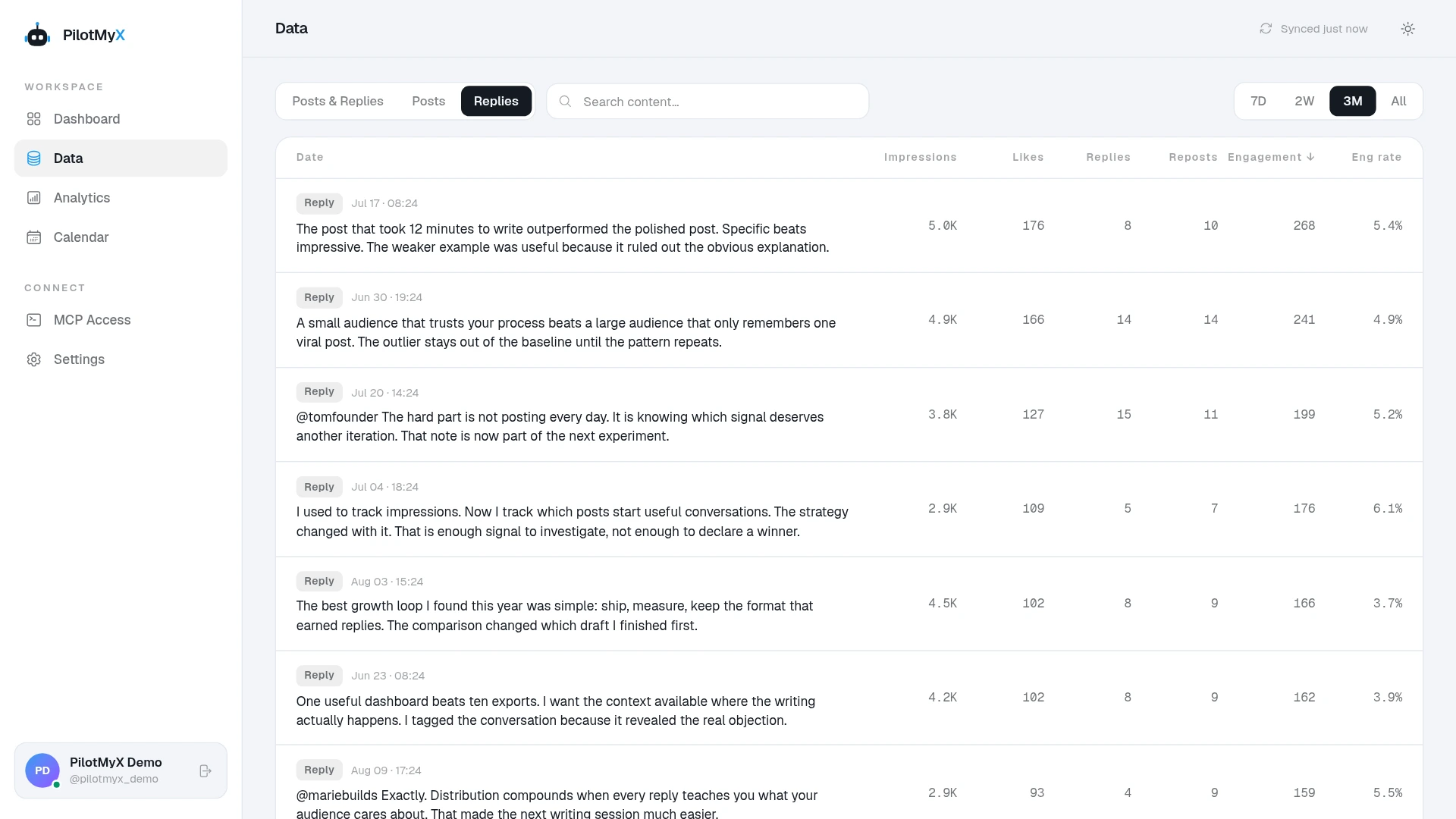
Search your own history for the customer problem, then read the matching conversations. In the invoicing example, terms such as "late payment," "payment reminder," and "scope change" may surface different parts of the workflow. Treat the results as context from your account, not a market-size study.
Separate two jobs:
- PilotMyX helps the agent understand what your account knows and how your audience describes the problem.
- Public research and the X Ads connection help the agent evaluate candidate reference accounts and the targeting available to your ad account.
That boundary prevents a useful account search from being misrepresented as a global prospect database.
Ask your agent for a reviewable shortlist
Start in read-only mode. Give the agent your brief, candidate handles, and permission to read your PilotMyX history and available X Ads settings. If it can browse public pages, require dated sources for every candidate. If it cannot, provide the source material yourself.
Help me prepare follower lookalike targeting for an X Ads campaign. Keep every action read-only.

Offer: [product or service]
Intended buyer: [specific person or role]
Recurring problem: [problem they want solved]
Promoted post and destination: [URLs]
Markets and languages: [scope]
Candidate reference accounts: [handles, if I already have them]

Use PilotMyX only to review posts and replies from my connected account. Find recurring language, objections, and examples related to the problem. Report the search terms, date range, sample size, and data freshness. Do not treat my account as a market benchmark.

For each candidate account, use dated public evidence to explain why the intended buyer would follow it, the repeated subject that connects to the offer, and the main mismatch risk. Do not infer audience fit from follower count or one viral post. Do not claim access to the account's exact followers.

Group the candidates by one reason to care, such as practitioners, problem educators, industry media, or adjacent tools. Keep categories separate so they can be tested as distinct audience hypotheses. Return keep, reject, or investigate further with a plain-language reason for each handle.

Using the official X Ads connection, inspect the current targeting criteria and any audience-estimate capability available to this ad account. Explain what each returned estimate includes and excludes. Do not create targeting, campaigns, line items, audiences, ads, or spending changes.

Finish with a shortlist, rejected candidates, missing evidence, and the exact settings I should review before authorizing a campaign. If a capability or account is unavailable, say so instead of substituting a guess.
The official X Ads MCP reference lists tools for reading targeting criteria and estimating an audience. That explains what the server can do in general, not what every ad account can use in every campaign. Have the agent report the response it actually receives.
Check audience estimates without pretending they are additive
An audience estimate is a feasibility check, not a forecast of customers. Record the criteria used, geography, language, device limits, exclusions, timestamp, and any expansion setting beside the estimate. X's current campaign targeting overview lists follower lookalikes among its audience features, but policies and account eligibility can still affect what you can use.
X notes that the handle estimate shown during campaign setup does not account for location, gender, age, or device targeting. That makes the number useful for orientation, but not interchangeable with the final eligible audience.
Expect overlap. The same person can resemble followers of several selected accounts. X warns that handle-level impressions, engagements, or spend can add up to more than the campaign total because one person may appear in multiple breakdown rows. Don't sum those rows and call the result unique reach.
Before launch, verify:
- The promoted post solves the problem in the audience brief.
- Every selected account has a documented reason to represent that interest.
- Different account categories remain distinguishable in the campaign structure.
- Geography, language, age, device, exclusions, and audience expansion match the approved plan.
- The actual targeting returned by X matches the shortlist; an agent's proposal is not proof of saved settings.
For the complete approval and launch sequence, follow the X Ads with AI guide. Keep campaigns and line items paused until you have reviewed the exact settings and spending limits.
Learn which audience idea deserved another test
After delivery starts, compare groups using the campaign objective and the business result you defined. Handle-level engagement can help locate promising interest clusters, but it does not identify an individual customer's reason for buying.
Keep the promoted post, offer, destination, and measurement setup stable enough to interpret the audience test. If you change the creative and target group together, you won't know which hypothesis earned the next experiment.
The first useful outcome may be a rejection. Discovering that a large industry-media audience clicks without taking the intended action can save more budget than forcing the agent to declare a winner.
Start with one customer problem and one defensible account category. Use PilotMyX to sharpen the language from your own conversations, document why each reference account belongs, and ask X for the audience it can actually build before you authorize any spend.
Use your own account