Give new readers a reason to stay
How to use Twitter ads to grow your audience
More people see your post, but few stick around. Build a Twitter ads test around the people you want to reach and what they'll find when they open your profile.
Give profile visitors a reason to follow
You pay to put a post in front of more people. Some open your profile, see a vague bio and a few unrelated updates, and leave. Spending more won't explain what they should follow you for.
To use Twitter ads for follower growth, make the promoted post a useful introduction to your account. Give the intended reader a clear reason to follow, support that reason in your profile and recent posts, and measure account growth separately from ad engagement.
This guide shows how to plan that test with PilotMyX and an AI agent. It covers the profile, the objective you select in X Ads, and the evidence to review before you spend more. For the broader campaign process, use the X Ads with AI guide.
Define who should want your next post
"People interested in business" is too broad to guide a useful campaign. Describe someone with a problem you regularly help solve.
For example, imagine you build invoicing software for freelance designers. You want to reach designers who lose time chasing overdue payments. Your account could earn their attention with clear invoice wording, examples of payment reminders, and explanations of what to do when a client goes quiet.
That gives the ad and the profile a shared purpose. A post about sending a useful reminder introduces the subject. A bio about getting paid for design work explains why the reader should stay. Recent posts demonstrate that you can keep helping.
Write a sentence you can defend:
I want [specific people] to follow because I regularly help them [solve a recurring problem].
If your immediate need is product signups, put that in the brief instead. Someone can become a customer without following you. Don't replace a sales goal with a follower target just because the follower count is easier to see.
Choose an available objective, not an old tutorial's button
X's campaign objectives overview, checked on September 19, 2026, lists reach, engagement, website traffic, and other objectives, but does not list Followers. Some other X pages still reference follower campaigns. Check the choices available in your Ads Manager and the current API contract before asking an agent to create one.
Keep the desired business outcome separate from the delivery objective:
| Campaign option | What it is designed to do | What you still need to evaluate |
|---|---|---|
| Engagement | Encourage interactions with the promoted post | Whether those interactions lead to interest in your account |
| Reach | Put the ad in front of more people | Whether the exposure produces meaningful attention |
| Website traffic | Send people toward a website | Whether they arrive and take a useful action there |
| Website conversions | Pursue a defined website conversion | Whether the recorded conversions support your business goal |
X describes profile visits as one of several interactions associated with engagement campaigns. That makes engagement an option to evaluate when introducing useful account content. It doesn't turn every result into a follow or mean the campaign optimizes only for profile visits.
The reach objective is about how many people see the ad. A low cost per thousand impressions can be useful for awareness, but it doesn't establish that the audience wants your next post.
Choose the option whose behavior fits your test. If the available options can't pursue your intended outcome directly, record the intermediate action you are buying and the separate outcome you'll observe. Your agent should flag that gap before launch.
Check the ad and profile together
Open your profile as a new reader would. The promoted post should make sense without knowing your product or your personal story. Then check what someone finds after clicking your name.
Your bio should explain whom you help and what you publish. The pinned post should show useful work, a clear explanation, or a current offer. Recent posts should give some evidence that the topic in the ad is something you cover regularly. The pinned-post guide helps with that choice.
In the freelance invoicing example, an ad about late payment would be a poor match for a profile filled entirely with software release notes. The visitor came for help getting paid. They should be able to find it.
An invitation such as "Follow for practical ways to handle overdue invoices" is a possible fit for that hypothetical account, provided the posts deliver on it. "Follow for daily insights" tells the visitor very little. Use your actual subject and cadence; don't promise daily advice if that isn't how you publish.
Use PilotMyX to inspect your recent posts beside their available results. For example, compare the last 14 complete days with the previous 14, keeping original posts and your replies separate. Look at the subjects, impressions, available profile visits, and the number of posts behind each pattern. Read the posts before deciding that a topic attracts the audience you want.
These are metrics for content published in those periods, measured at the available capture times. They aren't a count of every interaction that happened during each fortnight. Keep differences in post age and missing metrics visible. If you need to choose the ad itself, use the post-promotion selection guide.
Target people who care about the subject
Build targeting around the reader you described, including relevant locations and languages. An enormous audience attached to a famous account is not automatically a good fit for a specific customer problem.
X's follower look-alike targeting looks for people with interests similar to an account's followers. It doesn't promise delivery to that exact follower list. Choose reference accounts because of the subject their audience follows them for, not simply their size.
Use the follower lookalike account-selection guide to turn that principle into a sourced shortlist and separate audience groups.
For the invoicing example, a community about running a freelance design business is a more specific hypothesis than a celebrity entrepreneur. That is a reason to test the audience, not proof that its members will become customers.
Keep the first test explainable. If you change the audience, promoted post, profile promise, and budget together, you won't know which change deserves a second test. Record what you changed and what stayed the same.
Prepare the posts people will see next
Before the ad runs, decide what you'll publish during the test. You don't need a sudden burst of posts. You need material that gives interested visitors a reason to keep reading.
PilotMyX helps you turn the patterns you found into drafts and a schedule. Give your agent the examples, the customer problem, and facts you can support. Review the proposed posts before saving or scheduling them.
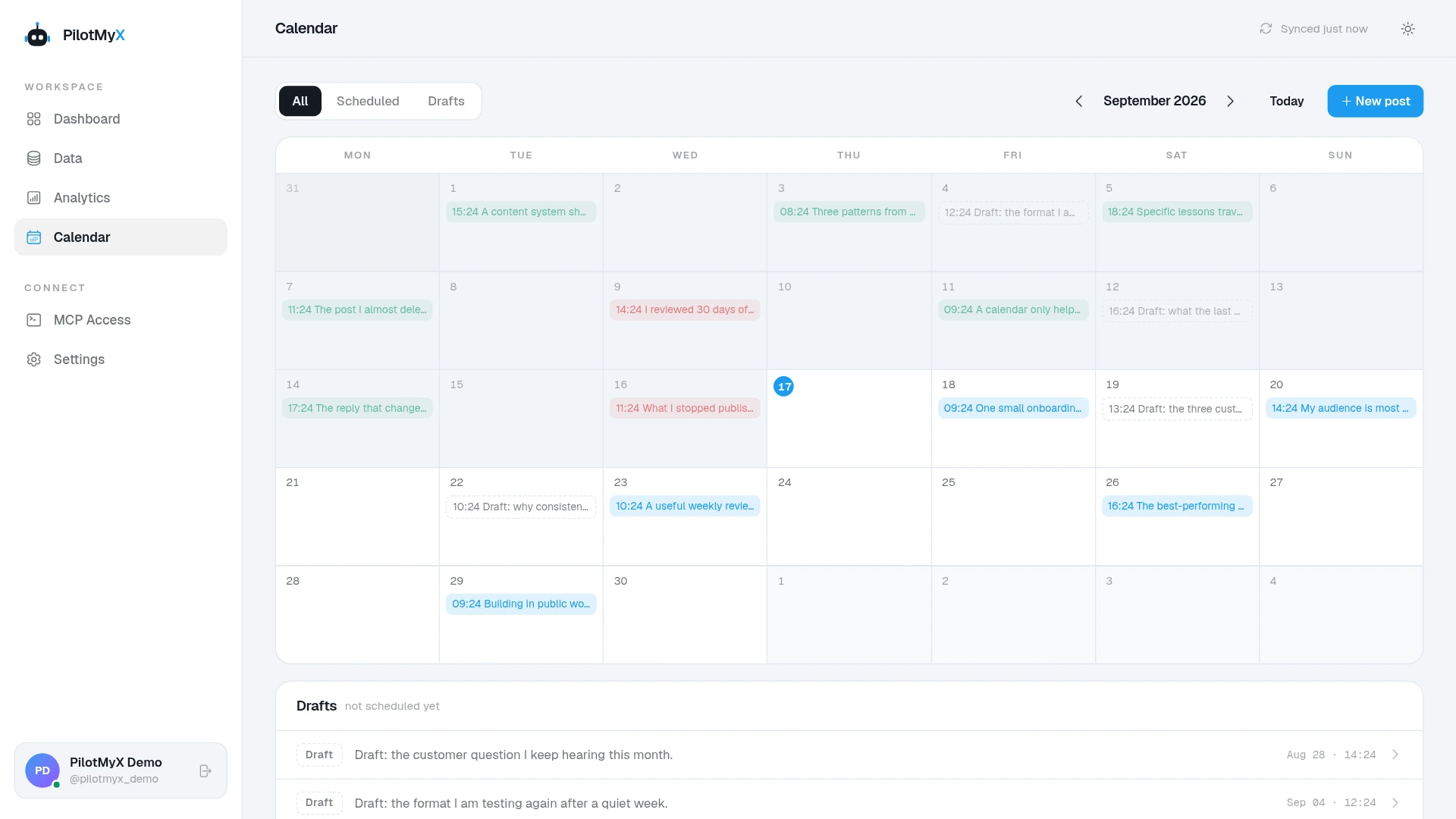
For the hypothetical designer audience, that might mean a payment-reminder example followed by an explanation of a common invoice mistake. The ad introduces a useful subject; the next posts continue it. Choose a cadence you can maintain after the campaign ends.
Measure growth without giving the ad credit for everything
Before launch, record the campaign ID, objective, promoted post, audience settings, approved spending limit, and review dates. Keep a dated snapshot of the profile and follower count too. Define a small test you can afford; there is no universal budget that buys a useful follower.
Separate the sources in your review:
| Observation | Where to get it | What it tells you |
|---|---|---|
| Spend, delivery, and objective results | X Ads | What the paid campaign delivered under its reporting definitions |
| Available profile visits and post metrics | The relevant ad report or PilotMyX, labeled separately | Which content prompted further interest in its measured context |
| Follower count at dated observations | PilotMyX follower history or recorded X profile counts | The net change between those observations |
| Useful conversations, signups, or purchases | Conversation records and your business reporting | Whether the attention connects to the purpose of the account |
In X's campaign dashboard, "results" depend on the selected objective. Read that label before treating cost per result as cost per follower.
PilotMyX exposes available follower-count history and capture times. Check that the observations actually cover your test. A missing history or a single observation cannot establish how the account changed over the full period. Follower counts are account-level data; filtering posts versus replies does not attribute followers to either activity.
Suppose a hypothetical account moves from 2,480 to 2,534 followers between two verified snapshots. That is a net increase of 54. It is not proof that the campaign acquired 54 followers: organic discovery and unfollows also affect the total. Comparing with a previous period gives context, not a controlled estimate of the ad's effect.
Likewise, PMX post totals do not provide a native paid-versus-organic split. Once a post has been promoted, keep its paid report and any verified pre-promotion observation separate. Don't add overlapping figures or call the difference an organic result.
Check the relevance of conversations you can actually read. A practical question from someone facing the problem is more informative than a guess about an anonymous impression. Avoid assigning every new follower a quality score from incomplete profile data.
Give your agent a review it can support
After connecting PilotMyX and, when available, the official X Ads MCP, use a brief like this:
Review my Twitter audience-growth test. Keep all actions read-only.

People I want to reach: [specific audience]
Reason they should follow: [recurring help my account provides]
Campaign ID: [ID, or state that the campaign is still being planned]
Test dates and timezone: [range]
Current profile bio and pinned post: [text and link]
Business outcome: [what makes this audience useful to my work]

Use PilotMyX to review original posts from the test period and the previous equal-length period. Keep my replies separate. Read the content and report sample sizes, available impressions, profile visits, and capture dates. These are publication-period comparisons, not event-time campaign reports.

Inspect available follower-count observations. Show the first and last capture times and any coverage gaps. Report net change only when at least two observations support it. Do not attribute that change to a campaign, post, or reply.

If the official X Ads connection is available, read the selected campaign's objective, settings, spend, and available results. State what a result means and keep paid metrics separate from PMX totals. Flag any objective or reporting capability you cannot verify; don't guess from an old tutorial.

Check whether the promoted post, profile, and recent content give this audience a consistent reason to follow. Identify a specific mismatch if one exists.

Return observed facts, plausible explanations, and one next test. Suggest original-post briefs using facts and examples from my account. Ask for missing product facts instead of inventing them.

Do not refresh data, save drafts, schedule posts, create or activate ads, or change spending. Finish with the proposed action and the evidence needed to approve it.
If the campaign gets attention but few people explore your account, inspect the message and audience fit. If profile interest rises without clear account growth, review what visitors find and whether your observations cover the same dates. Neither pattern proves a single cause.
Start with one customer problem your recent posts already explain well. Make the profile support that subject, prepare the next original posts in PilotMyX, and keep the first advertising test small enough to review before expanding it.
Use your own account