Choose where your ad budget goes
Which Twitter posts are worth promoting?
A post can earn hundreds of likes without giving a potential customer a reason to care. Use your account data to shortlist posts that fit the people you want to reach.
Your most-liked post can be the wrong place to spend money
You have a post that did well and a budget for Twitter ads. Before paying to show it to more people, read it as someone who has never heard of you. Would that person understand the problem, recognize why it matters, and know what to do next?
The tweets worth promoting fit your intended customer and campaign goal, make sense without your account's backstory, and have enough relevant evidence to justify a test. Organic results help you choose candidates. They don't establish what a different, paid audience will do.
Use the process below to build a shortlist in PilotMyX, give your AI agent a concrete selection task, and carry a reason for each choice into X Ads. This is a selection method; the full X Ads with AI workflow covers campaign preparation and review.
Choose the job before the post
Write down the action you want from the person seeing the ad. "More engagement" leaves room for a campaign full of likes when you needed people to visit your product page.
The useful organic signals depend on that action:
| What you want to achieve | What to look for in a candidate | What still needs checking |
|---|---|---|
| Bring people to a useful page | A clear reason to click, a relevant link, and available URL clicks alongside impressions | Whether visitors arrive and use the page |
| Attract interest in your account | A topic you cover regularly and available profile visits | Whether your profile gives that audience a reason to follow |
| Introduce a product or explain a problem | Copy and visuals that a new reader can understand, with engagement on related posts | Whether the intended audience understands the offer |
| Generate signups or purchases | A specific customer problem, credible product evidence, and a matching destination | Conversion tracking and the actual business result |
A profile visit is a clue about curiosity. It doesn't identify a new follower or a customer. Likewise, a post with plenty of clicks may send people to a page that doesn't persuade them to sign up.
Be precise about clicks. X distinguishes general clicks from link clicks in its campaign metric definitions. When the goal is website traffic, use the relevant link metric instead of treating every interaction as a visit.
Make the comparison fair enough to use
Start with a defined period, such as the last 30 complete days. In PilotMyX, review posts with comparable purposes and read the content beside the numbers. A product walkthrough and a joke about running a business can both be good posts while doing very different jobs.
Keep these details with your shortlist:
- The publication date and the time the metrics were captured.
- The available impressions and the action you care about, both as a count and a rate when the inputs support it.
- Whether the post had already been promoted when those numbers were collected.
- Any missing metric or unusual event that changes how you interpret the result.
Post age matters. A month-old post has had more time to collect activity than yesterday's post. Use comparable observation ages if you have them. If you only have current totals, record the age difference and treat the ranking as a rough starting point.
For example, imagine two posts with verified comparable observations: one has 90 URL clicks from 6,000 impressions, and another has 12 from 400. Their click rates are 1.5% and 3%. The second rate is higher, but it rests on only 12 clicks. It deserves investigation; those numbers alone don't justify calling it twice as effective. These are worked-example numbers, not a performance benchmark.
There is no universal organic engagement rate that makes a post ready for advertising. Decide how much evidence you need for the test you intend to run, and leave room for a promising candidate with limited exposure.
Keep previous promotion out of your organic baseline
X's public post totals can include paid activity. PilotMyX currently exposes post metrics without a native paid-versus-organic split. Use a post known to be unpromoted, a verified capture from before its first promotion, or a source that explicitly separates the two. A recent campaign search with no matches doesn't establish the post's entire advertising history.
X also limits access to some private metrics by post age. Its metrics documentation, checked on September 18, 2026, specifies a 30-day window for non-public, organic, and promoted metrics. A missing click count is therefore not evidence that nobody clicked. A saved earlier observation may still help, provided you retain its capture date.
Read each candidate as a potential customer
Consider a hypothetical founder selling software that helps shop owners handle returns. The founder has published these three posts:
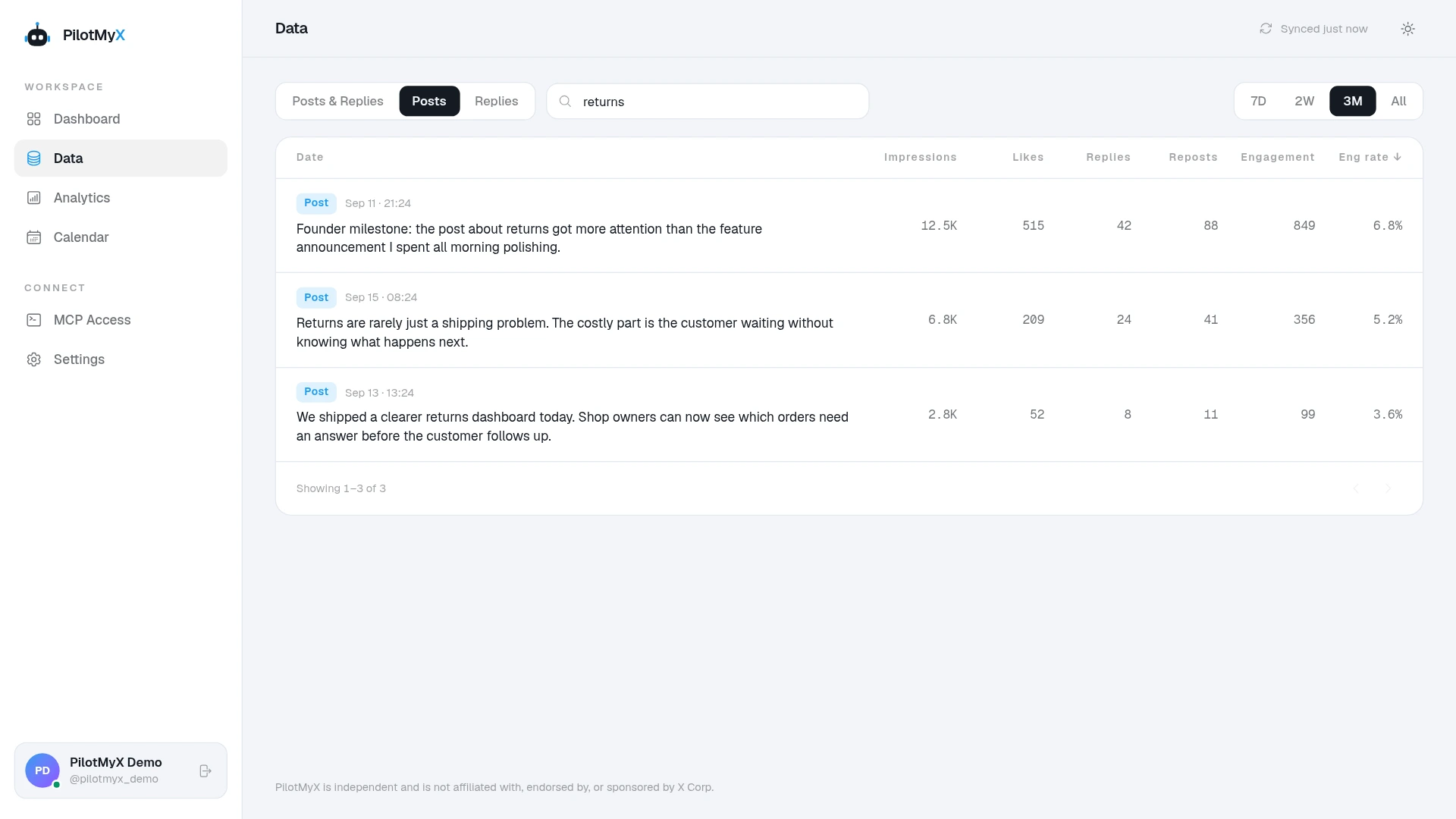
The first post celebrates a founder milestone. The second names a customer waiting for information about a return. The third describes a dashboard that helps shop owners see which orders need an answer.
For a campaign aimed at shop owners, the choices could look like this:
| Candidate | Why consider it? | Decision for this campaign |
|---|---|---|
| Founder milestone | It attracted attention and may fit an audience following the founder's journey | Leave it out of the first product campaign; it says little about the shop owner's problem |
| Customer waiting during a return | It describes a recognizable frustration without requiring product knowledge | Shortlist the angle; decide which offer and next step belong with it |
| Clearer returns dashboard | It connects a product change to a task the reader needs to complete | Shortlist it if the screenshot and destination make the benefit clear |
This is a judgment about relevance, not evidence that either shortlisted post will convert. The next test has a useful question: does the audience respond better to the problem explanation or the product demonstration?
Apply the same reading to your own posts. Check whether a stranger can understand the opening, whether any claim has supporting evidence, and whether the offer is still current. A launch announcement with an expired deal should be rewritten before you put money behind it.
Your replies can help with the wording. An explanation you've already written in conversation may say more about the customer's problem than a polished announcement. Use that language to prepare a new original post, while keeping the original-post shortlist and reply analysis separate.
Ask your agent for a shortlist you can inspect
PilotMyX lets your agent read your published content and available metrics together. That gives you a way to ask why a candidate belongs in the campaign, with the original post available for review.
After connecting PilotMyX to your agent, fill in this brief:
Help me choose which Twitter posts to promote.

My offer: [what I sell and the problem it solves]
Intended customer: [who should find this useful]
Desired action: [visit a page, explore my profile, sign up, or another specific action]
Destination: [page or profile]

Review original posts from the last 30 complete days available in PilotMyX. State the dates, timezone, number reviewed, and metric freshness. Read all relevant result pages. Keep replies separate; use my own replies only for context and voice.

Shortlist up to three posts. For each, return:
- Its link, publication date, and a short excerpt.
- The problem it addresses and why it fits the intended customer.
- Impressions and available goal-relevant counts and rates, with capture dates. Keep missing values distinct from zero and flag differences in observation age.
- Its promotion-history status and the evidence behind that status.
- What a reader unfamiliar with me might misunderstand.
- A decision: test the existing post, adapt the idea, or leave it out. Explain the decision and what a paid test could teach us.

If the official X Ads connection is available, use read-only advertising records to check promotion history. State the accounts and time range covered. Otherwise flag the history as unknown; don't label uncertain totals organic.

Show a relevant excluded candidate and explain why it lost its place. If none is suitable, tell me what is missing and propose a brief for a new post.

Keep this review read-only. Don't refresh data, save drafts, publish, create campaigns, or change advertising settings.
Read the excerpts before accepting the recommendation. An agent can calculate a rate correctly and still choose a post about the wrong problem. The excluded candidate is useful here: it makes the selection criteria easier to inspect.
Keep the shortlist small enough that each proposed test has a purpose. You don't need three candidates just because the prompt allows three.
When to adapt the idea or write a new post
An existing post may explain the right problem but lack the next step you want the ad to produce. Keep its useful observation and draft a version that connects it to your offer. Treat that version as a new creative: the old post's results don't belong to the rewrite.
If your history mostly consists of personal updates, don't force one into a product campaign. Use the guide to choosing what to post from your data to find a relevant question you can answer with facts you already have.
PilotMyX can help you prepare and schedule that approved original post. Once it is published, record the actual post link and its initial observation. Scheduling it doesn't make it an existing published post yet.
X supports promoting an organic post or creating a post for paid distribution, as described in its reach campaign guide. Organic publication isn't a universal prerequisite for testing an ad idea. Choose the route that fits the campaign and the evidence you want to collect.
Carry the reasoning into your paid test
Save a short note before promotion: the post ID, why you selected it, the intended audience, the baseline observation, and the outcome you'll measure. Add the destination and a question the test should answer. For the shop example, that question might be whether explaining the waiting customer's problem brings more useful visits than showing the returns dashboard.
Use the official X Ads MCP setup guide when you are ready to prepare the advertising side. Check that the selected post is usable for the chosen format and account before launch. After delivery begins, judge the campaign using its advertising results and the destination's business events. Keep those observations separate from the original selection note.
Open your recent posts in PilotMyX and choose the customer problem you want to advertise around. Use the prompt to compare candidates, then keep the post link and the reason for your choice with the campaign brief.
Use your own account