Read beyond the likes
What Twitter bookmarks tell you about your posts
A quiet post can still give you an idea worth developing. Read its bookmarks alongside exposure and your account goal before deciding to abandon the topic.
On this page
Few likes don't tell you whether an explanation was worth writing
You publish a practical explanation on Twitter. It gets fewer likes than yesterday's opinion, so you start dropping that subject from your plan. Then you notice people bookmarked it.
Before dropping the subject, read its bookmarks alongside impressions and the result you wanted. A bookmark records a save; it may suggest that someone wanted to find the post again. You still don't know whether they returned or used the advice.
If you're trying to become known for useful work on X/Twitter, the next step is to read what people saved and look for an explanation worth developing.
What a Twitter bookmark count actually means
X describes Bookmarks as a way to save posts so you can revisit them. Your saved-post list is private. The aggregate number of bookmarks received by a post is a different thing.
According to X's bookmark-count explanation, the count shows how many times a post has been bookmarked, without revealing the accounts that saved it. You cannot use it to identify interested prospects or build a list of people to contact.
The count doesn't reveal why someone saved the post. They might want to try your instructions later, keep a reference, check a claim, or show it to someone else. Treat usefulness as an interpretation to investigate, not a fact supplied by the number.
Your own Bookmarks tab also isn't an analytics report for your posts. It contains posts you saved, not the saves your writing received.
Bookmarks and likes help you ask different questions
When a practical post gets saves, look for something a reader could use again: a checklist, an explanation of a recurring problem, a reference link, or a worked example. When an opinion gets likes, read the opinion and its replies before deciding what people responded to. Neither action tells you the reader's motive on its own.
This matters when choosing what to write next. An opinion may prompt a discussion. A saved explanation may be worth expanding with a concrete example. A post that draws people toward your work may deserve a different review using profile clicks or website results.
Avoid ranking every post by whichever metric makes it look best. Choose the question first. If you want to help readers solve a recurring problem, bookmarks are worth inspecting. If you want more people to follow the account, also review audience growth and what visitors see on your profile.
There is no universal bookmarks-to-likes ratio that proves quality. A disagreement, a resource list, and a personal update have different reasons to exist.
Compare saves relative to exposure, then read the post
A post seen far more often has more opportunities to collect bookmarks. For a useful comparison, calculate:
Bookmarks per 1,000 impressions = bookmarks ÷ impressions × 1,000
These fictional posts illustrate the calculation. They are not customer results or figures from the founder's account. Assume similar subjects and formats, with counts recorded at the same post age.
| Post | Bookmarks | Impressions | Bookmarks per 1,000 impressions |
|---|---|---|---|
| A | 60 | 12,000 | 5.0 |
| B | 27 | 3,000 | 9.0 |
Post A received more saves overall. Post B received more saves relative to its recorded exposure: 27 ÷ 3,000 × 1,000 = 9. B deserves a closer read, but that rate doesn't make it the better post for every goal.
X's metrics documentation defines impressions as non-unique and lists bookmarks as a separate public metric. This ratio is a comparison of recorded actions and displays, not the percentage of individual readers who saved the post. It is also separate from the overall engagement rate.
Keep both the count and the ratio visible. A single bookmark on very few impressions can produce an impressive-looking rate with almost no evidence behind it. If impressions are zero or missing, leave the ratio unavailable rather than filling it with zero.
Compare original posts with original posts, and keep replies and quotes separate when their context differs. Note the publication dates and when you collected the metrics. An older post's current total is not its first-day result; the guide to judging post performance explains that distinction. If a post was promoted, don't treat its public counts as organic-only results.
Use PilotMyX to read the examples behind the count
An agent connected to PilotMyX can retrieve the bookmark counts available in your collected history and sort posts by that metric. Ask it to show the exact text and exposure alongside the ranking. A top-saved list is a place to start reading, not a content plan by itself.
Then put those examples back into your account goal. In the app, you can review original-post performance and available profile visits per 1,000 impressions. That view helps you inspect another part of the response; it is not a bookmark-rate chart.
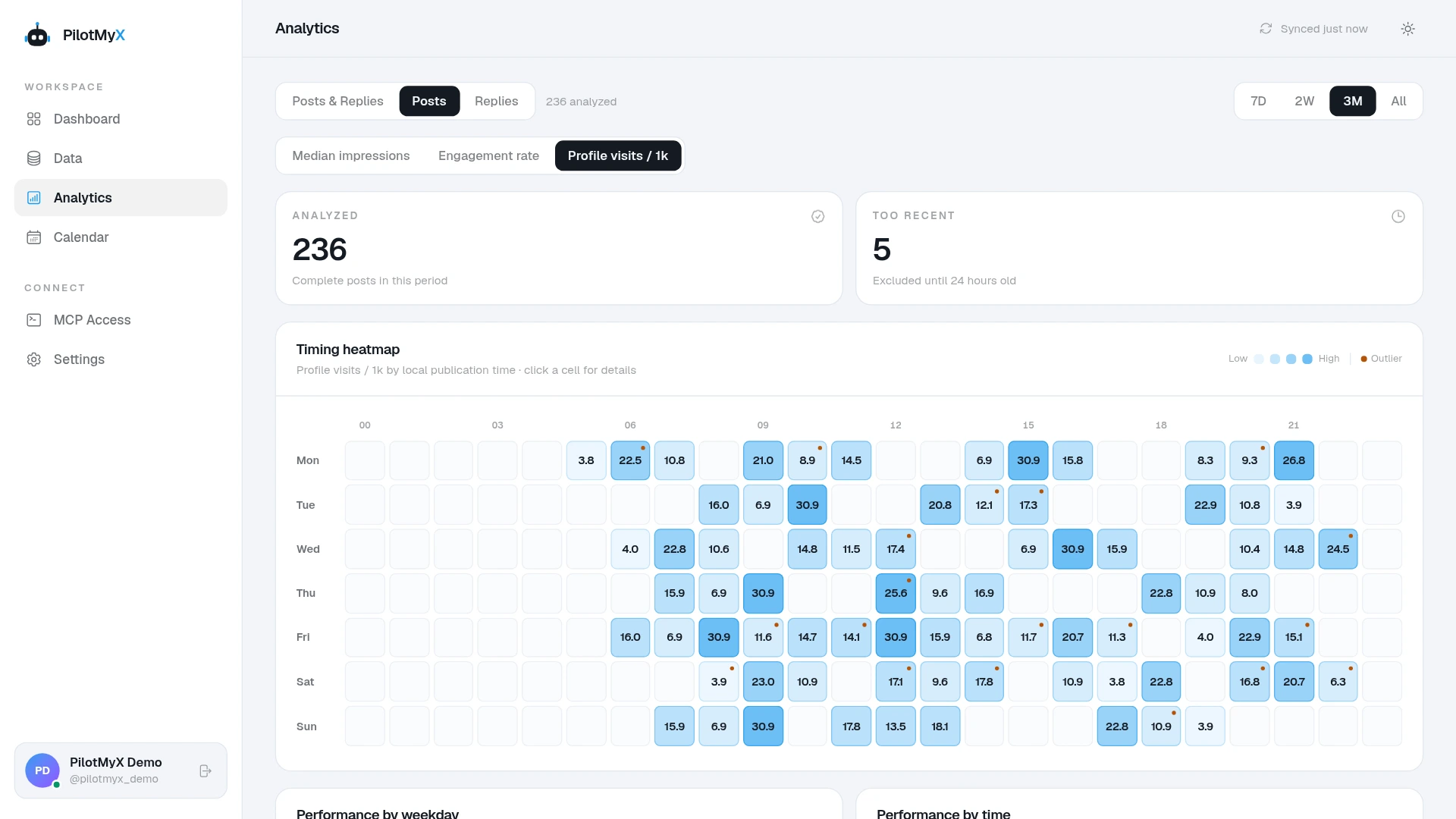
If several saved explanations concern the same problem, read one that performed less well too. Look for what changed in the explanation, example, or intended reader. One unusual mention can dominate a result, so check whether your conclusion survives without the biggest post.
Use this prompt with any connected agent. The setup guide covers the connection if you haven't made it yet.
Help me find a useful explanation to develop in my next Twitter post.
My intended reader: [audience]
My account goal: [what I want the account to achieve]

Use my PilotMyX history from the last 28 complete days in the
account timezone. State the actual dates, coverage, and freshness.
Review original posts separately from replies and quotes.
Show candidates ranked by available bookmark count, with their
exact text, publication dates, impressions, and likes.

Calculate bookmarks per 1,000 impressions only when both metrics
are available and impressions are positive. Show counts with rates.
Flag small samples, different post ages, missing metrics, and any
promotion I tell you about. Do not assume missing means zero.

Read the strongest candidates and a less-saved example on a similar
subject. Check whether one outlier explains the apparent pattern.
Suggest one follow-up question worth answering, with supporting
post IDs and an explanation of what remains uncertain.

Do not infer who bookmarked a post, whether they returned, or that
saves caused reach, follows, or sales. Ask me for any new facts
needed for the follow-up. Do not refresh, create a draft, schedule,
or publish anything yet.
PilotMyX provides the account data. Your agent does the comparison and writing; you decide whether the proposed follow-up has enough substance.
Give the next post something new to explain
Suppose a troubleshooting checklist keeps appearing among your saved posts. A useful follow-up could show one failure case, explain a step readers misunderstood, or apply the checklist to another situation you know well. Bring the actual facts before asking the agent to draft it.
Don't simply copy the checklist and ask for more bookmarks. The guide to reusing Twitter posts shows how to revisit an idea with a reason to read the new version.
Review the exact draft, media, and time before putting the approved original post in your PilotMyX calendar. Later, compare its response with similar posts at a comparable age. You are testing whether the new explanation deserves more work, not proving that bookmarks guarantee distribution.
FAQ
Can I see who bookmarked my Twitter post?
No. X exposes an aggregate count, not the accounts that saved the post. PilotMyX doesn't reveal those identities either.
Are bookmarks better than likes?
They record different actions. A save can be a reason to investigate a useful explanation, while likes can help you examine another kind of response. Neither number replaces your account goal or reading the actual post.
What is a good Twitter bookmark rate?
There is no universal target established by the sources used here. Compare your own similar posts with enough exposure, keep counts beside rates, and avoid judging the result from one saved post.
Do bookmarks prove the algorithm will boost my post?
No. The count alone cannot tell you how X ranked a post for any viewer. Use it to choose an explanation to investigate, not to promise extra reach.
Use your own account