Measure your X/Twitter audience growth
Is your Twitter audience growing, or are you just getting views?
A busy week and a big impression count don't tell you how much your audience grew. Compare follower counts over a clear period, then investigate what changed.
On this page
More people saw your posts. Did more people stay?
You spent the week replying to relevant conversations and publishing original posts. Your impressions went up. But when you open your profile, you can't remember whether the follower count was much lower last Monday.
Twitter follower growth rate measures the net change in your follower count relative to the count you started with. Subtract the starting count from the ending count, divide by the starting count, and multiply by 100. Keep the dates beside the result: a percentage without a period is hard to use.
That calculation answers whether your audience got larger. It doesn't tell you which post persuaded someone to follow, or how many people followed and later left. Here is how to use it without turning a small change into a confident story about your content.
Calculate net follower growth and the growth rate
Use two counts taken at the boundaries of the period you want to compare:
- Net follower growth = ending followers − starting followers.
- Follower growth rate = net follower growth ÷ starting followers × 100.
The following numbers are fictional examples, not PilotMyX customer results. Each row covers a seven-day interval measured at the same time of day; the second starts where the first ends.
| Period | Starting followers | Ending followers | Net growth | Growth rate |
|---|---|---|---|---|
| First seven days | 900 | 936 | +36 | 4.00% |
| Next seven days | 936 | 950 | +14 | 1.50% |
The second rate is 14 ÷ 936 × 100, rounded to two decimal places. The account grew in both periods, but added fewer net followers in the second. Nothing in that table explains why.
Keep the absolute change next to the percentage. Adding eight followers to an account with 80 followers is 10% growth. Adding 80 to an account with 8,000 is 1%. The larger percentage doesn't mean the smaller account attracted more people.
If you start at zero, the percentage is undefined because you cannot divide by zero. Report the number added instead. If the ending count is lower than the starting count, report the negative change rather than hiding it.
Net growth isn't the number of people who followed
An increase of 14 followers could mean 14 people followed and nobody left. It could also mean 30 followed and 16 left. Two total counts cannot distinguish those situations.
X includes followers_count in its account-level public metrics. It is a count associated with the account, not a record linking each follow to a post. Use “net gain” when that's what you measured; calling it “14 new followers acquired” would imply more information than the counts provide.
A notification isn't a durable measurement either. X's help page on following issues explains that a notified follower may later be absent because they unfollowed, deactivated their account, or were hidden for spam activity. That doesn't diagnose a particular dip in your count. It does explain why counting notifications and subtracting two follower totals can give different answers.
Check which dates your history actually covers
The dates on a report and the timestamps of its observations can differ. If you request Monday through Sunday but the first stored count is from Wednesday afternoon, the difference between the first and last counts is not a full-week measurement.
Before comparing periods, check:
- The timezone and first and last observation timestamps.
- Whether both periods have observations near comparable boundaries.
- How fresh the most recent profile observation is.
- Whether missing days or your plan's available history shorten the comparison.
PilotMyX stores observed follower counts with timestamps. Your connected agent can read the available history through MCP and explain the range it actually covers. Connecting today doesn't create follower counts for dates before observations were stored. Old posts being available doesn't mean old follower history is available too.
With only one observation, you have a count, not evidence of a change. With gaps, you can still calculate the change between the observations you do have. Name that interval accurately instead of filling the gaps with invented counts or labeling an incomplete range as a full month.
For a routine review, you could compare the last seven complete days with the preceding seven, provided the observations support it. Use a longer period if that fits your publishing pace. The important part is making the two periods comparable, not following a universal weekly target.
Connect audience growth to a question you can investigate
Once you've established the net change, look at what happened during that period. Did you publish a useful demo, join different conversations, change your bio or pin, or run ads? Record those changes before deciding that a particular post did all the work.
Replies can introduce a small account to people already reading a conversation. Original posts and a clear profile give those visitors a reason to want more. The posts-versus-replies guide explains that distinction. A follower count alone can't separate their contributions.
Use PilotMyX to review original posts and replies separately, then read the wording behind the results. Available profile clicks can help you find content that made people curious about the account. They are not follow counts.
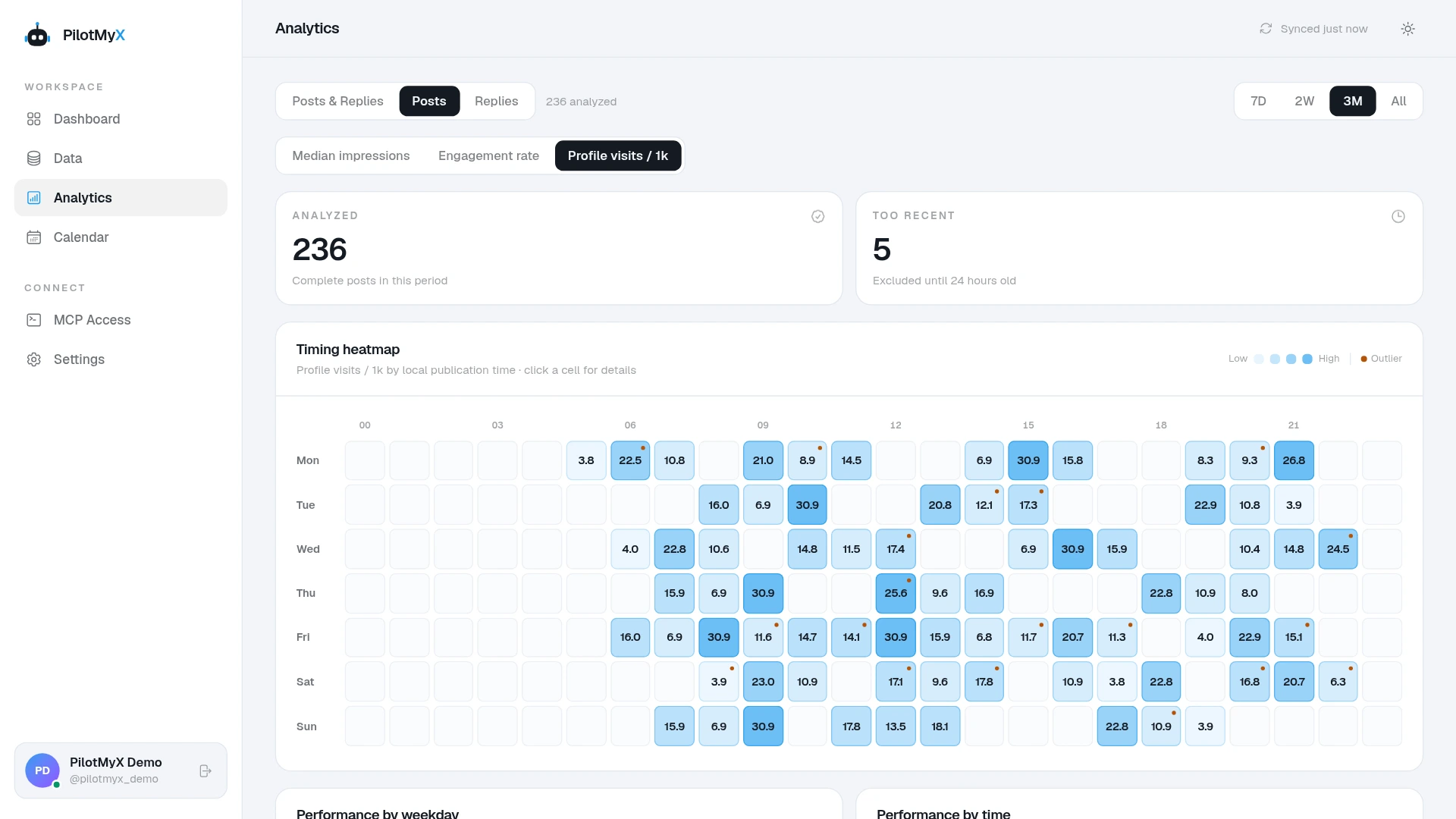
The follower history belongs to the account. Switching a content view from Posts to Replies doesn't turn it into a count of followers gained from replies. If you divide net growth by profile clicks, you've made a rough ratio between different measurements, not a verified visitor-to-follower conversion rate.
Choose the next question based on the gap you see. If views increased but profile interest stayed low, investigate why people aren't opening your profile. If visitors arrive but your account's purpose is unclear, review your bio, pin, and recent posts. Those are hypotheses to test, not conclusions the follower curve proves.
Ask an agent for a review that keeps the limits visible
An agent connected to PilotMyX can put follower history and content results into the same review, so you don't have to remember last week's count or assemble separate exports. Give it a specific comparison and keep the first request read-only:
Help me understand whether my X/Twitter audience is growing.
My intended audience is [specific audience].

Use PilotMyX's stored follower history for the last seven complete
days and the preceding seven in my account timezone, if available.
State the requested dates, actual first and last observation times,
profile freshness, and any missing history or partial periods.
Don't invent counts at the boundaries or treat one point as a trend.

For each supported interval, show starting and ending counts,
net change, and percentage change from the starting count.
If the starting count is zero, report absolute change only.
Do not call net change the number of new follows acquired.

Review original posts and replies separately for those periods.
Read relevant content beside impressions and available profile clicks.
Keep the account follower history separate from per-post metrics.
Don't attribute follows to an individual post or reply.

Ask whether I changed my profile, ran ads, or had other exposure.
Suggest one concrete next test for my audience and explain the
evidence and uncertainty. If coverage is insufficient, say what
comparison is possible instead. Keep the review here: do not
refresh, save, schedule, or publish anything.
Once you choose a test, you can approve the original posts you want to prepare and schedule in PilotMyX. Keep a note of what changed and when. The next review will be more useful if you can compare the results with that decision, rather than trying to reconstruct it from memory.
Questions about Twitter follower growth
What is a good Twitter follower growth rate?
There isn't one percentage in this guide that applies to every account. Starting audience size, period length, audience fit, and paid exposure matter. Compare your own equivalent periods and ask whether the people you're reaching fit the audience you want.
Why did I get follow notifications but little net growth?
New follows and departures can offset each other. Notifications also aren't a complete history of the final follower count. Compare stored counts over a defined interval; don't assume the difference means nobody followed.
Can PilotMyX recover my follower count from before I connected?
Its follower history uses stored observations. It doesn't reconstruct unobserved past counts from old posts. If your requested period isn't covered, use the available interval and build a comparison as more observations become available.
Can I see which tweet caused someone to follow?
The account totals and post metrics described here don't establish that attribution. You can identify posts worth investigating and compare periods, but “followers increased after this post” isn't proof that the post caused the increase.
Use your own account