From views to profile interest
Why your Twitter posts get views but few profile visits
A post can travel far without giving readers a reason to learn who wrote it. Find where attention stops before changing your bio or chasing more reach.
On this page
Your post got seen. Why didn't anyone open your profile?
A Twitter post can pick up thousands of impressions and barely move the metric you care about: people opening your profile to see who wrote it. Publishing more of the same post may bring more views without bringing more interest.
Start by checking whether you're comparing the right numbers. Then read the posts that got views but few profile clicks. If people do open your profile but don't stay, look at the profile itself. Views, clicks, and follows point to different questions.
An impression is not a profile visit
X defines an impression as a time a post appeared on a screen. The same person can produce more than one. X's view-count guidance says even your own view of a post can count. Impressions tell you the post appeared; they don't tell you how many distinct people considered following you.
A post-level profile click records a click from that post to your profile. It isn't the same as your account's total profile visits, which can come from elsewhere. It also isn't a follow, a website visit, or a customer. X lists user_profile_clicks among private metrics available for posts you own. Its current API documentation limits private, organic, and promoted metrics to posts created within the last 30 days. If an older post has no click value, label it missing rather than calling it zero.
For a fair first look, keep three numbers beside each post: impressions, available profile clicks, and the post's publication date. Check whether it was promoted. X's public metrics can combine organic and paid activity on a promoted post; don't quietly compare that with an ordinary post and call the difference an editorial win.
Put profile clicks in context
Raw clicks favor posts with more impressions. To compare how often a displayed post led to a profile click, calculate:
Profile clicks per 1,000 impressions = profile clicks ÷ impressions × 1,000
For a fictional example, 24 profile clicks from 12,000 impressions equals 2 clicks per 1,000 impressions. That is a rate of recorded actions per display, not the share of people who visited. One person may have seen the post several times, and a click count does not identify who clicked.
Keep the count beside the rate. A post with 8 clicks from 1,000 impressions has a higher rate than the fictional post above, but fewer actual clicks. Neither is automatically the better post for your goal.
| What the data shows | Check next | What it cannot prove |
|---|---|---|
| Many impressions, few profile clicks | Does the post give its intended reader a reason to learn more about the author? | That X showed it to the wrong people |
| Few impressions, some profile clicks | Is the subject worth revisiting in a clearer original post? | That the format would work at larger reach |
| Profile clicks, little account growth | Does the bio, pin, and recent work explain why someone should stay? | Which visitors followed or why they left |
| Missing profile-click data | Check post age and metric availability | That nobody opened the profile |
These are questions to investigate, not diagnoses X supplies. A short answer to someone else's question, for instance, may solve that person's problem without prompting them to visit your profile. A broad opinion can collect views from people who were never looking for your work. Read the actual words and context before deciding which explanation fits.
Compare posts that had a similar job
Open a recent, complete period of your own account history. In PilotMyX, select Posts and the Profile visits / 1k metric, then inspect the examples behind the result. The Analytics view groups posts by their local publication time; it doesn't reveal why any reader clicked. Keep original posts, quote posts, and replies identifiable when you read the underlying content.
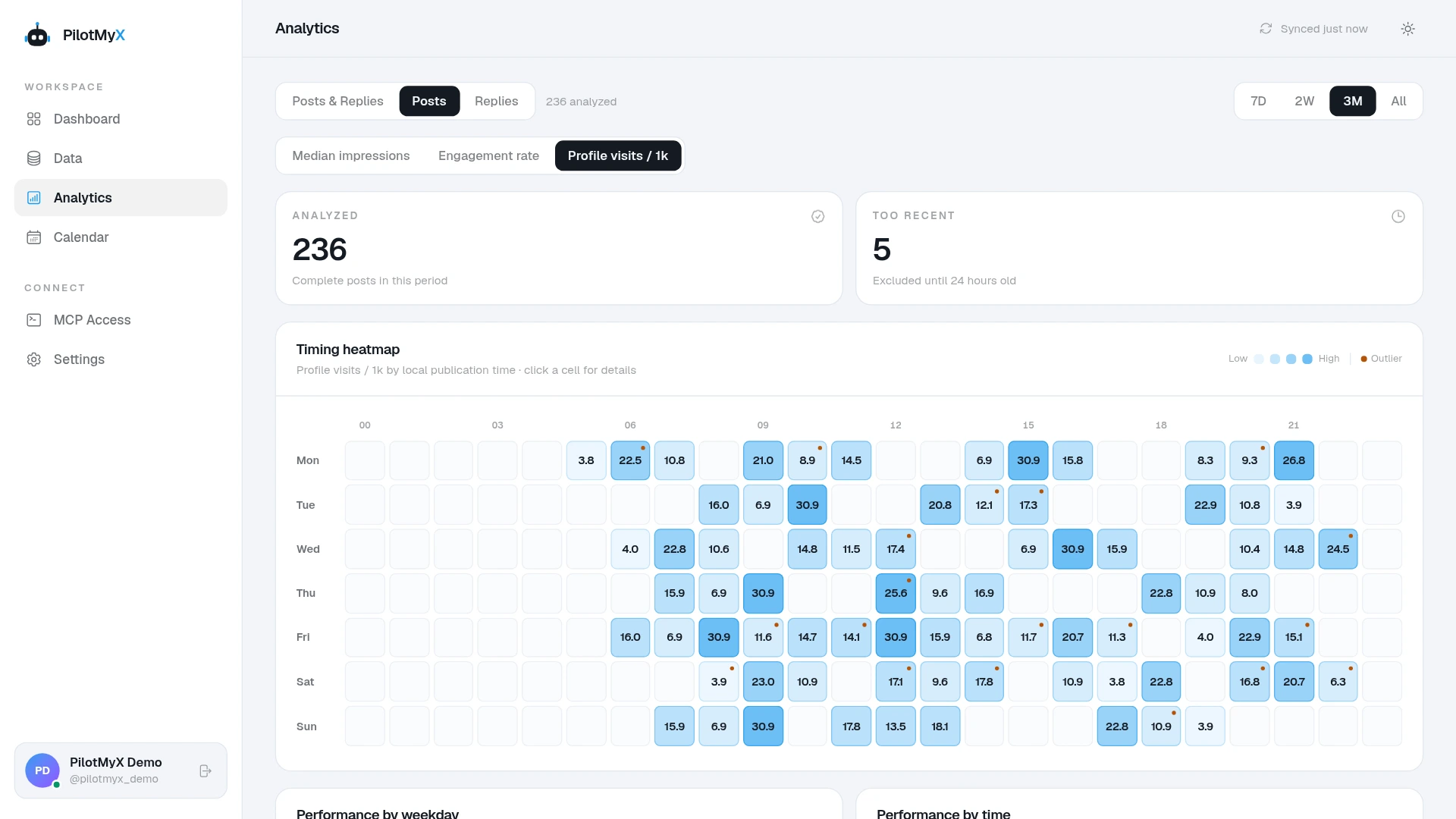
Find a few posts with similar subjects and purposes. A product explanation and a topical joke might both earn impressions, but only one was written to make people curious about the product. Compare their opening, audience, context, and next step. Then check the click counts, not just the rates. One unusually large post can distort the story if you treat it as your normal result.
The PilotMyX analytics methodology explains that period groups use publication dates and the latest synchronized metrics. They are not a record of which hour each impression occurred. For a new test, record results at the same post age; otherwise an older post has had more time to collect views and clicks.
If the posts that introduce your work repeatedly bring more profile interest than broad commentary, you have an angle worth trying again. You have not proved that one phrase caused the clicks. If impressions are low across the board, the guide to diagnosing weak Twitter engagement is a better starting point than optimizing this ratio.
Change one part of the path
If readers see the post but rarely click your name, write a new post that makes the relevance of your work clearer. You might replace an abstract claim with a specific problem you solved or a question your audience keeps asking. Don't bolt “follow me” onto every post; give readers a reason to expect more useful work from you.
If the clicks arrive but the account does not grow, inspect the destination instead. Your bio, pinned post, and recent posts need to make sense to someone meeting you for the first time. Use the Twitter bio guide for specific rewrites and a check against the posts you actually publish. The guide to growing a Twitter account from zero covers the wider profile check. A post-level click metric alone cannot tell you which visitor followed or whether the profile change worked.
Choose one change for your next small group of posts and keep the audience and subject reasonably similar. Note the publication dates and a consistent review age. Compare profile clicks, impressions, and the posts themselves. No universal “good” clicks-per-1,000 threshold can substitute for whether the right people showed interest in your work.
An agent connected to PilotMyX can help with the review without pretending to know the people behind the counters:
I want more relevant people to discover my work on X/Twitter.
My audience is [specific audience]. My account is about [subject].

Use my PilotMyX data for the last 28 complete days available.
State the date range, freshness, post counts, and which profile-click
metrics are missing. Keep original posts, quote posts, and replies
identifiable; focus first on original posts.

For posts with impressions and profile clicks available, show both
counts and profile clicks per 1,000 impressions. Read a few comparable
high- and low-interest posts. Explain their subject, opening, and
reason someone might want to see the author's profile. Separate what
the numbers show from your hypotheses. Do not infer individual
visitors, follows, sales, or algorithmic penalties.

Recommend one idea to test in my next approved original post. Show
the proposed text and how we will review it at a consistent post age.
Do not save, schedule, or publish anything yet.
Once you've reviewed the idea, you can draft and schedule the approved post in PilotMyX. The goal is not to force every post to send people to your profile. It is to know whether the posts meant to introduce your work are doing that job.
Use your own account