Understand a drop in your X/Twitter audience
Why am I losing Twitter followers? Check before changing your content
A falling follower count can make you question everything you publish. Confirm the change, separate documented causes from guesses, and choose a useful next check.
On this page
Your count fell. That doesn't tell you who left or why.
You've been publishing and replying, then the follower count drops. The tempting response is to blame your latest post, change your niche, or assume X removed a batch of bots. The number alone cannot tell you which explanation is right.
Twitter followers can disappear when people unfollow or deactivate their accounts. X also documents account restrictions that affect follower counts. Before changing your content, confirm when the change was observed and whether you have evidence beyond the total.
The useful question is what to check next. A mismatch between a live profile and an older saved count needs a different response from unauthorized activity or a sustained decline while your account's subject has changed.
Confirm the change before explaining it
Write down the earlier count, its observation time, the later count, and its time. Use the same account and timezone. An analytics view recorded yesterday and your profile open now are different observations; disagreement between them isn't automatically a broken counter.
Check whether you're comparing followers with followers. The number of accounts you follow is a different measurement. Follow notifications aren't a complete ledger of changes either.
X's help page on following issues says a notified follower may later be absent because they unfollowed, deactivated their account, or were hidden for spam activity. That explains why a notification and a later list can disagree. It does not identify the cause of your account's entire drop.
Record the interval honestly. If your previous stored count is three days old, you know the change between those two observations. You don't know that it all happened in the last hour just because that's when you noticed it.
Separate possible causes from evidence you have
Use this table to choose a check, not to diagnose the account from the shape of a chart.
| What you observed | What to check next | What it does not prove |
|---|---|---|
| A saved total differs from the current profile | Compare observation times and confirm the account | That followers were lost after the latest post |
| A follow notification has no matching visible follower | Review the particular account if you know it | That every missing follower was a bot |
| Posts, messages, or account actions you didn't approve | Follow X's account-security guidance | That a lower count alone means someone accessed the account |
| Several comparable intervals show a net decline | Review audience fit, recent content, and profile changes | Which people left or what caused each departure |
X's enforcement guidance states that accounts locked pending a challenge are removed from follower counts, Reposts, and Likes. This is a documented mechanism, not confirmation that a specific drop was a purge, that every affected account was fake, or that your count will return by a particular date.
A sudden drop can justify checking for platform information. Its size or speed is not a reliable test for bots versus people. Without account-specific evidence, leave the cause unresolved rather than putting a reassuring label on it.
A net loss isn't a list of unfollows
Consider this fictional example, not a customer result: a count falls from 1,008 to 1,000 between two observations. The observed net change is minus eight.
That could include four new follows and twelve departures. Eight accounts becoming excluded from the count would produce the same numerical change if nothing else changed. The two totals don't distinguish these possibilities, and neither scenario has been established by the example.
For percentages and comparisons, use the follower growth rate guide. Keep the negative absolute change visible as well. Don't rename it "eight people disliked my post" or "eight bots removed."
PilotMyX stores observed follower counts with timestamps. Its follower history and post metrics can help you inspect the interval, but they don't supply an unfollower list or a reason for each departure. A gap in stored history stays a gap; connecting the account doesn't reconstruct unobserved past counts.
Check security when the evidence calls for it
Unexpected posts, DMs, follows, unfollows, or blocks deserve attention before a content review. X lists these as warning signs in its compromised-account guidance, with steps to change your password, secure your email, review app access, and contact support when necessary.
A follower dip on its own isn't one of those unauthorized actions. Don't give an unfamiliar service your password just to find an explanation for a lower number.
Avoid the supposed counter reset of disabling and reopening your account. X explicitly says deactivating and reactivating does not resolve incorrect follower counts. If a count problem persists, use its troubleshooting or support route rather than treating deactivation as a repair.
Review content fit without blaming a single post
Once you've established a decline across usable observations, examine what changed in the account. Did a tutorial account become mostly promotional? Did a popular post attract people interested in a subject you rarely cover? Does the bio still describe what readers actually get?
These are editorial questions, not explanations the follower curve has proved. Ask them over a clear interval, such as the last seven complete days against the preceding seven, if your history covers both. Read the posts and replies separately, alongside impressions and available profile clicks. Note a change in paid exposure or publishing volume rather than silently comparing different situations.
In PilotMyX, use Data to read the relevant content and Analytics to inspect its recorded response. Profile interest can suggest which posts deserve a closer look; it doesn't tell you who followed or left.
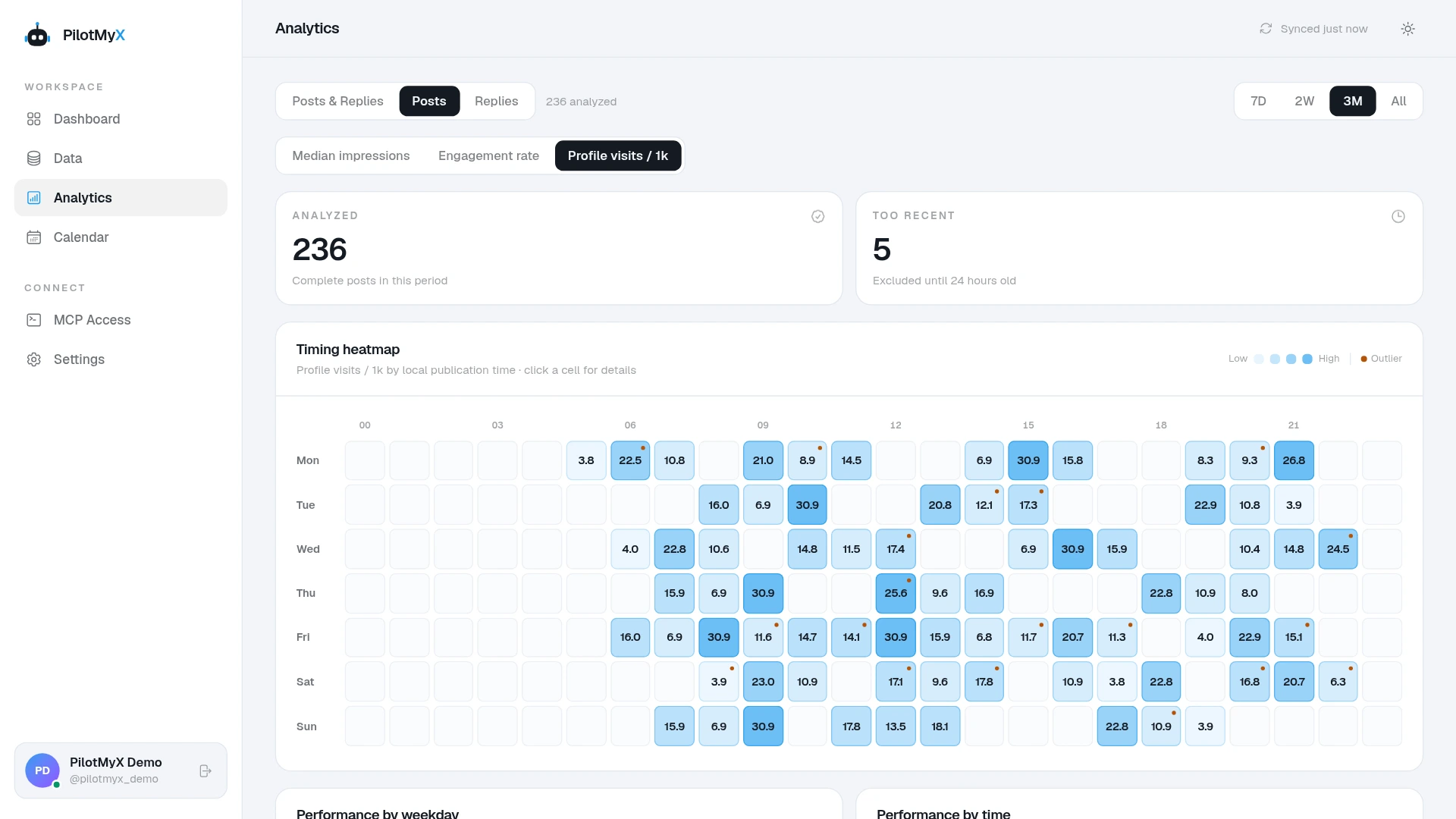
When people see posts but rarely open the profile, review the path from impressions to profile visits. If the profile promises something the recent posts don't deliver, review the bio and decide which promise you intend to keep. Neither change requires deleting a post merely because the count fell afterward.
Choose one test that fits the discrepancy you actually found. For example, a language teacher whose bio promises practical exercises could replace an unrelated promotional slot with a real exercise for the intended learners. Keep the rest of the plan stable enough to review. The test checks whether that content is useful; it cannot prove why previous followers left.
Give your agent a diagnostic question, not a recovery target
After connecting an agent to PilotMyX, you can ask it to organize the evidence. Analysis happens in the agent, using stored account data:
Help me investigate a drop in my Twitter follower count.
My intended audience is [audience], and I noticed the change on [date].
Use PilotMyX in read-only mode. Do not refresh, save drafts, schedule,
publish, or change account settings.

Inspect available follower observations for the last seven complete days
and the preceding seven in my account timezone. State actual observation
times, profile freshness, and missing or partial history. Show supported
net changes only; don't invent boundary counts or an unfollower list.

Read original posts and replies separately for the covered intervals.
Compare their topics, volume, impressions, and available profile clicks.
Ask whether my profile, paid exposure, or subject changed. Ask about
unauthorized account actions before making a content recommendation.

Separate observations, possible explanations, and unknowns. Do not claim
a bot purge, a ranking penalty, or a post causing unfollows from totals.
Suggest the next check and, if justified, one content test for my audience.
Explain what that check can and cannot establish.
Don't use a target like "recover every lost follower by Friday" as an instruction to buy followers or automate follow/unfollow cycles. X's authenticity policy prohibits artificial follower inflation and follow churn. Replacing a number with manipulated activity doesn't answer the original question.
Keep a short record of the verified counts, the interval, and the check you chose. At the next review, compare that record with the new observations before making another change to your publishing plan.
Use your own account