Before you delete that tweet
Should you delete tweets that get no engagement?
A quiet post can still explain your work or help a future reader. Decide whether the content needs removing before letting its like count make the decision.
Low engagement alone is a weak reason to delete
You spent time writing a tweet, checked it a few hours later, and found almost no likes. Now it feels awkward sitting on your profile.
If the post is accurate, useful, and still represents your work, keep it. A low like count does not tell you whether someone found the explanation helpful or followed its link. Remove or correct a post because of a problem with what it says, not because you hoped for a bigger reaction.
That is an editorial recommendation, not a claim about a hidden account score. The X help and policy pages cited below do not establish that deleting low-engagement tweets resets your reach. They also do not reveal every signal in the recommendation system.
Decide what is actually wrong with the post
Read the text before looking at the numbers again. Would you still stand behind it if someone sent it to a potential customer tomorrow?
| What you find | Suggested decision | What to do next |
|---|---|---|
| Accurate, relevant content with few reactions | Keep it | Review the opening and intended audience before your next post |
| An incorrect claim or offer that is no longer valid | Correct it, or remove it if leaving it up would mislead readers | Publish the accurate information where readers can find it |
| Private information you did not mean to share | Remove it promptly | Address the exposure; do not delay for an analytics review |
| An old post that no longer represents your work | Make a deliberate editorial choice | Check whether your bio and pinned post also need updating |
A launch announcement with little engagement may still answer questions about what you built. Conversely, a popular announcement pointing to an offer that has ended can mislead visitors. The number of likes doesn't settle either decision.
If your worry is that newcomers won't understand your account, start with the introduction you control. A clear pinned Twitter post is a more direct way to explain your work than trying to make every historical post look successful.
What deleting a tweet actually removes
According to X's deletion help, deleting a post removes it from your account, followers' timelines, and X search results. Its reposts are removed too. The post's content, metadata, and analytics are no longer publicly available on X.
Deletion does not remove posts where someone copied your text or added their own comment in a quote. X also cannot remove copies held by third-party sites, apps, or search engines.
For an ordinary content review, you can keep a private note of the lesson before removing something: what the post tried to do, what you would change, and why you removed it. Don't preserve sensitive material merely to complete that note. PilotMyX is not a recovery service for deleted tweets.
Don't keep deleting and reposting the same message
Moving an unsuccessful post to a different time can feel like an easy second chance. But X lists repeated posting and deleting of the same content under prohibited content spam in its authenticity policy.
That rule concerns repeated behavior. It is not a reason to leave an incorrect post online, and it does not supply a safe number of retries.
If an idea deserves another attempt, work out what a reader was missing. A screenshot captioned with only your product's name assumes people already know what it does. Explain the problem it solves and show the relevant part of the screen. You have given the next reader something the earlier post didn't provide.
Changing a few words just to repeat the same pitch gives readers little new value. Bring a clearer explanation or new information, and let that justify the next post.
Review the missed opportunity before writing again
In PilotMyX, look at the post alongside other original posts with a similar purpose. A product demo and a casual question ask different things of readers, so comparing their likes alone can send you toward the wrong rewrite.
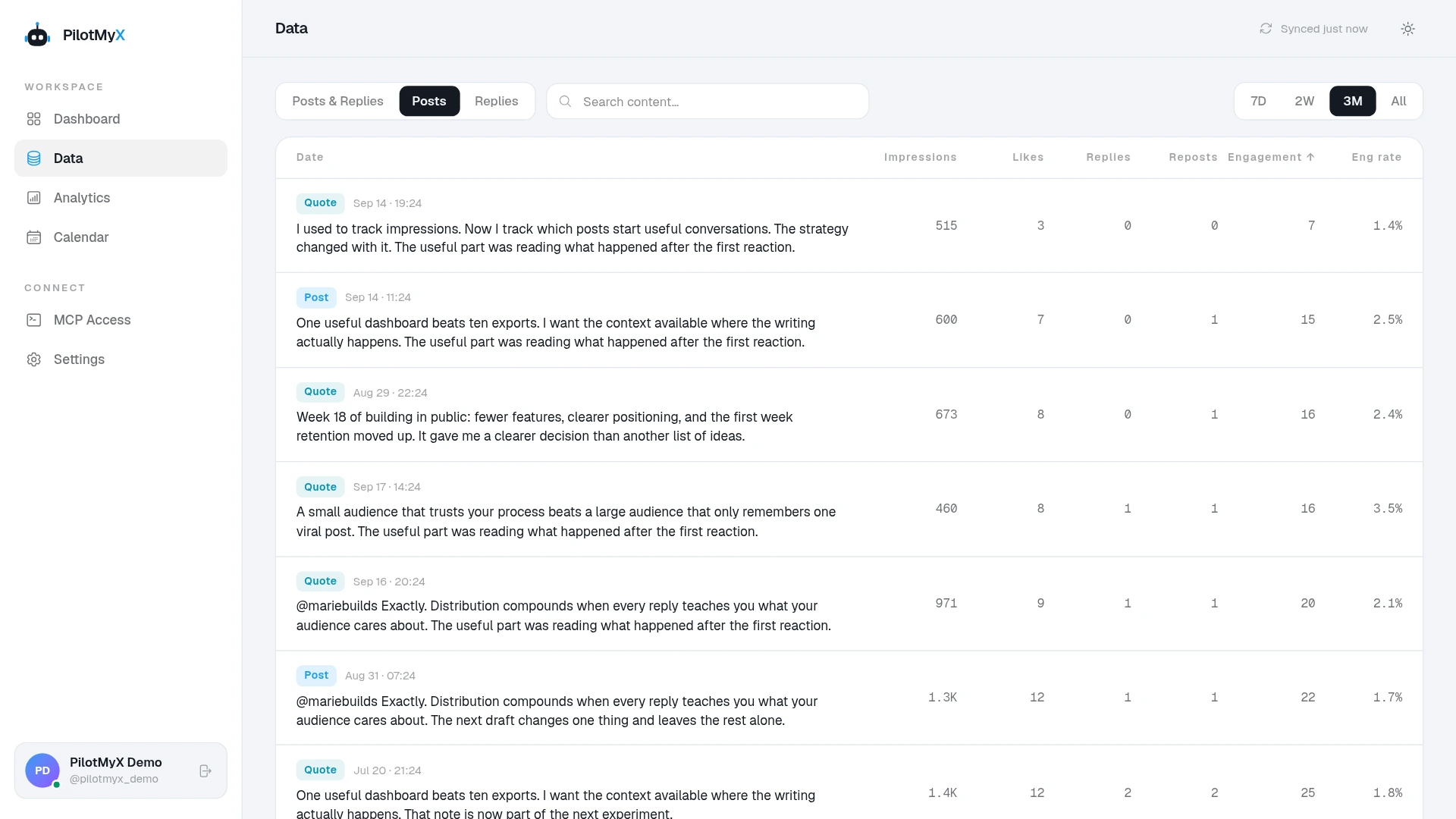
Start with a manageable period, such as the last 14 complete days, and keep replies separate. Read examples with stronger and weaker results. For a post meant to send people to your site, inspect available URL clicks alongside impressions; for an introduction, profile clicks may be more relevant. Keep unavailable metrics distinct from zero.
Post age matters too. Today's post has had less time to accumulate activity than last week's. Current totals are not an equal-age experiment, and PilotMyX cannot tell you what would have happened if you had posted the same message under different conditions.
Use that review to choose one change you can explain. For example, if several demos mention the product without showing who it helps, make the next demo understandable to someone who has never seen your account. Treat the expected improvement as a hypothesis until you have results.
If several posts have stopped getting a response, the guide to tweets that aren't getting engagement covers how to investigate the broader pattern.
A prompt for reviewing a post you want to delete
An agent connected through PilotMyX's MCP can read your post history and help identify a useful next attempt. Give it the reason you are considering deletion, including any factual problem the metrics cannot reveal.
Help me review a Twitter post before I decide whether to keep it.

Post URL: [URL]
Who it was for: [audience]
What I wanted it to achieve: [specific outcome]
Why I am considering removing it: [reason]
Anything in it that is incorrect or outdated: [details or none]

Use my PilotMyX data for the last 14 complete days in my account
timezone. Include the selected post if it is available. State the
actual dates, coverage, and metric freshness. Don't recover or
invent data for a post you cannot access.

Read the selected post and comparable original posts with stronger
and weaker results. Keep replies separate. Show the relevant
available metrics, including impressions and clicks when useful.
Flag differences in post age and keep missing values separate
from zero. Don't infer sales or algorithm penalties from them.

Separate any factual or privacy issue from low engagement.
Explain whether the text still helps the intended reader, then
suggest one concrete change for a future post using facts I supplied.
Label that suggestion as a hypothesis, with the examples behind it.

Keep this review read-only. Don't delete, create drafts, schedule,
or publish anything. Ask me about any fact you need to confirm.
If your agent isn't connected yet, follow the PilotMyX setup guide. After the review, you can have it prepare a new post, revise the exact text, and schedule the approved version through PilotMyX. Any removal of an existing published post happens directly in X.
The next time you are tempted to remove an accurate post, write down what you would change first. You might decide to leave the original where it is and spend the next writing session making that explanation clearer.
Use your own account