Replies worth reading
How to write better Twitter replies: 5 worked examples
You found a conversation worth joining, but your answer still sounds like it could go under any post. Use the specific question or detail in front of you to write something that belongs there.
On this page
Reply to a detail, not just the topic
Before sending a Twitter reply, point to the sentence you're answering. If your reply would fit under an unrelated post, rewrite it around that sentence. Answer the question, name a detail you noticed, or explain the condition that changes your view.
You don't need to fit a complete essay into the reply box. A short answer with a clear reason is often easier to respond to than a list of advice the author didn't ask for. Nor does every reply need a question at the end. Ask when you want to know the answer.
X's replies and mentions guide explains how replies join a conversation through the reply icon. It also says replies aren't always displayed chronologically and describes several ranking factors. Writing a useful answer doesn't guarantee the top position, a response, or extra reach.
If you're starting with few followers, replies give you a way to participate where people are already discussing your subject. Keep original posts on your own profile too, so someone who visits can see more of your work. The posts versus replies guide explains those different jobs. This guide focuses on the words you write once you've chosen a conversation.
Five Twitter reply examples, with the context included
The conversations and replies below are fictional writing examples. They are not posts from the founder, testimonials, or measured results. Use the reasoning, not the exact sentences. Don't claim an experience or intention you don't have.
1. Answer the problem before offering advice
Someone says their newsletter gets opens but few clicks and asks whether they should change the subject line.
A reply that skips the problem:
Try a stronger hook and be consistent!
A more useful answer:
Are readers clicking the first link, or not reaching it? I'd compare clicks by link before changing the subject line. The problem you've described happens after the open.
The second reply stays with the reported gap. It suggests what to inspect without pretending to know why the clicks are low. If you have relevant experience, add the actual observation. If you don't, keep the suggestion framed as something to check.
2. Say what you noticed in the work
A designer shares a mobile checkout screenshot and asks for feedback. The image puts the delivery cost beside the order total.
A vague reaction:
Clean design. Love it!
A specific reaction:
Putting delivery beside the total makes the full cost easier to spot. Does that row stay visible when someone expands the discount-code field?
The observation gives the designer something they can inspect. It also shows that you looked at the screenshot. You haven't invented a conversion result or assumed the design solves every checkout problem.
Plain congratulations can still be sincere. They don't all need to become critiques. When you want to contribute feedback, explain which part of the work you're reacting to.
3. Disagree by naming the condition
Someone argues that every creator should publish daily, regardless of what they make.
A dismissal:
Terrible advice. Quality beats quantity.
A disagreement with something to discuss:
Would you keep that target for someone who needs a week to document one experiment? I'd rather read the finished example than seven updates written just to meet the target.
The second version identifies where you disagree. The author can explain whether their advice covers that case. You can have a strong opinion without guessing their motives or treating the person as the problem.
Don't manufacture a disagreement just because arguments attract attention. If you agree, add a reason or a relevant example instead.
4. Ask for the missing detail
A creator says their landing page gets visitors but very few signups. They haven't said where people leave.
A question that asks them to repeat the post:
Why do you think it isn't working?
A question that narrows the next check:
Do visitors leave before opening the signup form, or after they start it? Those would send me to different parts of the page.
This question has a purpose. Its answer would change what you suggest next. Read the existing conversation first, though: if the author already answered it, acknowledge that detail and move forward instead of making them explain it again.
5. Thank someone with a concrete next step
A writer shares a process that puts research before drafting. You genuinely plan to try it in your next writing session.
A response that could go anywhere:
So much value here. Thanks for sharing!
A response tied to the idea:
I'll try doing the research before opening a blank draft next time. Do you stop that block when you have one usable example, or keep collecting material?
The second reply names what you'll use and asks about a decision the writer made. Only say you'll try it if you mean it. You can also thank them by naming the explanation that helped, without promising a follow-up or adding a question.
Keep the reply inside the conversation
Read your answer once beside the original post before sending it. Remove the sentence that merely restates what the author said. Keep enough context that the author knows which point you mean, but don't turn their question into a summary of your own business.
If someone asks for a resource you can genuinely recommend, explain why it fits. If nobody asked and your link doesn't help answer the question, leave it out. A reply should remain useful when the reader never visits your profile.
X's authenticity policy prohibits disruptive bulk or duplicative content and irrelevant promotional replies. It also prohibits bulk, aggressive unsolicited replies. A daily reply target doesn't establish relevance or guarantee compliance. Changing a few words in the same answer doesn't make it fit a different conversation.
When you have nothing to add, you can leave the conversation alone. If finding suitable discussions is the problem, use the guide to finding Twitter conversations worth replying to before trying to write more replies.
Review your replies without judging only the biggest number
After you've written replies for a while, review a defined period, such as the last 14 complete days. In PilotMyX, filter Data to Replies, read the text, and inspect the available metrics alongside it. Keep original posts separate so their totals don't answer a different question.
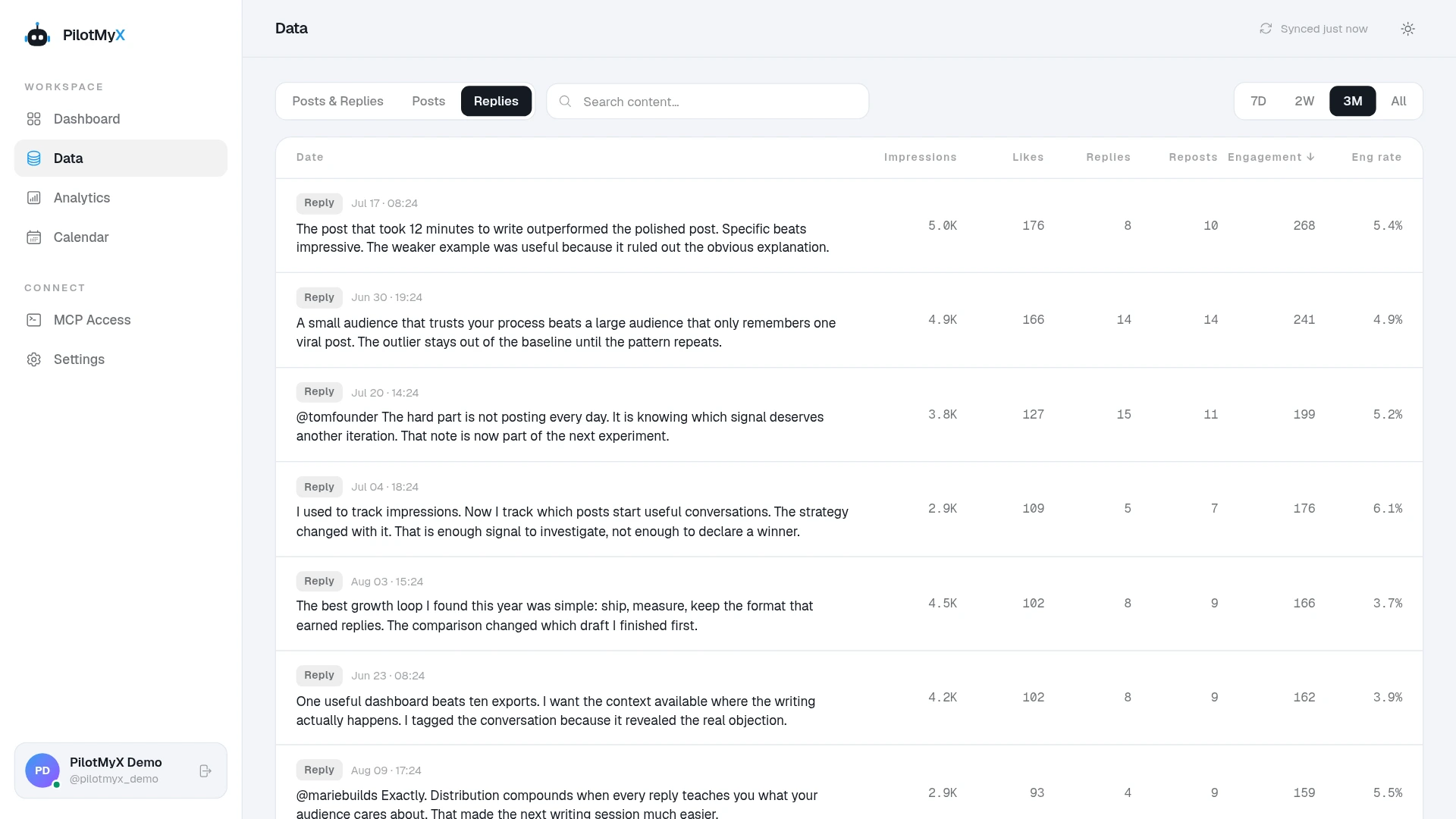
Start with several ordinary replies as well as the largest result. Did you answer a specific question? Did you add a detail the original post lacked? For follow-up quality, revisit the exchange on X or use notes you saved; don't assume a reply count tells you what people said.
X defines impressions and profile clicks separately. Impressions count appearances, not unique people. Profile clicks can help you spot curiosity, but they don't prove that a reply caused a follow. Non-public metrics have availability limits, and a missing count should stay missing rather than become zero.
You can review the examples yourself in the app. An agent connected to PilotMyX can also read your collected replies and help you identify writing habits:
Review my own replies from the last 14 complete days available
in PilotMyX. Keep original posts separate. State the actual date
range, sample size, freshness, and missing metrics.

Read several ordinary replies and the largest results. Show
examples of a specific answer, a useful question, and generic
agreement if those examples exist. Explain the classification
using the words I wrote, not impressions alone.

Use conversation context only if it is available in the data or
notes I provide. Ask when the original question is missing.
Don't invent the surrounding exchange, outcomes, or my experience.
Suggest one writing habit to test next. Do not refresh data,
draft replies to other people, or change or publish anything.
Choose one adjustment for your next conversations, such as replacing broad advice with a question that changes your recommendation. Review whether it made your answers more specific before crediting it with growth. If an explanation deserves a wider audience later, turn that reply into an original post with the context a new reader needs.
Use your own account