A schedule you can keep
How often should you post on Twitter?
If keeping up with Twitter means inventing a lesson every night, reconsider your posting target. Use your results and the time each post takes to choose a pace worth keeping.
Start with the posts you can actually support
Choose a Twitter posting frequency you can maintain with useful, specific material, then test whether adding posts earns enough relevant attention to justify the work. If you already publish consistently, use that pace as your baseline instead of replacing it with someone else's daily target.
If you're starting from zero, try three original posts a week for an initial planning period, provided you have three ideas worth writing. That is a manageable experiment for a busy founder, not an X requirement or a growth benchmark. Reduce it if preparing those posts crowds out the work you wanted to share in the first place.
The decision is how much of your week Twitter deserves. A publishing target should help you make that decision, not turn every quiet evening into a deadline for another opinion.
Define what counts before comparing schedules
For this guide, frequency means original posts published from your account. Track the replies you write separately. A week with three original posts and twenty replies is a different use of your time from a week with twenty original posts.
Choose one outcome for the review. If you want people to explore your work, examine the profile clicks associated with your posts when available. If you want website visits, look at URL clicks on posts containing a link and check what happens on the site. The Twitter traffic guide covers that second step.
X lists impressions, profile clicks, and URL clicks as distinct metrics. A higher impression total does not by itself tell you that more people visited your profile or website. See X's metrics documentation.
Write down how much time you can spend too. Count drafting, editing, finding material, scheduling, and reviewing results. Keep conversation time separate so a busy week of replies doesn't make your writing process look slower than it was. PilotMyX provides account metrics; your time estimate has to come from you.
Look at the total and the cost of getting it
Publishing more can raise the total while making each additional hour less productive. That doesn't automatically make a higher frequency a bad choice, but it changes the question you need to answer.
This fictional example compares two equally long periods. All posts are measured at the same age, and the figures are invented to explain the calculation, not taken from a PilotMyX customer or the founder's account.
| Measure | Lower frequency | Higher frequency |
|---|---|---|
| Original posts | 6 | 10 |
| Profile clicks attributed to those posts | 90 | 100 |
| Time spent preparing and reviewing posts | 3 hours | 5 hours |
| Profile clicks per hour spent | 30 | 20 |
The higher frequency produced ten more profile clicks for two more hours of work. Its total improved, while clicks per hour fell from 30 to 20. Those clicks are actions, not necessarily different people or future customers.
The extra attention might justify the time for your business. Read the posts and the conversations they started before deciding. Ten clicks from people interested in your work may matter more than a larger total from an unrelated debate, but the table alone cannot tell you who was interested.
Inspect the individual posts as well. If one launch announcement explains most of the difference, the comparison says little about ordinary posting frequency. Keep the announcement in the record, then check how the two periods compare without it.
Change the volume without changing your whole strategy
Choose two schedules you could realistically keep. A founder publishing three original posts each week might try five. Someone already posting every day might test fewer posts while putting more time into the remaining ideas. The direction depends on the problem you're trying to solve.
Use equal-length periods and write down the dates before you start. Two weeks at each pace can be an initial review window for the three-versus-five example. It is not enough to establish a universal rule, especially when one post can change the result. Extend the review or repeat it when the evidence is thin.
Keep your main topics, audience, formats, and usual publication hours reasonably similar. Don't put a product launch in the higher-frequency period and a vacation in the lower-frequency one, then credit the schedule for the difference. Record unusual mentions, paid promotion, and changes to your offer.
If you also want to change the hours, do that in a separate test using the guide to choosing posting times. Otherwise, you won't know which change deserves another try.
Compare results at the same post age when you can, such as 48 hours after each publication. Record those observations as you go. PilotMyX's current collected totals do not automatically represent each post's first 48 hours. If current totals are all you have, keep the age difference visible in the review and avoid treating it as a fair measurement window.
Even a careful before-and-after comparison has limits: the posts are different, readers change, and events happen. Use it to choose your next schedule, not to claim that frequency caused every change in results.
Give each extra post a reason to exist
Before adding a slot, name the material that will fill it. A concrete answer to a recurring question, a decision you made, or a useful explanation can justify another post. A second version of Monday's announcement with different adjectives probably cannot.
X's authenticity policy prohibits repeatedly publishing identical or nearly identical posts in a duplicative manner, alongside other forms of content spam. Don't fill a larger schedule by recycling the same message over and over. Spacing duplicates further apart isn't a substitute for making a worthwhile contribution.
You can revisit a subject when you have something new to add. For example, a release announcement and a later explanation of a design decision can serve different purposes. The later post needs its own facts and point, not a claim that your audience demanded an update when nobody did.
If finding useful material is the constraint, work through what to post based on your account history before raising your target. An empty slot is less work to repair than a calendar full of drafts you don't want to publish.
Use PilotMyX to prepare the comparison
In PilotMyX, examine published posts separately from the replies you wrote. Start with a recent period that represents your usual activity, then read examples behind the totals. Use the available impressions and goal-relevant metrics to identify what deserves another test.
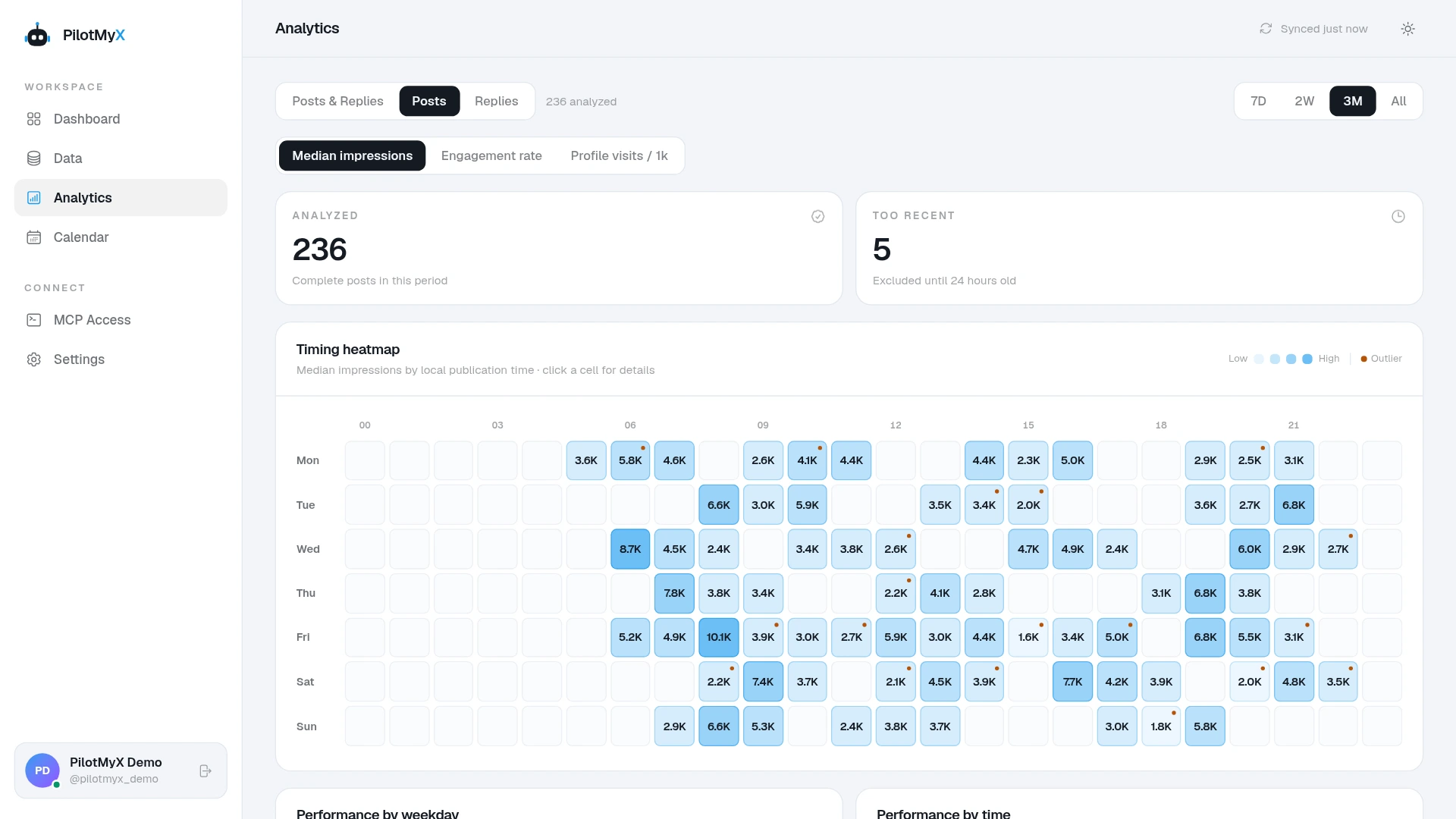
An agent connected through MCP can review that history with you. Tell it how much time you have and mention anything that made a week unusual. Use this prompt to ask for a comparison before filling the calendar:
Help me choose a sustainable Twitter posting frequency.

My goal: [what I want the account to achieve]
Time available for preparing and reviewing posts: [hours per week]
Current posting target: [original posts per week, or no target yet]
Upcoming constraints or events: [launches, travel, deadlines, or none]

Use my PilotMyX account timezone and review the last 28 complete
days available. State the actual coverage and keep original posts
separate from replies I wrote. Show the weekly post counts,
available metrics relevant to my goal, and representative examples.
Flag missing metrics, small samples, and results dominated by one post.
Do not infer time spent from account data; ask me for estimates.

Suggest a baseline schedule and one realistic alternative.
Explain what each extra slot would need to contribute. If there
isn't enough evidence, call the proposal a starting experiment.
Keep topics and hours comparable. Include a way to record results
at the same post age and account for time spent.

Check my existing calendar before proposing dates. Show the plan
for review. Don't schedule or publish anything yet.
If you haven't connected an agent, use the PilotMyX setup guide. You can also do the review in the app and keep your time notes alongside it.
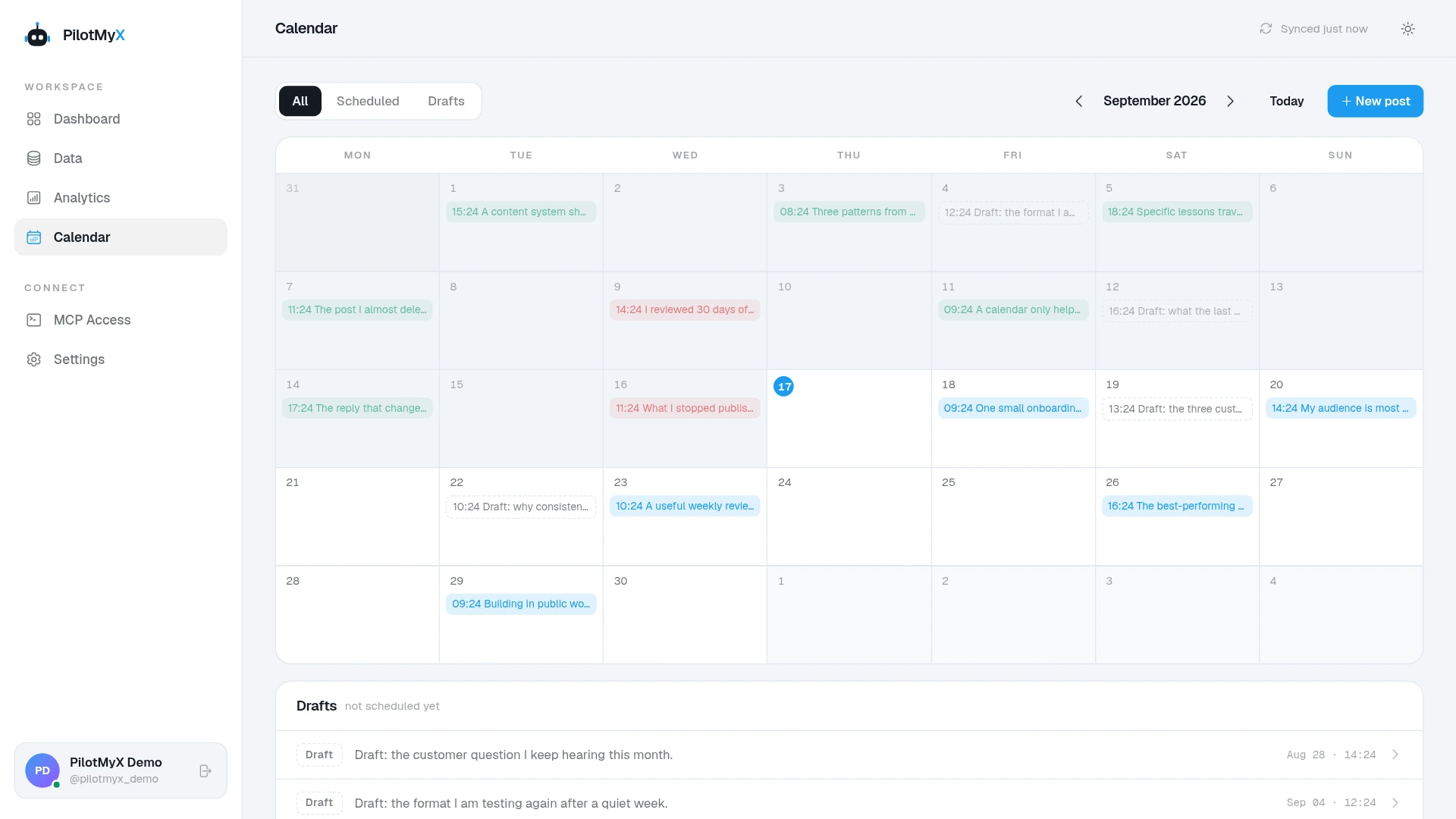
Once you choose the cadence and approve the exact drafts and dates, put the posts in the PilotMyX calendar. Scheduling saves you from interrupting work to publish each one manually. It doesn't decide whether the extra post was worth writing.
Keep, increase, or reduce the pace
At the review date, compare your chosen outcome, the individual posts, and the hours you spent. A higher total may be worth the extra work, or it may have come at the cost of time you needed elsewhere. Don't let a single rate make that decision for you.
Keep the baseline if the difference is small or inconsistent. Increase only when you have useful material for the extra slots and enough evidence that you want to spend more time on them. Reduce the target when meeting it repeatedly means rushed drafts or work you regret postponing.
Record the choice in one sentence: "For the next month, I'll publish [number] original posts per week because [observed result and time constraint]." Keep that note and a review date with your calendar so you can check whether the schedule did what you wanted.
Use your own account