Quote post or reply
Quote tweet or reply: which one should you use?
A good answer can get lost when you pull it out of the conversation. A quote post can fall flat when it adds nothing. Choose the format your point actually needs.
You have a good answer. Where should it go?
You read a post and have a useful answer. Should you reply below it or quote it to your own audience? Copying your answer into a standalone post is another option, but that can strip away the question that made it useful.
Start with whom you want to reach. Reply when you're speaking to the person and readers already in that conversation. Quote when your audience needs the original post to understand your take. Write a new post when the idea stands without borrowing someone else's context. Don't choose a format because somebody promised it would get more reach.
X defines a reply as a response to another person's post. Its quote-post instructions describe a separate post that references the original and adds your comment. X says it shares that quote with your followers. The two formats put your words in different contexts, even though recommendations may bring either one to other readers.
Reply when the conversation needs your answer
Suppose a founder asks why people abandon a signup form. You have seen a similar problem in your own product and can name one question that helped you investigate it. A reply lets you answer that founder directly. Readers can see the question above your answer instead of guessing what you are responding to.
Read the whole exchange first. If someone has already given the same answer, add a missing detail or leave it alone. X's description of replies explains why the recipient will be notified and why a reply is not simply another post dropped into all of your followers' timelines. That does not mean only the recipient can see it; X can also recommend replies outside the immediate conversation.
An answer like “check your analytics” gives the other person little to do. “Compare completions before and after the address step; if exits cluster there, test a shorter form” is more useful, provided that advice fits the question. The goal is to contribute, not to turn somebody else's problem into a billboard for your account.
If finding relevant questions is the hard part, use the guide to finding Twitter conversations worth replying to.
Quote when your audience needs the original in view
Now imagine the signup-form post makes a claim you want to challenge: “Every form should remove the address field.” You have a counterexample where the address is needed for delivery, but its position in the form is the problem. Your followers can understand your point better with that claim attached. A quote post gives them both pieces.
Write enough that your comment earns its place above the original. "This" or "Exactly" adds little. So does repeating the claim in slightly different words. Name the exception, show a concrete example, or explain what you would test instead. Make sure the quote still makes sense to a reader who has never seen the author before.
Check the source before you share it. X itself may prompt people to open an article before quoting a post that links to one. That is good editorial discipline even when no prompt appears. Be especially careful with a cropped screenshot, a breaking-news claim, or a post written as a joke. Your comment may reach people who never open the original context.
Your quote also starts its own conversation. X says replies to it do not automatically add the original author. If you need an answer from that person, reply to their post. If you want to discuss the claim with your own audience, quoting may fit better.
Write an original post when the idea stands alone
After several similar questions, you might have enough material for an explanation that does not depend on any one person's post. Write the question in your own words, use an example you can verify, and give readers a useful conclusion. You can still credit the exchange that prompted the idea when that context matters.
Don't copy a reply into a new post unchanged. A reply can lean on the question directly above it; an original post has to establish its own stakes. The guide to choosing your next Twitter post from your own data covers how to check whether a repeated question is worth developing further.
| What you want to do | Best starting point | Check before posting |
|---|---|---|
| Help the person who asked | Reply | Does your answer address their actual question? |
| Discuss a specific post with your audience | Quote post | Does your comment add a point the original lacks? |
| Explain an idea that works without the source | Original post | Can a stranger understand it with no quoted context? |
Use the table to place your idea, not to predict impressions or followers. X does not promise that one of these formats always wins.
Review the result without confusing the formats
Before changing your habits, look at a complete period of your own activity. In PilotMyX, you can read posts, quote posts, and replies with their available metrics. Quotes are a post type; replies are a separate conversation activity. Keep them identifiable when you review the examples behind a total.
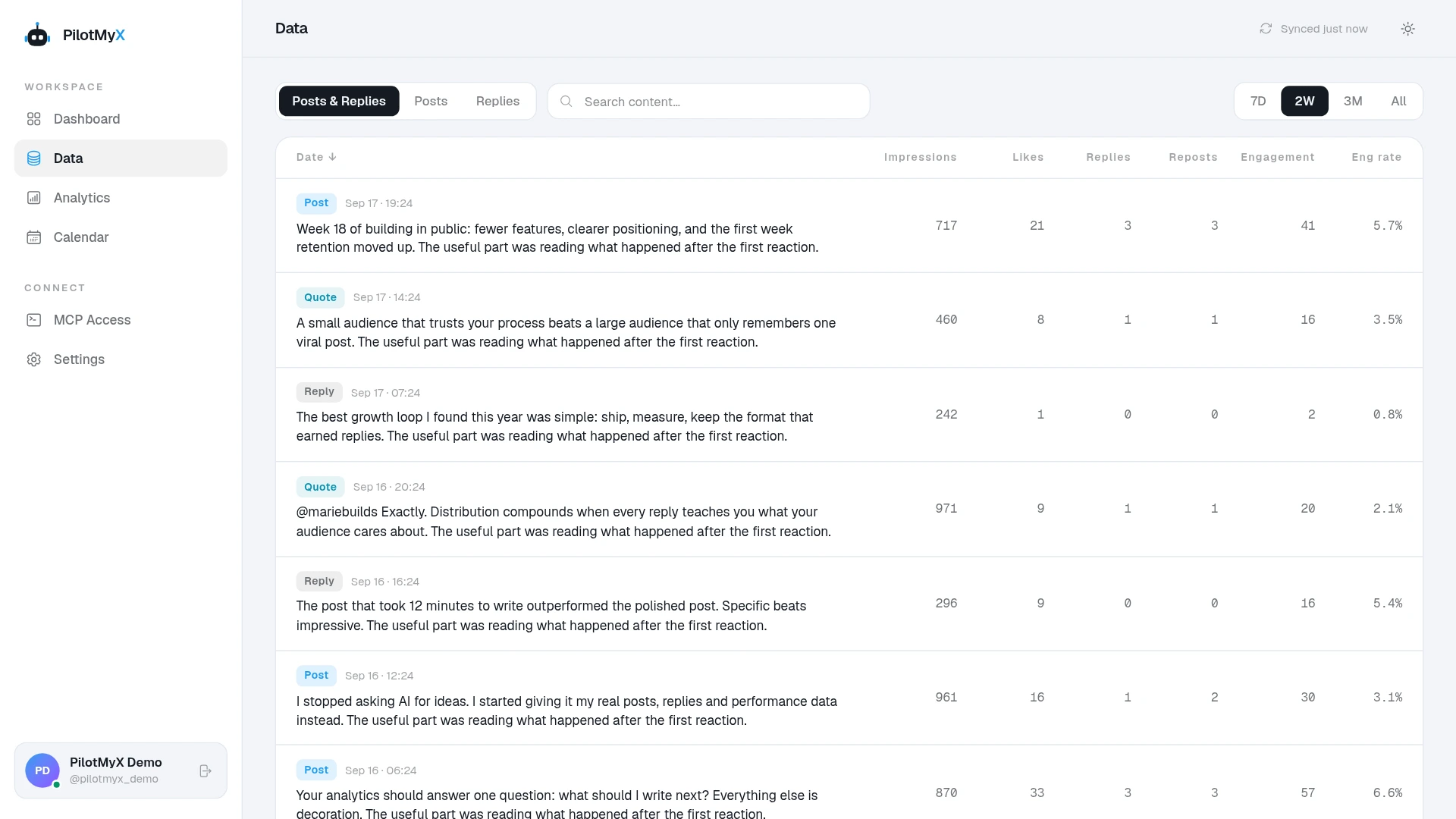
Choose a measure that matches your purpose. For a quote meant to introduce your work, available profile clicks may be more useful than likes alone. For a reply meant to help somebody, read the follow-up exchange as well as its metrics. X defines impressions and private click metrics separately; impressions are not unique people, and private metrics may be unavailable for some older posts. Missing is not zero.
Compare several ordinary examples, not your biggest quote against a random reply. Topic, author, timing, and the size of the original conversation all change what you observe. If quotes on one subject attract relevant profile interest more than once, you have a reason to test another useful angle. You have not proved that quoting caused the difference. The posts versus replies guide goes deeper into that comparison.
An AI agent connected to PilotMyX can help sort the account history, but it still needs your goal and the context of the conversation. Ask it to show the actual examples before proposing a format:
Help me decide whether to reply, quote, or write an original
X/Twitter post about [topic]. My intended reader is [audience],
and the point I want to make is [your verified observation].

Review my connected PilotMyX account for the last 28 complete
days available. State the date range, data freshness, sample sizes,
and missing metrics. Keep original and quote posts identifiable;
review my replies separately. Read representative text and explain
what each format let me say in its original context.

Recommend one format for this specific idea and explain whom it
addresses. Flag any claim or source I need to check. If you draft,
show the exact words and any quote target for my review. Do not
create, schedule, or publish anything yet.
If you choose a quote or original post and approve the exact draft, PilotMyX can place it in your calendar. If the right move is a reply to somebody else, join that conversation on X. Then revisit the result alongside your other work rather than treating one post as a verdict on the format.
Use your own account