X/Twitter ranking signals
What the X/Twitter algorithm rewards, and what its weights really mean
Creators often read the public ranking weights as a points table: one like is worth this much, one report cancels that many likes. X says that interpretation is wrong because the weights scale predictions for one viewer, not raw engagement totals.
The short answer
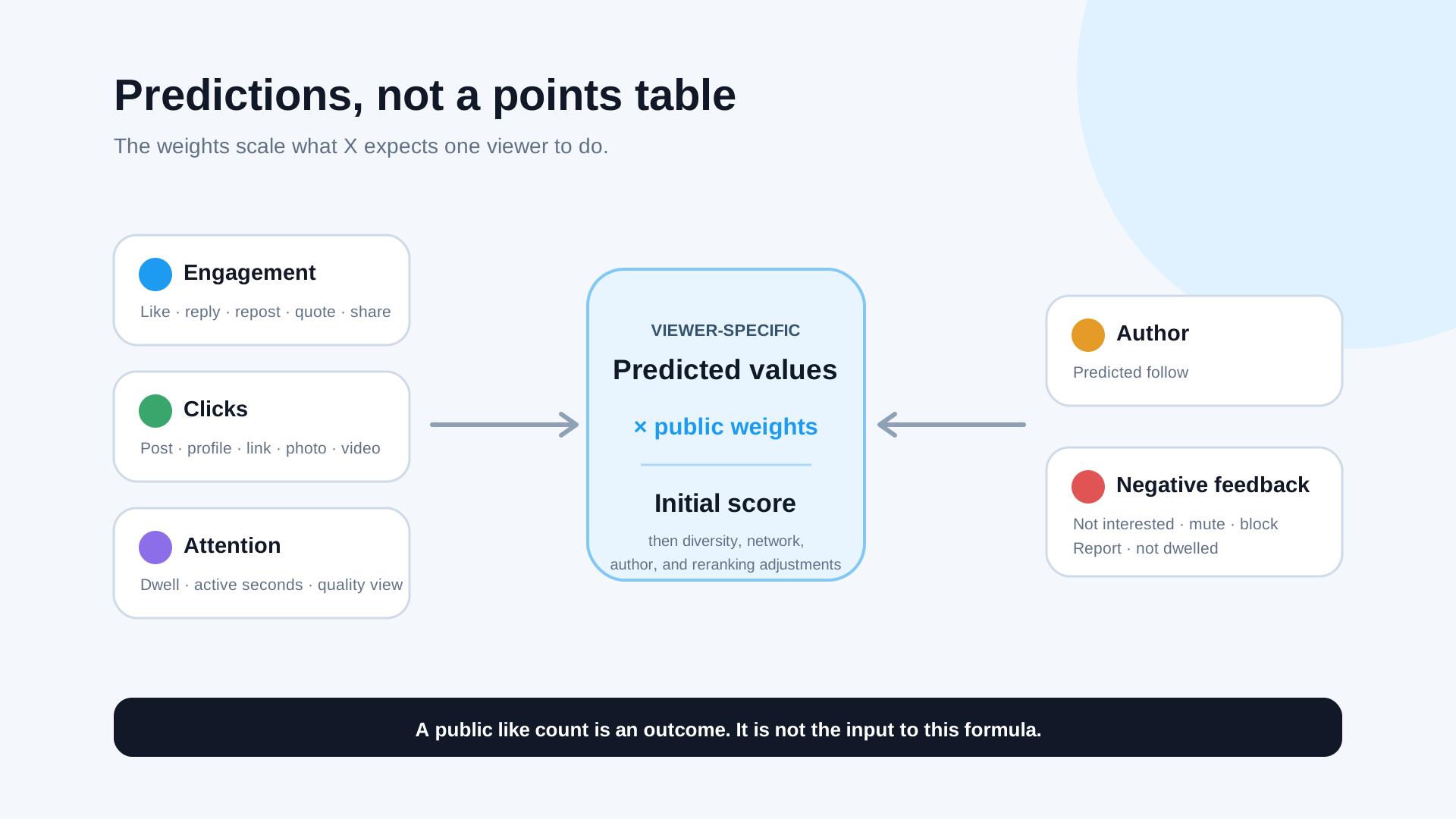
X/Twitter predicts how likely one viewer is to like, reply, repost, click, keep reading, follow the author, or send negative feedback on a candidate post. It combines those predictions with public configuration weights to produce a ranking score.
The weights do not multiply the post's existing engagement counts. A large negative weight beside "report" does not mean that one report cancels a fixed number of likes. X added this clarification to the official algorithm README on August 14, 2026 because people were reading the numbers as a public points system.
The model predicts more than engagement
The published action list is wider than likes, replies, and reposts.
| Signal family | Examples in the public model |
|---|---|
| Engagement | Like, reply, repost, quote, share by message, copy link |
| Clicks | Open the post, profile, link, photo, video, or quoted post |
| Attention | Video quality view, dwell, dwell time, active seconds |
| Author | Follow the author |
| Negative feedback | Not interested, mute, block, report, or leave without dwelling |
Phoenix predicts a value for each action. The RankingScorer applies positive weights to desired predictions and negative weights to unwanted ones, then adds the results.
In simplified form:
post score = sum of (action weight × predicted action value)
That formula describes the mechanism. It does not tell you how many likes your next post needs.
Why the public weights are easy to misread
Suppose a viewer regularly likes posts about Elixir and reports almost nothing. The model may predict a meaningful chance of a like and a tiny chance of a report for one candidate. Another viewer with a different history receives different predictions for the same post.
The weights scale those viewer-specific predictions. They do not wait for the post to collect public engagement and then award points afterward.
This makes three popular interpretations unsafe:
- "one report cancels a fixed number of likes";
- "a reply is always worth more than a like";
- "maximizing the largest positive weight guarantees distribution."
The configuration comments say the values reflect both how X values an action and how often that action normally occurs. Comparing two numbers without their underlying probabilities strips away the part that makes them meaningful.
A prediction is not a creator command
If the model predicts dwell time, it is tempting to stretch every post so people spend longer reading it. That can backfire. A longer post that loses the reader is not automatically better than a short post that delivers the point quickly.
The same problem appears with replies. Reply probability has a positive weight in the published configuration, but that does not prove that ending every post with a question will improve reach. Forced engagement can also create weak responses or negative feedback, and the final score contains many signals.
Treat each published signal as evidence about what X tries to predict, not a template for manipulating readers.
Ranking adjustments change the first score
The weighted prediction is not the last step. The public pipeline applies several adjustments:
- repeated posts from the same author receive a decaying multiplier in one feed request;
- out-of-network posts are discounted, as are some replies and reposts from followed accounts;
- authors below an impression threshold can receive a lift toward a target position;
- another service reranks the result.
The exact candidate set matters too. A good predicted score can still lose if the viewer has stronger candidates available.
The full 2026 X/Twitter algorithm guide shows where these adjustments sit between retrieval and final visibility filtering.
What should you optimize instead?
Optimize for the person you want to reach. The model's action list is a reminder that attention has several forms, while negative feedback has a cost. It is not a reason to turn every post into engagement bait.
A useful account review asks:
- Which posts earned reach and a meaningful response from the audience I wanted?
- Did the strongest results depend on one outlier or repeat across several posts?
- Were people opening the profile, clicking, replying, or following after the post?
- Did a format work because of the format, or because the topic and audience were different?
- Do original posts and replies show different patterns when compared fairly?
The posts versus replies guide explains the last comparison without treating one format as the automatic winner.
Use the code to test ideas, not manufacture certainty
PilotMyX does not expose Phoenix predictions or X's private score for your posts. It keeps the observable side of the experiment in one place: the posts and replies you wrote, their available metrics, when they were published, and how comparable groups performed.
That is enough to replace "the code says replies win" with a better question:
On my account, which kinds of original posts repeatedly create the response I care about, and what should I test in the next three scheduled posts?
The public algorithm can help you choose the hypothesis. Your own account has to provide the evidence.
Use your own account